


Letter from Shanghai
In late September I, along with a group of 25 other filmmakers and critics from Beijing, was invited to Xining, the capital of Qinghai Province, for the World Mountain Documentary Film Festival and the Sanjiangyuan International Photography Festival.
Qinghai is located in China's mid-west, between Gansu Province and the Tibetan Autonomous Zone. It is home to several minorities including, at over 20% of the population, Tibetans. Its elevation, some 3,000 meters above sea level, one might argue, places it very close to heaven, making it a spiritual place indeed. So spiritual, it seems, that even a film festival there isn't required to show films.
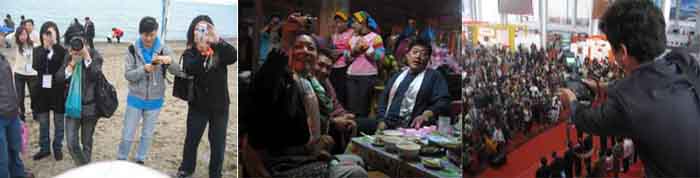
Left to right: Festival-goers at Qinghai Lake; feasting at the Tu Minority Village; opening day at the World Mountain Documentary Film Festival and Sanjiangyuan International Photography Festival. Photos: Mathieu Borysevicz.
The Xining city government, which organized the event, generously hosted 1,000 plus visitors from as far away as Brazil, Australia and the United States. It was a four day event chock full of sightseeing, feasting, singing, and awards ceremonies - but oddly, no films. We were treated to an entertaining time, yet remained slightly perplexed throughout the proceedings.
On the first night there, we went to a singing contest at the Tu Minority Village and dined on home cooking. The next morning we visited the stupendous crystal blue Qinghai Lake, China's largest saltwater lake. At 3,600 meters above sea level, it is a truly amazing, even godly, sight. After taking in the scene for a few hours, we rushed back for the festival's grand opening dinner ceremony that evening. It was a red-carpet affair, with simultaneously translated congratulatory speeches by delegates from the local government and foreign VIPs. Karaoke followed dinner and lasted late into the night.
The next day was the grand opening ceremony, which took place in the same red-carpeted hall as the glittery dinner ceremony, with more speeches about the success of this ambitious event. The film trade fair's unmanned booths eventually led visitors to a fashion show where models sauntered up and down the runway to the beat of some strange carnival techno tune, wearing the same clothes for about twenty minutes, and then disappeared. It was here that a local TV crew interviewed me about how I felt about the film festival. Needless to say, I was stumped.
Printed programs for the festival, left in hotel rooms along with fruit baskets each day, listed what looked like some pretty interesting films: one about polyandry in a minority tribe in China; a Dutch film made in North Korea; and one by Rick Widmer, an American now living in Beijing, whose film about a Massachusetts county fair ended up winning the Special Jury Prize for Best Social Documentary. There were films from Russia, India, and Germany on topics like goats, agriculture, the environment, man against nature, love, death, and more mountains. But none of these films was ever screened.
Later that day there were some developments in the direction of the film festival. A forum was held where topics included "Introduction to the Creation Status Quo of Chinese Western Mountain Documentary" and "What do viewers expect of a documentary on mountains and climbers?" In the given context these questions took on existential dimensions.
It wasn't until the awards ceremony that evening, which was televised live, that the films actually made it to the screen. Before the presentation of each award, the first 30 to 60 seconds of each winning film was shown. It wasn't enough to get a gist of the film, or for that matter to get past the opening credits, but it was a refreshing dose of cinema anyway.
As we said our goodbyes at the airport the next morning we reminded each other of the Buddhist maxim about abandoning expectations in order to achieve enlightenment. Who said there needed to films at a film festival anyway? We all had a fine time and I'll definitely return for next year's installment.
A very little information about the Qinghai 2008 film festival is available online.
http://www.xining.gov.cn/html/1383/87375.html and http://www.qh.gov.cn/html/31/97406.html
and Sanjiangyuan International Photography Festival.
Artist/videographer Mathieu Borysevicz is ArtForum's Shanghai correspondent. His project Learning from Hangzhou was featured at Storefront for Art and Architecture last summer.