


American Stories at The Bruce
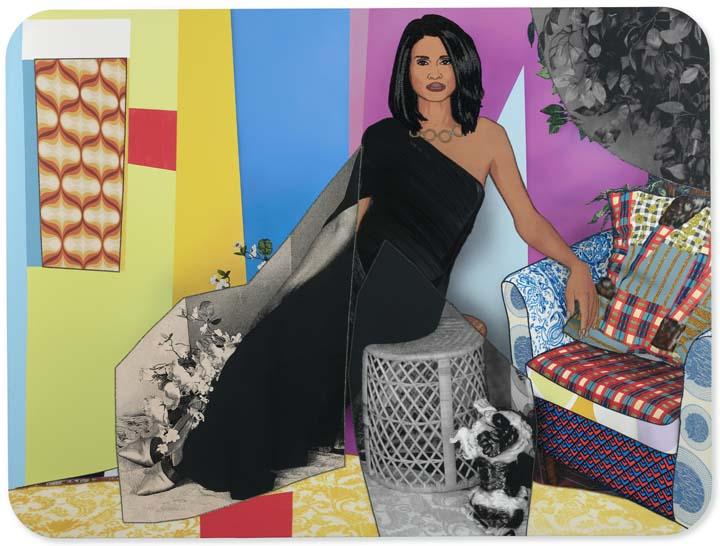
What happens when some of the most recognizable names in American art end up in the same gallery? Coinciding with the nation’s 250th anniversary, American Stories from Sargent to O’Keeffe: A Partnership with The Newark Museum of Art brings forty-five masterworks to Greenwich, CT. This sweeping presentation looks across generations, movements, and vastly different philosophies to explore what American art can be. Above: Mickalene Thomas (American, b. 1971), Isn’t She Lovely, Tracey Norman, 2022
By placing legendary figures side by side with essential modern and contemporary voices, the exhibition moves beyond a traditional chronological timeline. Instead, it maps out a living, visual dialogue organized around four central themes that have defined the American experiment: Identity, Belonging, Belief, and Making. Visitors will experience iconic masterpieces—including John Singer Sargent’s grand society portraits, Georgia O’Keeffe’s striking modern abstractions, and Edward Hopper’s melancholy urban scenes—recontextualized alongside powerful works by contemporary masters like Mickalene Thomas and Martin Puryear.
 Confronting the classical traditions of the gallery space, Mickalene Thomas’s monumental portraiture—such as her vibrant, full-length commission Isn't She Lovely, Tracey Norman, 2022 (top)—fundamentally redefines Black women's representation within the art historical canon. Anchoring the Identity thematic section of the Bruce Museum exhibition, Thomas centers her portrait on iconic Newark native and pioneering trans supermodel Tracey "Africa" Norman. Thomas subverts traditional Eurocentric portrait tropes by imbuing her subject with absolute agency, dignity, and a commanding, direct gaze.
Layering acrylic paint with her signature tactile embellishments of rhinestones and glitter, Thomas uses the dazzling, textured surface as a form of cultural masking and adornment that celebrates the complex humanity of Black femininity. Placed side by side with the historic Gilded Age society paintings of John Singer Sargent, Thomas’s work serves as a powerful contemporary mirror, demanding an expanded and inclusive understanding of who belongs in the story of American glamour, power, and high art.
Bringing an indispensable contemporary counter-narrative to the exhibition, Apsáalooke artist Wendy Red Star reframes historical representation through her sharp, archival interventions. In pieces like her celebrated 1880 Crow Peace Delegation series (below right) Star overlays post-Civil War government photographs with bold red ink annotations.
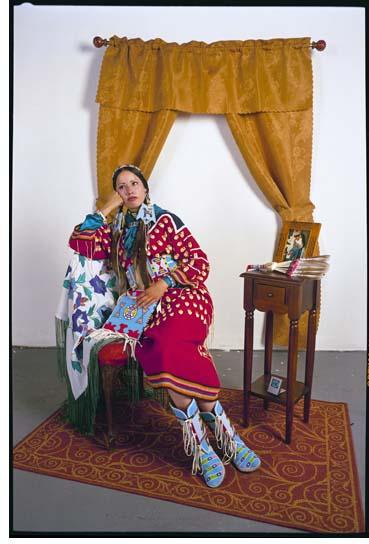
By meticulously detailing the cultural significance of the delegates' regalia, detailing their war achievements, and injecting personal commentary, she strips away the sterile, anonymous lens of the colonial archive, effectively transforming the subjects from static historical artifacts into vivid, sovereign individuals. These interventions directly challenge the erasure of Indigenous history, forcing a critical dialogue about whose stories define the American landscape today.
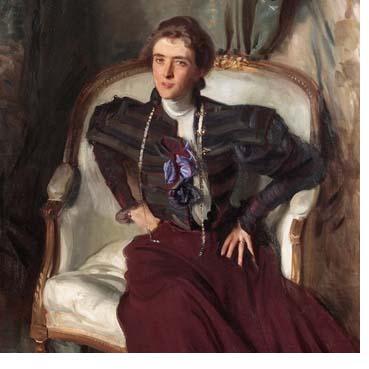
John Singer Sargent’s masterful portrait Mrs. Charles Thursby,c. 1897–1898 (above left, detail) exemplifies his ability to revolutionize Gilded Age portraiture by capturing his subject in an active, conversational pose rather than a rigid Victorian stance. Sargent utilizes his signature impressionistic brushwork to render the shimmering textures of her attire while maintaining a vivid realism in her direct expression.
The exhibition’s emphasis on the act of material creation comes to life through a deliberate dialogue between two-dimensional paintings and three-dimensional sculptures, grouped primarily within the Making thematic section. By breaking down the traditional barriers between mediums, the gallery places the atmospheric, luminous brushwork of painters like Georgia O'Keeffe and Marsden Hartley directly alongside the tactile, structural innovations of master sculptors.
Visitors can trace how the rhythmic weight of Martin Puryear’s wood forms, the delicate kinetic balance of Alexander Calder’s mobiles, and the monumental, found-wood assemblages of Louise Nevelson mirror or challenge the spatial experiments happening on canvas. This fluid interplay invites a reconsideration of texture, space, and volume, showing that whether pushing paint across a linen canvas or anchoring steel and timber in space, these artists were engaged in the same foundational pursuit: redefining the physical boundaries of the American experience
Through October 10, 2027 at the Bruce Museum, 1 Museum Drive, Greenwich, CT Info