


The DART Board: 09.30.2026
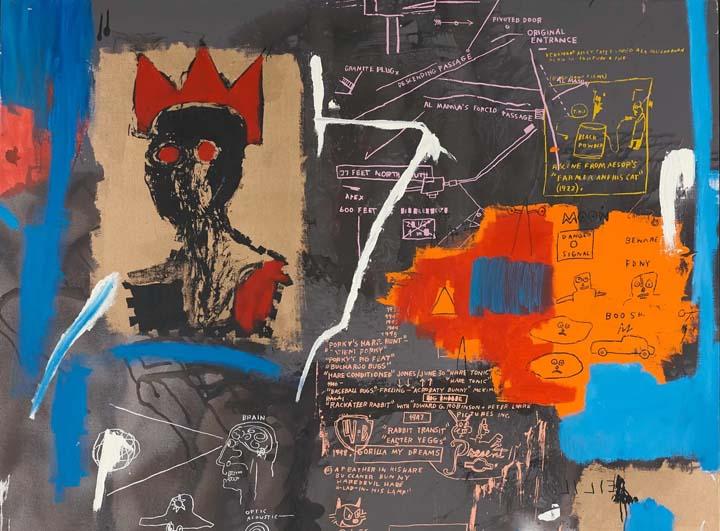
Sunday, October 4; Basquiat | The Blue Ribbon Paintings and the Art of Reproduction at Princeton
Jean-Michel Basquiat’s urgent, visceral brushwork has long been celebrated for its raw street poetry, but a major upcoming exhibition at the Princeton University Art Museum promises to fundamentally reframe how we view his studio practice. Basquiat, the Blue Ribbon Paintings, and the Art of Reproduction shifts the lens away from pure expressive spontaneity to dissect the artist's highly sophisticated, conceptual engagement with multi-layered printmaking. Gathering over 60 seminal works anchored around his 1984 Blue Ribbon series, the presentation offers a fascinating, granular look at how Basquiat masterfully weaponized photocopies, repetitive silkscreens, and mechanical reproduction to build his dense, iconic visual lexicons. By contrasting the industrial coldness of the copy machine against the immediate, handmade textures of his mixed-media surfaces, the show reveals an artist who was not just a painter of modern life, but a brilliant tactician of its technological signifiers.
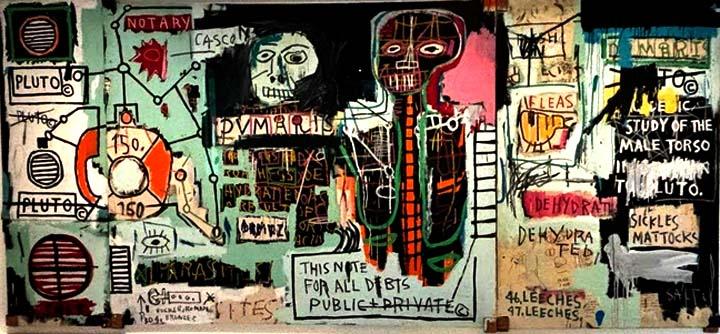
The exhibition explores Basquiat’s connections with artists including Robert Rauschenberg, and with pioneering Black printmakers such as Bob Blackburn, revealing and celebrating a lineage of Black experimentation and intergenerational exchange in reproductive media. Assembling nearly all of Basquiat’s known print projects, the show focuses a lens on Basquiat as a conceptual artist, probing identity, reproduction, and visibility in an increasingly commercialized art world.
Through January 31 at Princeton University Art Museum, 45 Elm Drive, Princeton, NJ Info
Continuing: Robert Rauschenberg & the News: Select Prints at the New School
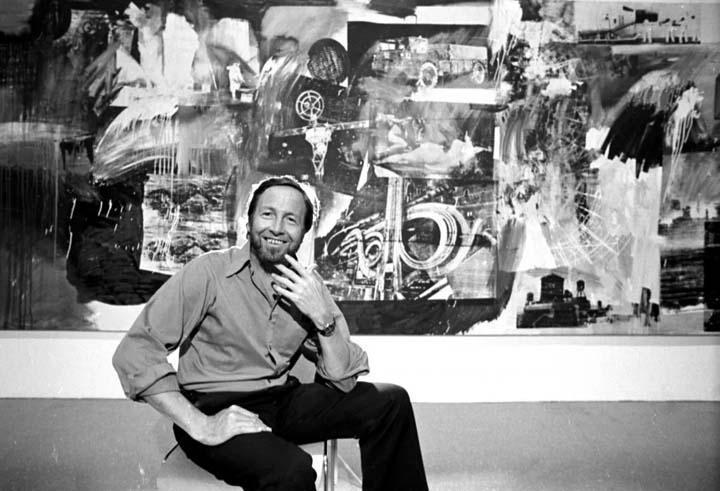
There is a bracing, ink-stained immed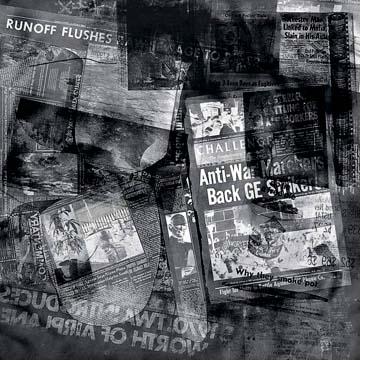 iacy to this intimate exhibition that could not be more vital as the artist's centennial celebrations continues to be celebrated. In the Village, this compact installation at NYUs Wollman Hall gathers fifteen graphic works from the 1960s to the 1990s, offering a concentrated look at how masterfully Rauschenberg stepped directly into the chaotic gap between the studio and the social unrest unspooling outside. Above: Robert Rauschenberg (1925 - 2008) during an exhibition of his work at the Museum of Modern Art, New York, NY, March 1977. Photo: Jack Mitchell/ Getty Images
By collaging front-page headlines, civil rights pamphlets, and environmentalist banners into complex, layered fields—he essentially weaponized mass media onto a single, mesmerizing picture plane. Seeing works like Surface Series 48 [left] in the context of today's fractured media landscape serves as a sharp reminder of a protean figure who swept the rules aside, proving that printing ink can still mirror a society in upheaval.
Through January 4, 2027, at The New School, 5th Floor, 65 West 11th Street, open to the public by appointment (email artcollection@newschool.edu to schedule your visit).
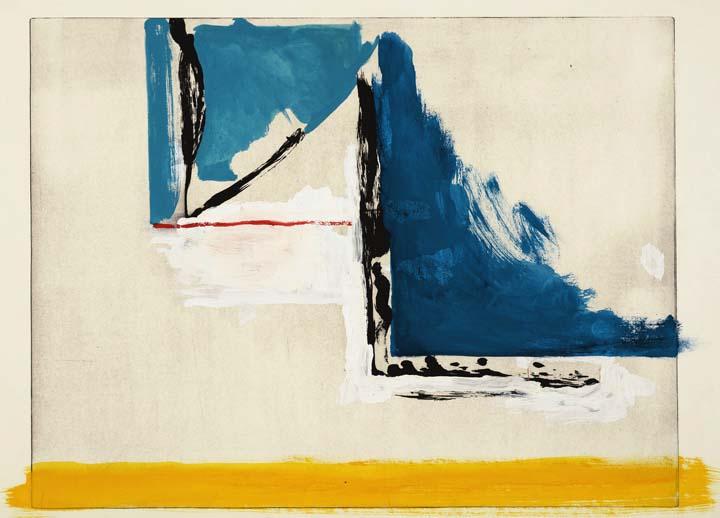
Continuing: Making Music: Helen Frankenthaler Prints at Grey
Great music, beautifully performed is transcendent. At that moment, on that frequency, it demonstrates the same magic, the same je ne sais quoi that applies to any art; magic that really can’t be described, only experienced. —Helen Frankenthaler
In Making Music: Helen Frankenthaler Prints from the New York University Art Collection, the nine career-spanning works on view—primarily selected from a 2023 gift from the Helen Frankenthaler Foundation's Prints Initiative—shatter any lingering notions that printmaking was, for this artist, a secondary pursuit to her painting practice. Instead, you see an artist experimenting tirelessly, translating her legendary "soak-stain" vocabulary into a spectacular display of color and texture that dances between sight and sound. Above: LaSardana [detail], 1987
From the rich, tactile depths of her multi-layered aquatints to the syncopated lines that echo her love for the performing arts, each piece feels as though it happened all at once, as if a daydream has independently materialized on paper. This small exhibition is a rare, focused look at how an abstract icon bypassed conventional boundaries, inviting us to experience the transcendent magic of a lifelong dialogue between ink, paper, and the collective rhythm of the printmaking workshop.
Through July 3, 2027 atGrey Art Museum, New York University, 18 Coopern Square, New York, NY Info
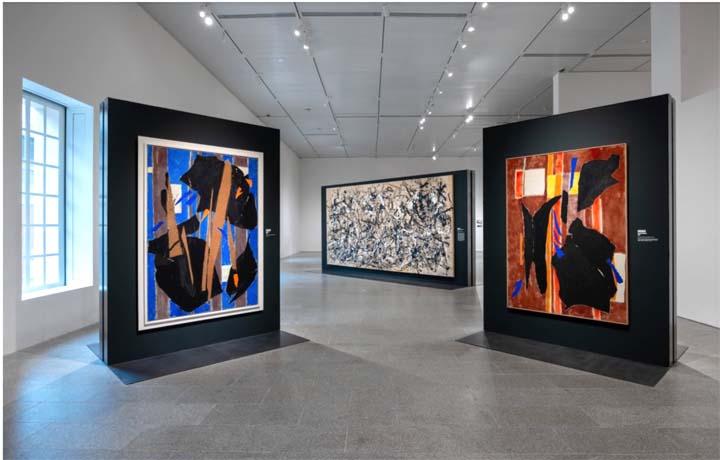
Krasner and Pollock: Past Continuous at The Met
Lee Krasner (1908–1984) and Jackson Pollock (1912–1956) met as emerging artists in New York in the winter of 1941. They married in 1945 and moved to Springs, Long Island, where they remained entwined personally, artistically, and professionally until Pollock’s untimely death. While Pollock’s reputation historically eclipsed Krasner’s, today, both artists’ practices are rightly recognized as central to the innovations of art from the mid-20th century onwards.
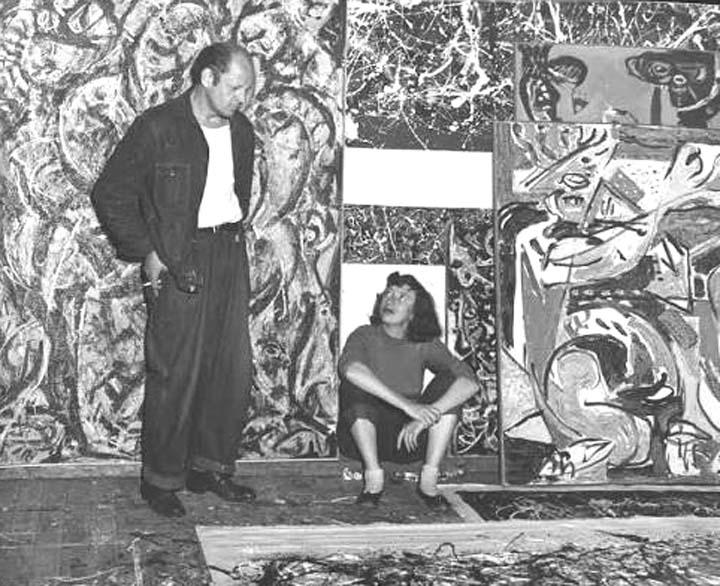
Drawing its subtitle, Past Continuous, from a 1976 painting by Krasner, the exhibition traces parallel lives and practices—forged first by lived experience, then shadowed by memory. Their early paths traced distinct strands of American modernism that would ultimately converge in the rupture known as Abstract Expressionism, a movement that valued the translation of inner feelings into dramatic visual action. In the wake of World War II, artists asked why art mattered and what it could be. For Pollock, his breakthrough was the “drip” technique, a radical mode of painting that flourished in a condensed but prolific period. Krasner’s varied practice was typified by ceaseless explorations of abstraction, often cued by her abiding interest in the possibilities of nature and color.
Through January 31st at The Metropolitan Museum of Art, 1000 Fifth Avenue, New York, NY Info
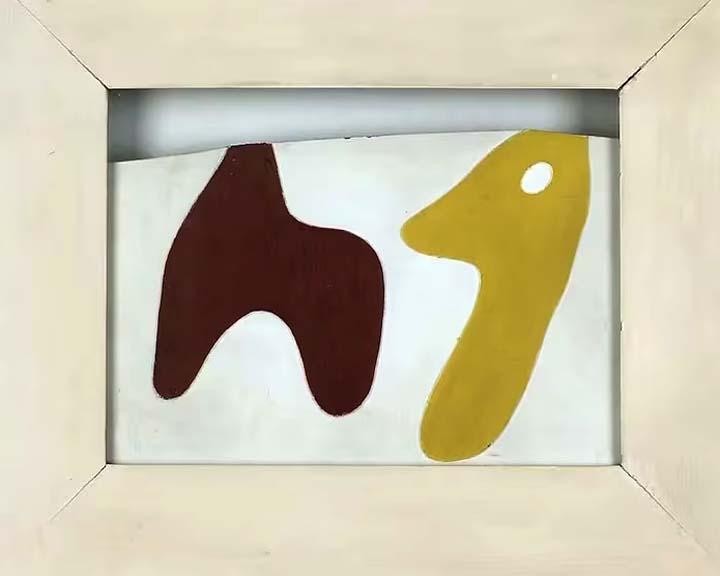
October 17, Last Chance for Arp | Heads or Tails at Hauser & Wirth
Hauser & Wirth presents Arp. Heads or Tails, the first New York exhibition in nearly fifteen years dedicated to the seminal German-French modernist. Organized by Curatorial Senior Director Alexis Lowry, in collaboration with the Stiftung Arp e.V., Berlin/Rolandswerth, this presentation takes Arp’s late Threshold sculptures as a point of departure, situating this pivotal but underexamined body of work within the trajectory of Arp’s long career of aesthetic and philosophical inquiry. The exhibition’s design takes inspiration from Arp’s studio in Locarno, Switzerland, and traces a line from his early cut-outs and reliefs to his mastery of form as a tool for reconfiguring and transforming our perception of space.
Through October 17 at Hauser & Wirth, 542 West 22nd Street, New York, NY Info