

Chris Sharp: Shelf Life
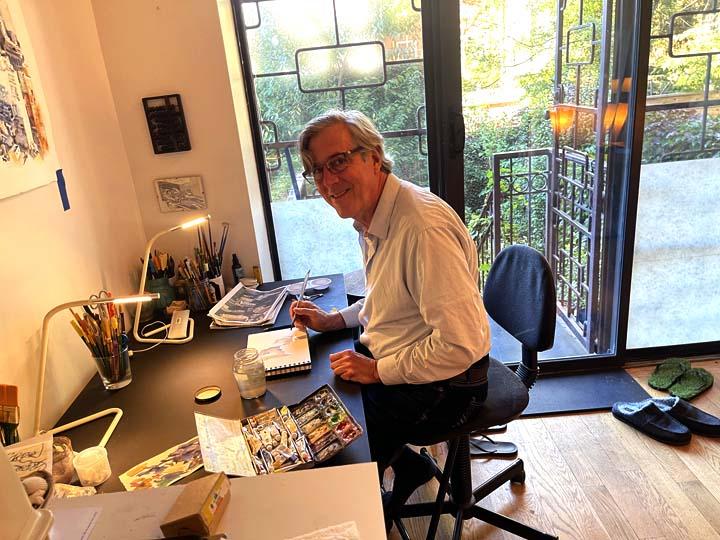
Peggy Roalf: Do you remember the first art book you ever purchased? Why did it capture your attention?
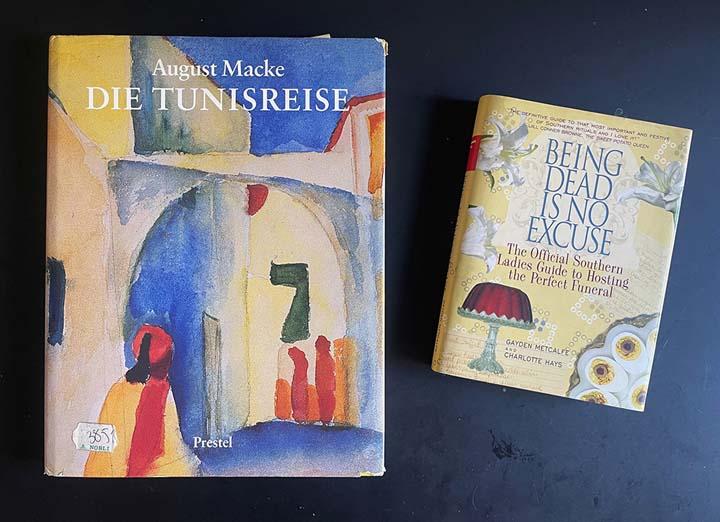
Chris Sharp: I don't remember the actual first art book that I bought, but one book that really stands out and is my go to for inspiration is August Macke's Tunisian Watercolors and Drawings. I found this in a bookstore in Oslo after moving to Norway and was preparing to travel around Southern Europe and sketch my summer away. August Marke's style felt like the perfect match to get down on paper what I was looking at quickly. I still love that book and return to it all the time!
PR: Where is your library located and how do you organize your design and art books?
CS: My books are either on the shelves in my studio or in storage. The books that made it onto the shelves after my recent move are mostly sketchbooks, a few favorite/random art/reference books, magazines and some literature. I organized my sketchbooks in chronological order. All other books are grouped by their size or shape.
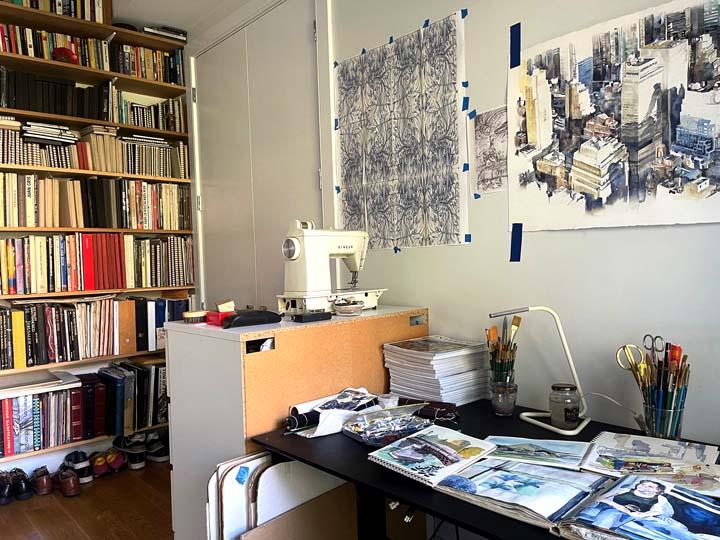
PR: What went into your own bookcases? Did you do any research? Any seen/admired among friends/colleagues? Any particular manufacturer?
CS: I have always had the poor man's version of bookshelves—the type that one can get in any hardware store or lumber yard. I would love to have a bookcase that was made to order, but unfortunately, I haven't had the money to hire someone to build one.
My partner and I moved to Brooklyn right after the pandemic as our Manhattan rent had become way too high and at that time, mortgage interest rates were very low. So, we moved to what my friends refer to as the "Outer Hebrides." My books remained in boxes for over a year before I plucked up courage to install a bookcase in my office!
PR: How do you maintain your library? For example, do you periodically take it apart and reorganize, or something like that?
CS: I am probably due for a reorganization although I pretty much like what I have in my cases now. I basically have all my sketchbooks which I periodically peruse. I also have a few fun books. One in particular I like to show guests is Being Dead Is No Excuse: The Official Southern Ladies Guide to Hosting The Perfect Funeral.
PR: What do you do when you run out of shelf space?
CS: When I run out of shelf space the books go back into storage. With that being said it's about time for me to reorganize the storage room. I was thinking of offering some books to my local library to free up some space. I think a dumpster is in order for all the other junk that one collects.
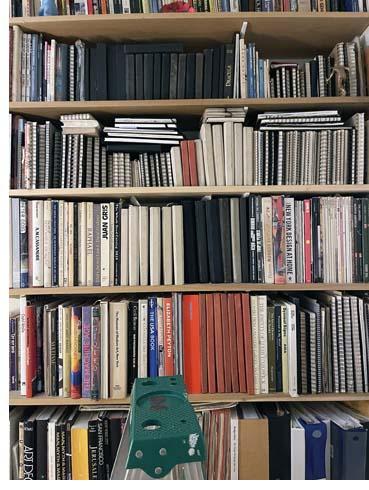
PR: I've noticed that you have regular sketchbook practice. How many sketchbooks have you made over the years? Do you periodically look through them? Do you have an indexing system in case you want to refer to something in particular?
CS: Ever since I took my first college watercolor class at Jamestown Community College in 1983, I've always loved working in sketchbooks. I never thought of counting how many sketchbooks I made until you asked the question, so thank you! So far, I counted 149 sketchbooks and 57 painted postcard pads that haven't been posted yet. I like the postcard size when traveling, and I spend a lot of my vacation painting in them to capture where I am visiting. (and it's always fun to see if they make it to their posted destination!). I do periodically look through my sketchbooks. They are kind of a personal time capsule that transports me back in time.
PR: Do many of your sketchbook pages become material for illustrations assignments?
CS: Every now and then I get lucky enough to incorporate something from my sketchbook into an illustration assignment. I find that keeping a sketchbook is a great generator for new ideas and styles. Recently I have started working on a series of patterns taken from my sketchbook. My plan is to make wallpaper, wrapping paper, and textiles with them.
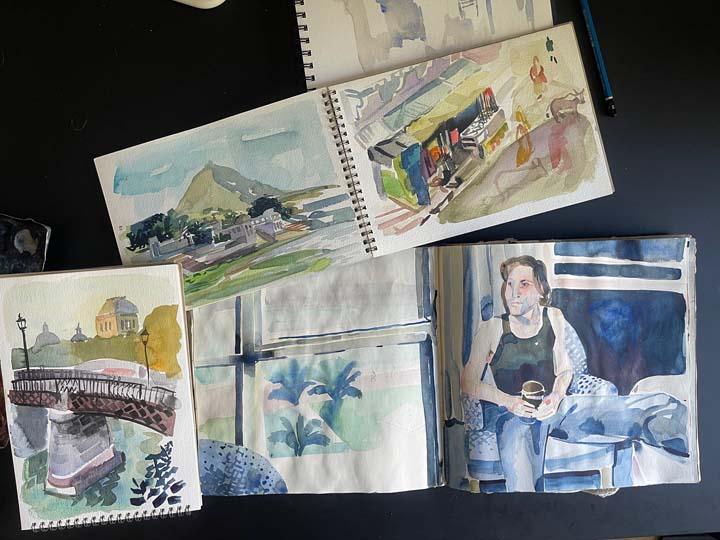
PR: What are some of your favorite places for sketching? Is there a special type of sketchbook you use?
CS: I always paint in watercolor while traveling or whenever I'm inspired. I prefer to use the Winsor Newton watercolor 10" x 7" ringed books, but reality I have a lot of different sizes and types of sketchbooks. I recently started working in small Moleskine notebooks. Because I moved out to Brooklyn, I'm riding the subway more often than before and my commute can get really long depending on the time of day. I stopped looking at things to draw and started drawing from imagination. I found that the pens that one gets at the voting booths are especially good for this. They are waterproof and glide easily on the smooth Moleskine paper. In the last year or so, I've been drawing whatever comes to mind. It's been a great way for me to make the commute fun.
Chris Sharp is a New York City based illustrator specializing in images for advertising, design, publishing and editorial clients.
Website https://instachrissharp.com/
Instagram https://www.instagram.com/chrissharpnyc/