


Moonrise, Hernandez: A Closer Look
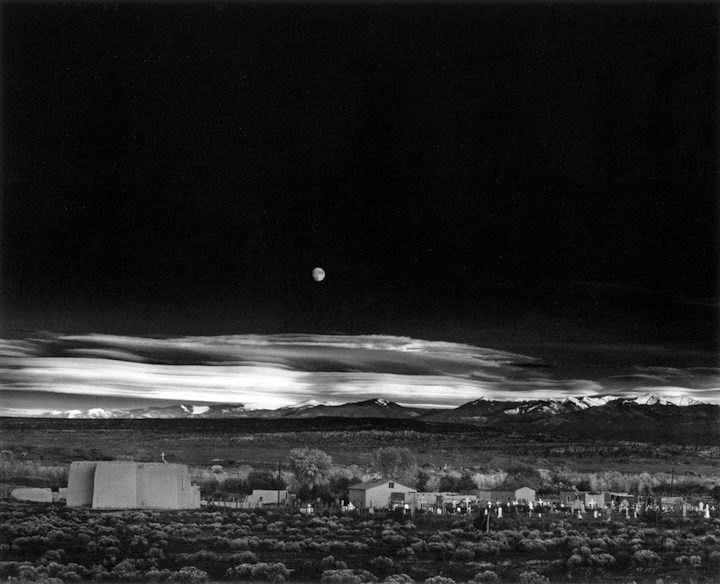
Nightfall in the New Mexico desert. A passing photographer notices the full moon with craters defining a face, illuminating the darkness around a lonely church and graveyard in the village of Hernandez. He stops his car and quickly sets up his 8 x 10 camera, exposing a single negative. There is no time for another setup before the light shifts, no time to check his light meter. It is November 1, 1941 and Ansel Adams has caught what might be the most recognized landscape photograph in history.
Moonrise, Hernandez is Adams's most famous photograph and is presently the most lucrative fine art photograph ever made, sold and resold at auction, printed on wall calendars and posters by the millions. In 1996, Adams biographer Mary Alinder estimated that Adams had made 1,300 prints of Moonrise, Hernandez over a period of 40 years—in the process, becoming financially independent for the first time.
Every fall as the photo auction season gets underway, I become curious as to how many prints of Moonrise, Hernandez, will be up for grabs. While this might seem like an odd obsession for someone interested in contemporary art, it has its roots in the first edition of AIPAD that I attended. Back in the day when The Photography Show was held at the New York Hilton (from 1994-2005), I was surprised to see so many prints of the same image. One year there were more than 20 by my count, in various sizes and in a broad range across the quality spectrum, from work prints to stunning images made by the master himself.
Since that time, the inventory of available prints of this iconic photograph has, of course, dwindled, and today only prints of exceptional quality generally make it to the block. In its [2019] Classic Photography auction…, Sotheby’s [offered] just one, “probably printed between 1973 and 1977,”at 15½ by 19 in. The presale estimate is $30,000 to $50,000. Info
Adams knew a good thing when he saw it and the marketing aspect of this photograph is worth more than a second look today. The story of how so many prints of this photograph came to be and why it remains so important in Adams’s oeuvre follows.
Adams knew it was a great picture, but “he was never completely satisfied with the prints he was making,” according to his grandson Matthew Adams, and so the photographer tinkered with them in the darkroom, producing approximately 1,300 prints over the course of 40 years. “In 1948, he bathed part of the negative in a chemical intensifier in order to create more contrast in the foreground and to make the moon brighter. Before that, things had looked a little flatter.” Over the years, the prints also became larger, moving from 16 x 20 in. or smaller up to 40 x 60 in. As reported by Daniel Grant for ArtNetNews, Ansel Adams himself said that, with all that tinkering and various alterations, “it is safe to say that no two prints are precisely the same.”
Alinder also estimated that the 1,300 prints of Moonrise, Hernandez—most of them made in the 1960s and ‘70s— were worth a cumulative $25 million [in 1996 dollars]. Still, one might presume that the market had some rational way of valuing individual prints: By the year in which they were printed; by the square inch; by whether or not they are signed. But it's never easy to estimate, especially in a volatile market such as today’s. As of now, the standing record for a [15-1/8 x 19-1/4-inch] print of Moonrise, Hernandez is $685,500, from 1941, sold at Sothebys in 2020. A mural-size print of the image went for $930,00 at Christies in 2020.
Note: this article first appeared, with slight differences, in DART’s October 3, 2018 edition.
If you woild like to subscribe to DART: Design Arts Daily, please go here