


The Q&A: Jon Han
Jon Han is an illustrator who turns a white page into mental space with what seem like splashes of paint. His cover design for the forthcoming AI32 capitalizes on that idea—but you’ll have to wait a little longer to see what this means. For now:
You live in Brooklyn, NY, originally from Los Angeles, CA. As an artist, what are some of your favorite things about living and working in Brooklyn?
My favorite thing would have to be how close I live to my studio and the other artists, illustrators and designers that I see on a daily basis. There is a creative energy I feel here that I didn’t feel as much of in California.
How and when did you first become interested in art and illustration?
Comics are what first piqued my interest in art. When I was around 7 or 8 years old, I accompanied my dad to a warehouse where
he used to buy inventory and he ended up buying me this grab bag of 200 comics with box sleeves and backing boards.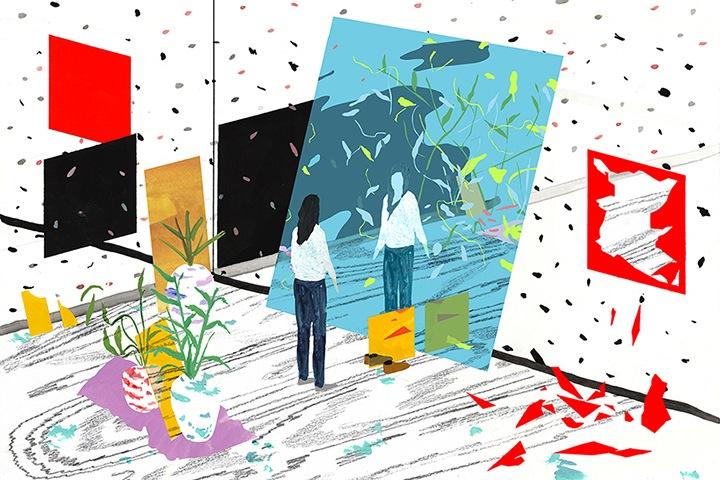
Not What It Seems, for aiCIO magazine.
What was your first commercial assignment?
My first illustration job came from the New York Times. It was a “Letters” piece about great ideas living on forever. I often think about the way that assignment really changed the direction of my illustration career. I remember sending sketches based on my preconceived ideas of what illustration was along with a couple of ideas of images that I found interesting and having the art director go with what excited me.
What is your favorite part of the creative process?
I like every part of the creative process, but if I had to choose only one it would have to be the finish. It’s definitely the most rewarding part since I look at the completed work, see what I’ve done differently, what I can do on another project, and, most of all, move on to something fresh and new.
Do you keep a sketchbook? What is the balance between art you create on paper versus In the computer?
I don’t keep a sketchbook right now. I haven’t kept a sketchbook since art school, actually. When it comes to the balance between traditional materials vs. digital, I think it’s usually around a 50/50 balance, but it really comes down to what the project/concept is about and finding what fits best. Sometimes things just look great 100 percent digital and some things look great 100 traditional. I try not to get attached to the medium.
What are you reading?
Right now Philip Guston: Collected Writings, Lectures, and
Conversations.
What was the last art exhibition you saw and what did you take away from it?
The last exhibit I went to was the Paul McCarthy show at the Armory in NY. I
thought it was really beautiful in a disgusting way. It was a great show.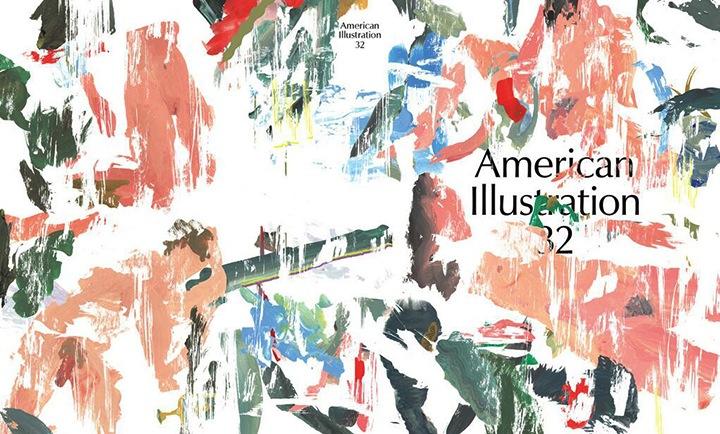 Cover for
AI32
Cover for
AI32
Has social media been a boon for self-promotion? Or do you have methods you’ve always used that still work?A
Social media has done wonders for self-promotion. I think its really gets your work out there in the hands of the artists more than what I hear it was like in the past. It seems like nowadays it’s not just your work that’s important—people really want to connect with personalities and that’s something that I don’t think was as easy to get a sense of in the past.
Have you ever had a creative block with a deadline looming? What do you do to get crackin’?
Yes, I’ve had creative blocks with looming deadlines. I found what works for me during these times is just to keep sketching out ideas and actively trying to work through these blocks. For me the idea stage is the most crucial since it’s the foundation that everything else is built on.
Where do you teach—and what do you like best about teaching?
Right now I teach at Pratt Institute. The thing I enjoy the most about teaching is trying to figure out how to get growth out of the students. Every student is different and it’s great when you can see some sort of improvement from them or to see them getting excited about making their work.
What advice would you give to a young illustrator who is just getting noticed?
I’d say do good work and continue to challenge yourself. Don’t get set on a style. You want to be honest with your work so when your interests change in the future, your work can as well.
Jon Han is an artist, illustrator who graduated from Art Center College of Design. His work has been published in the New York Times, New Yorker, and GQ, among others. He recently did the cover art for American Illustration 32.