


Peter Kuper's Library
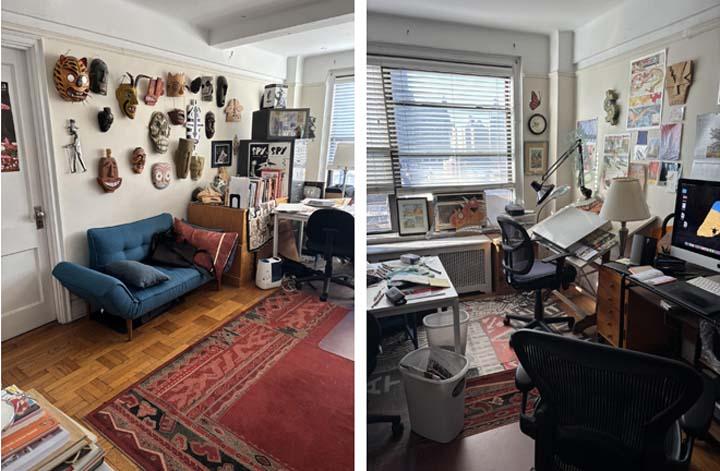
Peter Kuper is, luckily, an artist who needs no introduction. I say this because his long and varied career is impossible to summarize in a paragraph. Whether celebrating his life-long fascination with the universe of bugs, in Insectopolis, or satirizing the political nature of human inhumanity in World War III Illustrated, Peter’s work begins with research—scientific, literary, political, psychological and you name it. For this reason, I asked him to share his thoughts about books and his own library. You can find out more about his practice here, and his long-time contributions to DART here.
Peggy Roalf: As an artist, writer and educator, you must own a lot of books. How have you structured your library for how you use it?
Peter Kuper: There’s no structure, but I know exactly where everything is.
PR: When did it become evident that you were meant to be an artist?
PK: When I was 15 years old, I got the common teenage malady, mononucleosis and was sick in bed for a month. I had just started to give up collecting comics as kid stuff, but while I was sick I fell back into reading a ton of them. At the same time, I started drawing in earnest in my sketchbook.
When I got better, I told my father “I wanna be an artist“ he said, "OK do me a drawing a week." I managed to do that for about two weeks before it felt like a job and I stopped. As I headed towards college, I realized the world was made up in large part of jocks and cannon fodder and I didn’t wanna be either. I started running towards an art career, scrambling as fast as I could, and haven’t stopped since.
PR: Do you remember the first art book you ever purchased and why?
PK: I don’t remember the first one I purchased, but the first one that really grabbed me was Crockett Johnson’s Harold, and the Purple Crayon when I was 4. That book gave me the idea that you could draw yourself out of any bad situation. Dr. Seuss books were another important influence. Probably the first “art book“ that I purchased, age 7, was Thor by Stan Lee and Jack Kirby. I became an instant comic book fan and that's never left me. A hugely important reference/art book for me was the Golden Guide to Insects. I also received that when I was 4 and to this day it sits on my desk like a talisman (in a plastic bag since all the pages are falling out!)
PR: At what stage had you collected enough books to be concerned about having bookcases that were right for your own library?
PK: My room growing up in Cleveland was full of bookshelves, but there was a special one that held my mint condition comic books. That antique bookcase has made it through my whole life and it sits in my studio holding my favorite books, and happily, various editions of my own work.
PR: Where is your current library located?
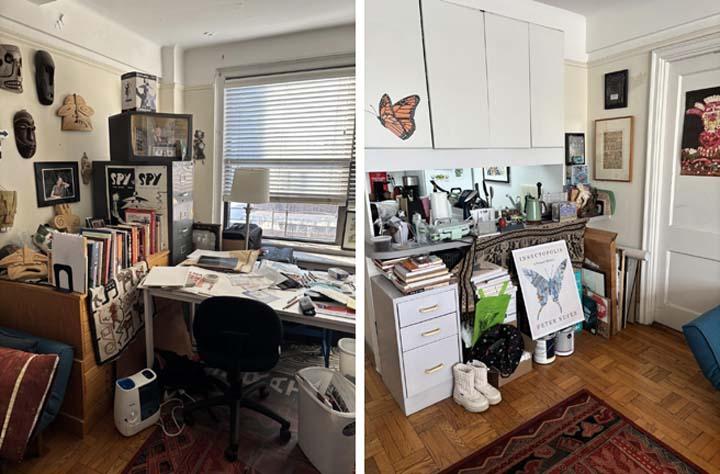
PK: In my studio on the Upper Westside of Manhattan, just down the street from Columbia University and a few blocks away from my apartment.
PR: What went into your choice of bookcases — any research? Any seen/appreciated among friends/colleagues?
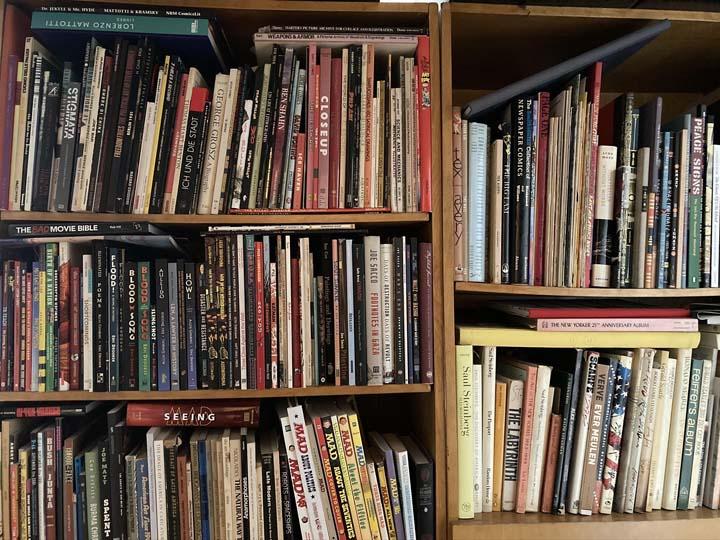
PK: No research at all, except what was cheap and held a lot of books. I have the same IKEA bookcases that I got early on in my career they’re jammed to the hilt with the shelves bowing, one layer holding up the next.
PR: How you organize your art, design and photo books?
PK: I’ve grouped books by friends, and some art books are gathered together as well as research books side-by-side. A lineup of Mad books hangs together, but overall, it’s wildly random, and often based on height. Those amazing Winsor McCay early comic strip books by Sunday Press and many by Chris Ware and Gary Panter need tons of space!
PR: How do you maintain your library? For example, do you periodically take it apart and reorganize, or something along those lines?
PK: Things are beginning to get stacked every which way. I try to keep individual artists together, but some who are prolific like Jules Feiffer, make that difficult without stacking. As for reorganizing—absolutely never.
PR: What do you do when you run out of shelf space?
PK: I utilize every part of my studio, so the kitchen shelves are all filled with books. At one point I also had them in the oven! To reduce the need for pots and pans and utensils, I stick with peanut butter and jelly sandwiches. My studio has become a warehouse of my own books as well as boxes of back issues World War 3 illustrated. We've been publishing it for 47 years, so there's...a lot. My wife tried to help me reduce the cram by having me bring home 2 books a day to give away. I found the whole experience traumatic.
PR: Have you ever had to move your library? What are the best and worst things about that situation?
PK: I'm still suffering from PTSD from the last time I had to do that. When my wife, daughter and I moved to Oaxaca, Mexico for two years, back in 2006, I had to put my entire studio in storage. When I got everything back, many of those mint condition comics were no longer mint, and a few things had molded.
PR: Is there anything you might want to include about favorite libraries for doing research or just hanging out in?
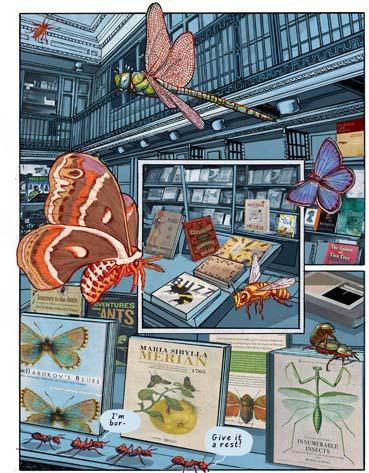
PK: In 2020 I got a Cullman Fellowship at the amazing New York public library on 42nd St. They gave me an office for a year, but that landed during Covid and the library was closed to the public. It was like a night at the museum ghost story with all those empty halls. It gave me the backdrop for the project I had proposed, so it turned out it was a real gift.
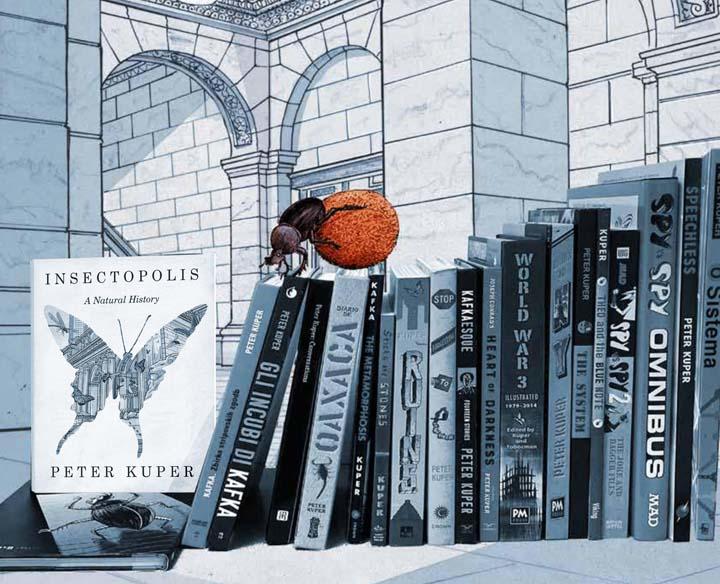
I was able to research in the library's collection and see things like John Tenniel's original sketches for Alice in Wonderland, Maria Sibylla, Merion‘s hand colored lithographs from 1707 of insect metamorphosis, Arthur Rackham's fully illustrated originals to Shakespeare’s Midsummer Night's Dream, Charles Addams 150 original drawings from the New Yorker, Vladimir Nabokov’s drawings of butterfly genitalia—and on and on. I photographed each room and incorporated that reference into my graphic novel,Insectopolis [interspersed here] a history of insects and the people who study them.
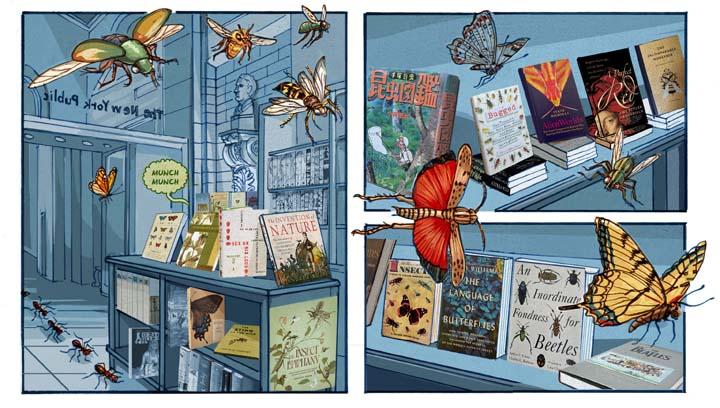
Above and above right: These pages from Peter Kuper's Insectopolis were created as a visual bibliography for his graphic novel. Subject matter includes all the books he read as research for Insectopolis, as well as some other favorites from his childhood.
PR; Do you consider being a bibliophile a special form of madness?
PK: Yes, it certainly is, and I’d wish it upon everyone.
Peter Kuper is a regular contributor to The New Yorker, The Nation Charlie Hebdo and MAD magazine where he has been writing and illustrating their feature SPY vs. SPY since 1997.
He is the co-founder of World War 3 Illustrated, a political graphics magazine that has given a forum to political artists for over four decades and has produced over two dozen books including The System, Diario de Oaxaca, and Ruins. He has also adapted Joseph Conrad's Heart of Darkness and many of Franz Kafka's works into comics including The Metamorphosis and Kafkaesque.
His latest books are, Insectopolis: A Natural History and Wish We Weren’t Here a collection of environmental comics.
Kuper has exhibited and lectured around the world and teaches comics at Harvard University. He currently has an exhibition in Seoul, Korea and upcoming exhibitions at Cleveland's Maltz Museum and Fall 2026 at The American Museum of Natural History
www.peterkuper.com
Instagram: @Kuperart
Bluesky :@pkuper.bsky.social