


Bucky Fuller: Starting With the Universe
R. Buckminster Fuller (1895-1983), who is most widely known today as the originator of the geodesic dome, was a visionary inventor/designer/philosopher/humanitarian and a self-described "comprehensive anticipatory design scientist." The first major exhibition on his life and work in more than 20 years opens today at the Whitney Museum of American Art. It explores the theories and inventions of a transdisciplinary thinker who devoted much of his practice to closing the gap between the sciences and the humanities.
Among his utopian goals was the design, production and distribution of affordable housing that could be economically built, transported by airship and constructed with minimal environmental impact. Housing, the curators point out, was part of Fuller's larger vision of a global system of transport, habitation and resource allocation.
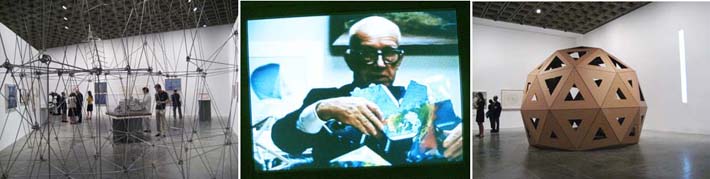
Installation photos: Peggy Roalf
One such project was Triton City (1967), presented here as the original large scale architectural model complete with landscaped parks and recreational spaces. The multistory self-sufficient neighborhood for thousands of residents is moored offshore, thereby freeing up land for agricultural use. Fuller had the support of the U.S. Department of Housing and Urban Development under Lyndon Baines Johnson's administration. There was funding enough to build this model and a second one; however interest in the project vaporized when LBJ left office.
The models, drawings, paintings, prints and videos detailing the mathematically complex calculations and geometric structures that Fuller invented feel very much at home inside the Whitney's soaring fourth floor gallery. In one area, just 20 or so yards into the show, a visual scan from the front to the back of the space reveals the amazing progression of Fuller's development.
Near the front are models of his 1946 Dymaxion Dwelling Machine, which he designed to be built by repurposing aircraft technology and materials, in abundant supply following WWII. These round structures, which look for all the world like a colony of stainless steel yurts, were prototyped in partnership with the Beech Aircraft Company of Wichita, Kansas.
A view 45 degrees to the left reveals the ultimate expression of Fuller's creativity: the geodesic dome, including a model of the U.S. Pavilion at the 1967 World's Fair in Montreal. "When I am working on a problem," he said, "I never think about beauty; but when I have finished, if the solution is not beautiful, I know it is wrong." This 3/4 dome structure, which spanned 250 in diameter, proved his maxim. Its innovative design and shimmering surface were so perfectly realized that the pavilion attracted more than 50 million visitors during the first six months.
The exhibition is the most comprehensive one to date on Fuller, and includes many of the toy-like models of his geometric constructions; a room devoted to his Dymaxion Air-Ocean World Map that corrected distortions in the Mercator map; and several videos showing Fuller demonstrating complex concepts, using invented words and a language that he felt more accurately expressed his outlook on the universe, and the present and future challenges facing mankind. Although keenly aware of his powers, Fuller measured himself almost modestly. He once said, "I started with the universe as the organizing principle of my investigations... but I could easily have ended up with a pair of flying slippers."
Fuller's originality gained him a cult following that, during his lifetime, also somewhat tarnished his image. But in many ways it seems that the world is just now catching up with his prophetic ideas. This exhibition is a must for anyone interested in sustainability -- especially for those who know little of Bucky Fuller and his legacy.
Buckminster Fuller: Starting With the Universe
continues at the Whitney Museum through September 21, 2008. Please check the website for public
programs, including a two-day symposium to be held in September at
The Great Hall of The Cooper Union.