


Restored Dioramas at AMNH
The American Museum of Natural History just completed a thorough rejuvenation of its North American mammals hall, which was initially opened more than a half century ago. Although the dioramas had been created with great skill by some of the most accomplished wildlife artists and craftsman then at work, they had aged, in some cases not well.
At a recent press conference, Ross D.E. MacPhee, the hall's curator and a mammalogist at the Museum, explained why these spectacular natural history dioramas can't be beat by television or the Internet: They literally bring nature inside—not only inside the building, but inside the mind's eye.
The dioramas offer glimpses of unique North American environments and their inhabitants, depicting, for example, wolves running across the snow-covered southern shore of Gunflint Lake in northern Minnesota under the moonlight, or a pair of bull moose clashing in the Alaskan wilderness while a female looks on.
These exhibits are considered, as someone at the museum stated, “the greatest natural-habitat dioramas in the world.” Not the least of the reasons for this distinction is that the backgrounds are the work of a legendary scene painter, James Perry Wilson, “the Raphael of the animal diorama.”
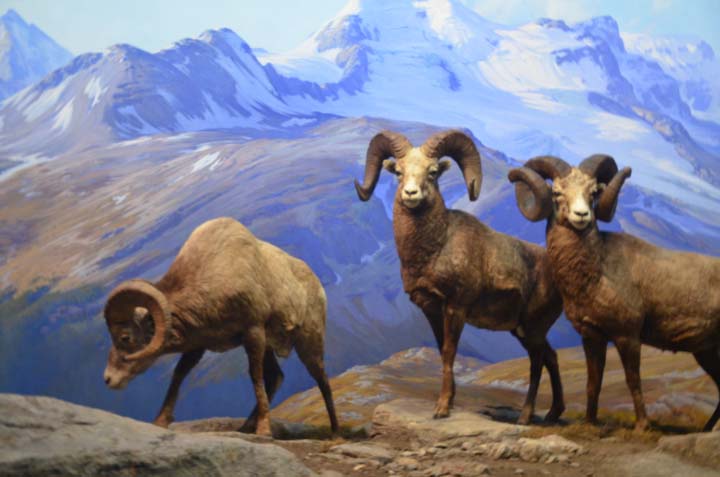
Big Horn Sheep diorama, after restoration.
“When Wilson and his contemporaries were working, dioramas were the state-of-the-art virtual reality of the day,” Steve Quinn, the senior project manager of the restoration, and a diorama man, said. He was accompanied by Robert Voss, the curator in charge of the conservation. “They were windows onto other worlds and landscapes, and the engineering that went into making them completely convincing is still astounding now,” Quinn said, adding that when the hall opened, in 1942, just after America’s entry into the Second World War, “the dioramas became a kind of patriotic pageant, a picture of our land and our values. They stood for America.” The task at hand is to restore the works to their original state while gently emending wall labels and the like to reflect new knowledge about the animals who gave their lives, and skins, for the depictions.
“Dioramas may seem old-fashioned, but they have a theatrical quality that engages museum visitors’ imaginations and allows them to see a scene from a variety of angles, something that is not feasible with a nature documentary,” MacPhee said. “Each diorama depicts a specific place and time,” added George Dante, president of Wildlife Preservations and a taxidermist involved in the restoration. "You can actually find this exact location and see how it has changed over time," he added.
Over the years, UV from the artificial lights used to illuminate the scenes had burnt out the pigments in the fur of many of the taxidermied mounts. Some background paintings had peeled or separated from their backings, and New York City grime had inevitably worked its way in.
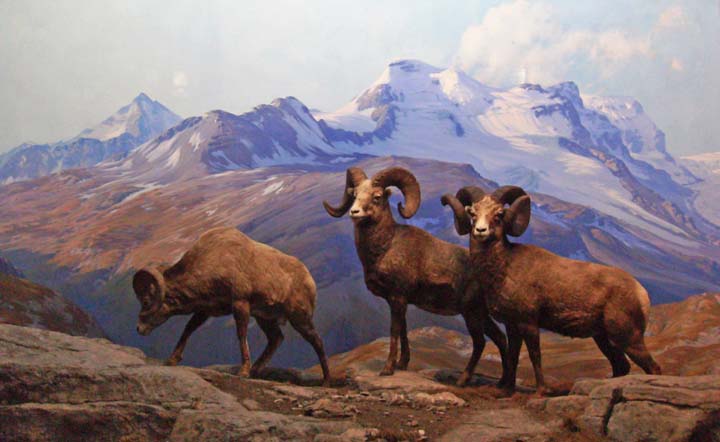
Big Horn Sheep diorama, before restoration.
To turn this hall into a showcase of mammalian diversity, the AMNH's exhibitions department, together with a host of outside experts and numerous volunteers, labored to give the hall and its contents a thorough cleaning and upgrade. The results are beyond remarkable. "With the help of [the] scientific department, we were able to get study skins that were not faded and compare them against these specimens and then develop a coloring process where we went in and actually recolored the specimens to bring them up to a more accurate color," Dante said.
In the new hall, every scene is crystal clear; the postures and appearance of the animals, caught in freeze-frame, are as accurate as science and art can make them. Every one of the 43 diorama presentations is accompanied by a completely rewritten and reconceived text panel. Most importantly, the feeling of being an on-the-spot witness to our natural heritage remains, but now with a much greater sense of urgency and involvement.
You can view videos of the remarkable processes involved in this restoration, including the process of sculpting the forms of habitat animals on Vimeo.
The American Museum of Natural History reopened today at 10 am, at Central Park West at 79th Street, NY, NY. Information. Please visit www.amnh.org/notice-for-ticket-holders for specific updates on programs that have been canceled and/or rescheduled.