


Cape Farewell at New York's Solar One
The Cape Farewell project, as reported in photographer Nick Cobbing's Letter from Greenland last month, brings scientists, artists and environmentalists together aboard the 100-year-old Dutch schooner Noorderlicht. The team headed to Greenland on a 17-day expedition to draw attention to the melting ice sheet and the effects that changing weather patterns will have on us.
Tomorrow night in New York, Ben Jervey, a Brooklyn-based environmentalist and author (The Big Green Apple) who was on the expedition, will give a talk and video presentation about what he learned about the current state of change in the Arctic. His presentation is part of the Green Renter program, which is held at the Solar One Green Energy Arts and Education Center in Stuyvesant Cove Park, on the East River.
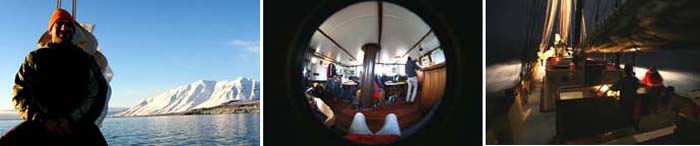
Above, left to right:
Ben Jervey in Greenland, photo by Carol Cotterill; upper mess area of the Noorderlicht, photo by Shiro Takatini; night watch on the Noorderlicht, photo by Nick Cobbing.
I caught up with Ben by email over the weekend to find out more about his experience on the expedition and to get some tips on conservation.
Peggy Roalf: How did you connect with the Cape Farewell project?
Ben Jervey: A good friend of mine is the niece of David Buckland, the program's founder, and she put us in touch. David was hoping to increase Cape Farewell's exposure in the States, and I'm fairly well entrenched in the American green new media scene.
PR: As a member of the team, what were your day-to-day responsibilities on board?
BJ: While we were actually sailing, every member of the crew took part on "watch," the two hour shifts up on deck, steering the boat, looking out for ice, helping to hoist sails. I think it was a little more of a real sailing trip than a lot of us anticipated.
PR: Did living on a 100-year-old wooden ship give you new ideas for living green in the city?
BJ: Living on a boat for three weeks definitely makes you conscious of consumption and waste. We were carrying everything we would consume-food, potable water, fuel for stretches when we couldn't sail, even electricity stored in batteries. And we're hauling our waste around too-except for the food waste that could be tossed overboard.
So while I wouldn't say it gave me any real new ideas for living a more eco-friendly life in New York, it was definitely a good metaphor for this great big self-contained vessel that is Earth.
PR: I live in a 100-year-old five-story walk-up, overheated by city steam. The Con Ed bill is staggering, considering the fact that I don't even spend that much time there. Apart from replacing the old refrigerator and giving up paper towels, what can I do, as a renter, to go greener?
BJ: Well this is a tough question to summarize in a paragraph or two considering I couldn't do it in under 200 pages in The Big Green Apple. But there are any number of things you can do to make your apartment more energy efficient and eco-friendly. Save energy with more efficient lighting and appliances; using cleaning products with no volatile organic compounds (VOCs); cut your water consumption with faucet aerators and a low-flow showerhead; you could even try composting organic waste at home.
PR: If every New Yorker changed only a few things in their daily routine with a view towards conservation, what would have the greatest impact?
BJ: There are so many easy ways to save energy here in New York, so many low hanging fruits. I'd encourage people to take a good look at their energy consumption and see where some more savings could be found. The biggest impact? Probably in heating and cooling homes-but so many of us are renters who have no control over that. But you should turn off your home electronics when they're not in use. Show your support for local bike and pedestrian programs, and let your elected officials know that you support congestion pricing.
PR: Thanksgiving has to involve more energy consumption than any other day on the calendar. What can we do to make up for this?
BJ: Buy your turkey and all the fixins' from a local farmer and take the train or carpool to visit your family.
For a map and directions to Solar One, click here. To view photographs of the 2007 Cape Farewell expedition, click here. To read Ben's post from the expedition, click here.