


Weekend Update: 01.15.2026
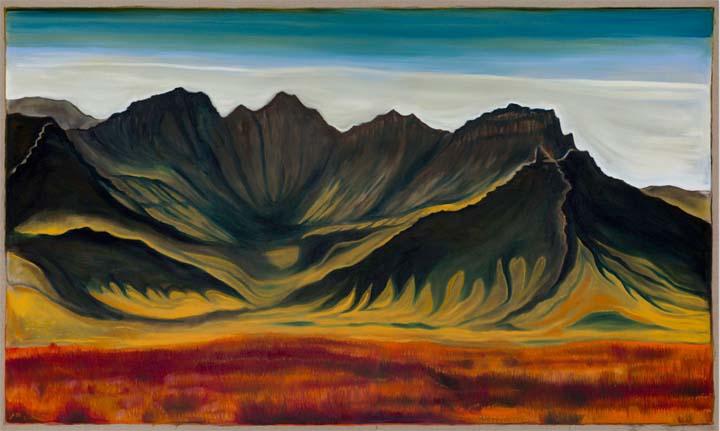
Continuing: Billy Childish | keep the mojave weird at at Lehmann Maupin
In his newest series based on a road trip in 2025, British painter, writer, and musician Billy Childish depicts the western United States in scenes from California. Seen together, the works occupy a space that is both contemporary and eternal, where each landscape feels familiar yet remote. From soaring mountain ranges, to arid desert, to verdant lakes, each image offers a narrative vignette that feels at once personal and universal.
The expansive subject matter gives Childish room to work on a grand scale, showcasing his particular talent for creating sublime cohesion within each composition. Throughout the exhibition, he compresses large swaths of the Sierra Nevada mountain range onto a single canvas, while images from Joshua Tree of massive rock formations and bare expanses of desert are contained in one or two panels. Rendered on an even smaller scale, mono lake (version) (2025) portrays the titular lake in Mono County, CA.
A selection of portraits is included, including images of the artist himself and his family in various Californian settings. Each composition functions as both personal documentation of the family’s journey and a timeless portrait of figures and landscape.
Through February 28 at Lehmann Maupin, 501 West 24th Street, New York, NY Info
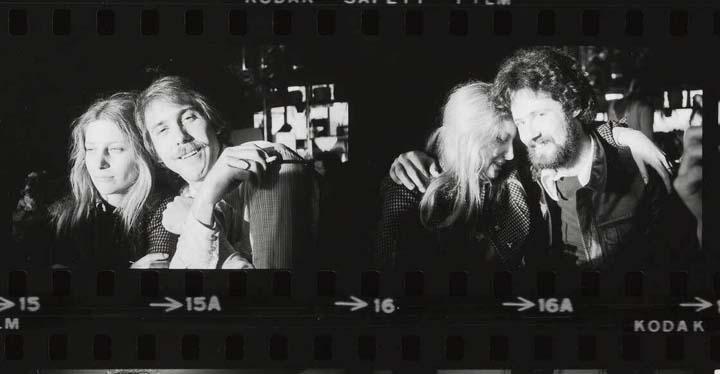
Continuing: Ken Ohara | Contacts at the Whitney
With CONTACTS, Ken Ohara preloaded his camera with film, mailed it to a stranger, and invited the recipient to photograph themselves, their family, and friends before returning the camera to the artist along with the name and address of the next person to send it to. Over two years, Ohara’s camera traveled to 100 participants in 36 different states. By surrendering control and shifting his role from sole image-maker to facilitator and co-creator, Ohara transformed photography into a collaborative act of social exchange.
The exhibition presents the resulting contact sheets recently acquired by the Whitney in chronological order, preserving the order in which they were created. Spanning the country, the images offer glimpses into the mundane intimacies of American life: candid family gatherings, quiet domestic interiors, scenes of labor and leisure, and fragments of urban and rural environments. Together, they form a vast, unfiltered portrait of the country defined not by singular narratives but by the throughlines and repetitions of daily existence.
While rooted in analog photography practices of the 1970s, CONTACTS introduces a form of image-sharing that shapes social media and participatory archives today. Its resonance lies not only in its historical moment, but also in its continuing relevance to conversations about co-authorship, collective engagement, and the social life of images.
Ken Ohara (b. 1942) was born in Tokyo, Japan. After briefly studying photography at Nihon University, Ohara moved to New York City at the age of 19. From 1966 to 1970, he worked as an assistant for Richard Avedon and Hiro. In 1970, his first book ONEearned support from The Museum of Modern Art’s photography curator John Szarkowski. In 1974, His work was featured in “New Japanese Photography,” a groundbreaking survey show at The Museum of Modern Art, New York. From 1974 to 1975 [More]
Through Feburuary 16 at the Whitney Museum of American Art, 92 Gansevoort Street, New York, NY Info. For Info about Free Fridays, go here
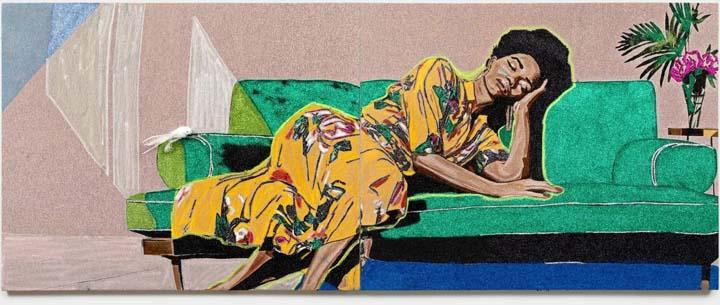
Continuing: Akea Brionne | Time Bends for the Tender at Lyles & King
Drawing inspiration from bell hooks’ Sisters of the Yam, this series explores the interior landscape of black women cultivated in order to survive the psychic, social, and geographic pressures placed upon them. The works explore how identity is shaped—softened, hardened, fragmented—and how the body learns to perform or mask itself within neurotypical, racialized, and gendered environments. Above:Where the Body Lands, 2025
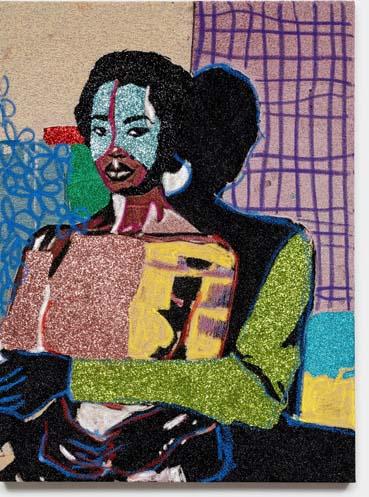 Brionne paints figures situated inside vividly colored domestic spaces: bedrooms, plants, bedsheets, and architectural planes of pinks, greens, yellows, and blues. The interiors are not merely backdrops; they are emotional geographies, worlds built from memory, longing, and quiet defense. The saturated colors function like shields—both expressive and protective—suggesting ways that women learn to craft environments that can hold what the outside world cannot. Below: Learning the Weight of Being Held, 2025
The concept of ‘masking’ emerges as a central gesture in the layered surfaces of the face and body. Tears appear with painterly emphasis, but they are not singularly about sorrow; they mark release, rupture, and reclamation. They reveal what happens when the mask briefly slips and the interior becomes visible.
These portraits incorporate characteristics of Afro-surrealism, where the real and the emotional coexist without hierarchy. The distortions of scale; figures dwarfed by blankets or domestic plants, intend to capture how memory distorts time, how the past interacts with the present, and how interiority becomes a landscape of its own.
Through February 21 at Lyles and King, 19 Henry Street, New York, NY Info
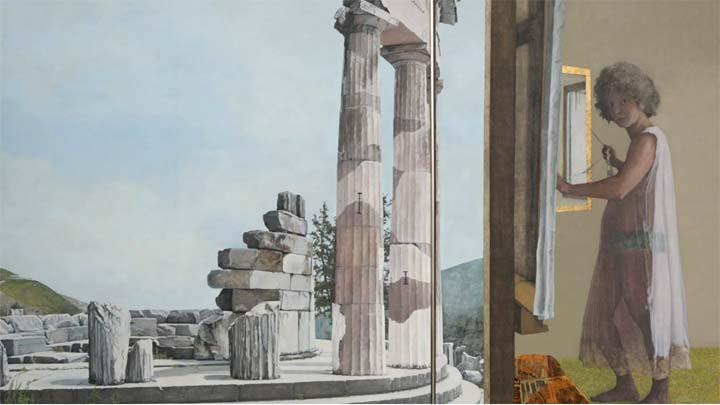
Continuing: Marcia Marcus | Mirror Image at Olney Gleason
Marcia Marcus: Mirror Image presents three of Marcia Marcus’ critically acclaimed group portraits in dialogue with important works in other genres – self-portraiture, still-life, landscape, and architecture – demonstrating the artist’s formal inventiveness and arguing for her traceable influence on painters working today. The exhibition anticipates the artist’s career-spanning retrospective at Provincetown Art Association and Museum from June 26–August 30, 2026, which will be accompanied by a major monograph.
Marcia Marcus (1928–2025) is recognized for her rigorous and sensitive portraits of a generation of New York artists, writers, and other cultural figures from the 1960s through the 1980s, as well as her incisive self-portraiture. Typically working from life, she developed a distinctive atmospheric quality that combines intimacy with intensity, employing frontal poses, a direct gaze, and meticulous attention to costume, setting, and gesture.
The exhibition emphasizes Marcus’ sustained engagement with Classical imagery and mythic time. Several key works were made after the summer of 1962, when the artist traveled extensively in Greece, living for a month in the city of Delphi prior to her Fulbright Grant in France. The Tholos of Delphi – a stone temple ruin – appears in Mirror Image (Self-Portrait) (1973). Other paintings reference ancient architectural sites, including the Tomb of Unas (1976) named after the burial chamber in which the earliest hieroglyphic funerary texts were inscribed, and Painting for Olympic Poster (1974) which depicts the artist as the Greek goddess Athena.
Through February 14 at Olney Gleason, 509 West 27th Street, New York, NY Info