


Life in a Mountain Kingdom, at the Rubin
More than 100 years ago a civil engineer in service to the British Raj, whose name was John Claude White, got the assignment of a lifetime. Tasked by the Sikkim-Tibet Boundary Commission with mapping and surveying the region's borders, he moved his family to Sikkim, where they lived for over 20 years.
White was born in Calcutta, but educated in Bonn German, where he
no doubt become enthralled by the "golden age" of mountaineering. On his move to the Himalayas, he indulged his passion for photography during the many long expeditions he made in the course of
mapping the region. Like many educated men of the time, he was far more than adept in his use of a large format, glass plate negative camera.
According to his diaries and photographic
records, White trekked nearly every valley and mountain pass in Sikkim and Bhutan. He had a group of native porters with mules and yaks assigned to carry the cumbersome and fragile photography
equipment. White trained one of them as his assistant, and charged him with setting up and moving the camera on location. One of the pictures on display, View looking South from Chorten Nima
La, c. 1890-93, depicts a vertiginous mountain pass between Sikkim and Tibet, with perpendicular cliffs rising out of the frame. It's nearly impossible to imagine where and how the camera was
positioned to record this stunning image.
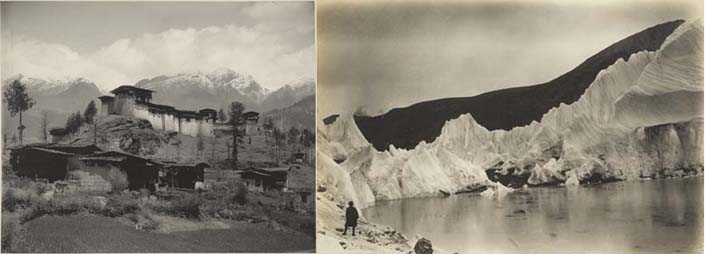
Photographs by John Claude White, left: Drukyul Dzong, 1905; right: Glacier Head of Langpo Vally, c. 1890-93. Courtesy Rubin Museum of Art.
The wall text for Glacier Source of the Teesta North of Powhunri, c. 1890-93, states that this colossal river of ice is presently about half the size it was when the photograph was made. In Glacer Head of Langpo Valley, c. 1890-93, the silhouetted figure of a man standing at the left gives a sense of scale to the massive ice floes rising from the water. A map created by the National Geographic Society for a 1914 article by White brings the terrain - and White's efforts to represent it - into sharp relief. In addition to his explorations for the Boundary Commission, White also went for weeks at a time to photograph the area to satisfy his personal interests.
What makes these pictures so intriguing is his evident concern for the people he encountered along the way. He also photographed his assistants, local men trained as surveyors who collected data to be be used by Commission cartographers. But some of the most fascinating photographs on display are from the Bhutan album, which depict the King of Bhutan's coronation, in 1905. At this event, White and three other British officers were among the first western visitors to the region in over 40 years.
Photographs from the Bhutan album, which is displayed in a case, are seen as an enlarged copies; a touch interactive screen allows visitors to "page through" the album to view the remaining photographs. One, of the Drukyul Dzong castle seen from below, with massive snow peaks beyond, caused me to involuntarily whisper, "Shangri La." The medieval fortress had been built by the leader of Bhutan in 1649 to celebrate his country's victory over Tibet that had been won in 1644.
White's platinum prints were made in Calcutta by the Johnston and Hoffman Studio, and bound into albums, which was a common practice for presenting "view" photographs of the period. The Bhutan album is seen as it was originally produced while the Sikkim album has been unbound in order to exhibit the prints.
A British Life in a Mountain Kingdom: Early Photographs of Sikkim and Bhutan, by John Claude White, continues at the Rubin Museum of Art through January 20, 2011. A series of talks beginning October 18th will explore fundamental questions about life, starting with Karen Armstrong on Islam; other participants include Laurie Anderson, Oliver Saks, Rick Moody and many more. Please visit the website for information and tickets. 150 West 17th Street, New York, NY. 212.620.5000.
081010