


Robert Frank's Camera Truth
The 50th anniversary of the publication of Robert Frank's seminal book The Americans has spawned thoughtful consideration of the photographer's contributions to making of images as well as exhibitions of his work, both large and small.
Tonight, Robert Mann Gallery opens a gem of a show of images by Frank from a private collection. It begins with a series of pictures from The Americans, including fat-cat politicians and ordinary folks, then offers glimpses of Frank's highly idiosyncratic ways with black-and-white film. It ends with a photograph of a man holding a flower that Frank made in Paris a few years after he emigrated to America in 1947.
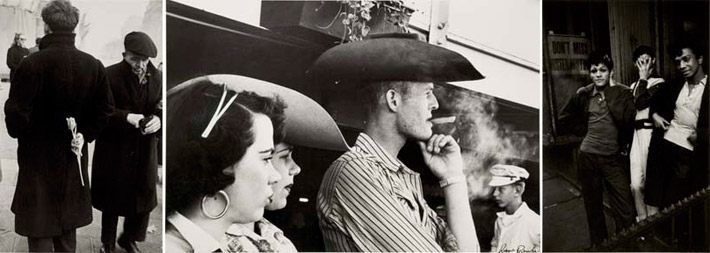
Left to right: Paris, 1951-52: Rodeo, Detroit, 1955;NYC, 1955. Copyright Robert Frank, courtesy Robert Mann Gallery.
Much has been written about how Frank changed the perception of camera truth. At the time The Americans was published, the country was in the throes of the Cold War. Fear of the bomb, the racial divide that was just beginning to be challenged by the Civil Rights Movement, along with a complacent prosperity that emerged with the post-war American Dream contributed to a sense of mistrust of the foreign and an almost naive boosterism.
When The Americans, a slim volume with 83 pictures was published by Grove Press in 1959, angry critics denounced Frank's dark, brooding picture of a country and its people, who seemed deeply distressed by their circumstances. The photographer used techniques considered radical at the time, such as ignoring the camera's frame and letting his images bleed away from the center; capturing large areas of shadow; out-of-focus foregrounds; all of which conveyed a sense of dislocation and despair.
In an essay for the Wall Street Journal, author and critic Luc Sante wrote, "The mainstream aesthetics of the time could only see the pictures' oblique, asymmetrical approach. Their fluid edges and melting grays were received as messy, even squalid. The refusal to present sharply delineated, self-contained, centered figures was to the eyes of the time as troubling as the failure to provide clear-cut moral anecdotes and examples for emulation. The pictures were a photographic counterpart to beatnik poetry and bebop jazz and Abstract Expressionist painting and European art movies, none of which got much respect in the conventional press of the time, either. Both their form and their function were suspect in a time when uncertainty was as good as treason."
It's hard to imagine today the outrage these photographs caused. The book's influence on Frank's younger colleagues and the following generation of photographers, including Lee Friedlander, Garry Wiogrand, Danny Lyon, Bruce Davidson, Eugene Richards, and Silvia Plachy, to name a few, has changed the perception of the purpose of image-making, the use of photographs and the twilight zone that exists when a picture is open to interpretation.
Today, Frank's photographs can be appreciated for their powerful sense of place and the simple beauty that can be found in ordinary subjects when they are given more than a second glance. In 1951, when applying for the Guggenheim Fellowship that supported his travels for The Americans, Frank wrote, ''When people look at my pictures I want them to feel the way they do when they want to read a line of a poem twice."
Robert Frank inaugurates Robert Mann Gallery's newly renovated space with an opening reception from 6:00-8:00 pm tonight, and continues through December 23, 2009. 210 Eleventh Avenue, 10th Floor, New York, NY. 212-989-7600.
Looking In: Robert Frank's The Americans is on view at The Metropolitan Museum of Art through January 3, 2010. 1000 Fifth Avenue at 82nd Street, New York, NY. 212-535-7710.
The 2007 Steidl edition of The Americans by Robert Frank, produced in cooperation with the photographer, is available at Dashwood Books, as well as an array of rare editions of many of Frank's publications, including a signed copy of the 1993 Scalo edition of The Americans.
092409 frank