


archiveFever: The Public Domain Review
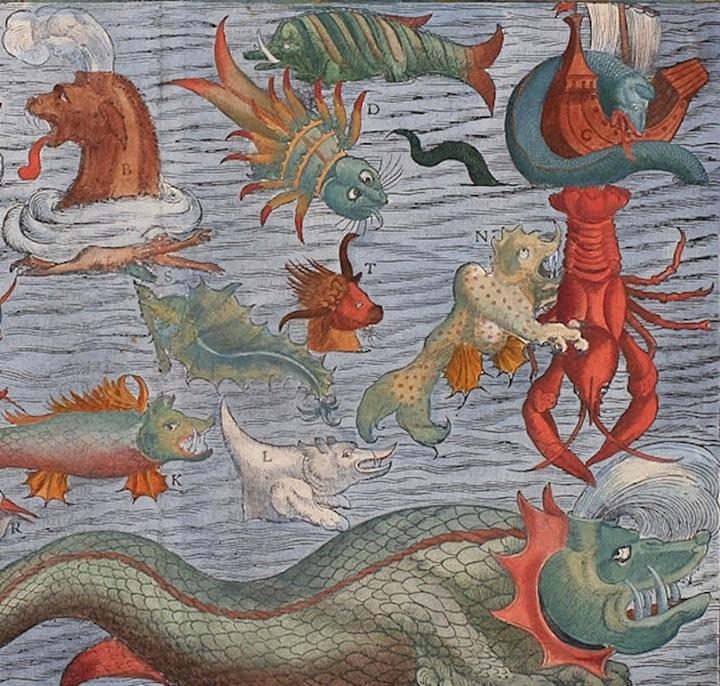
Detail from a version of Sebastian Münster’s sea monster chart (1544 and after), composed from copies of the vignettes found in Olaus Magnus’s Carta Marina from 5 years earlier [below].
Everyone occasionally runs out of ideas, needs inspiration, or simply gets bogged down. Perhaps this is why we surf? One of the most intriguing newsletters that regularly hits my inbox is the Public Domain Review. Launched in 2011 by founders Jonathan Gray and Adam Green, it showcases works that have entered the public domain. A project of the Open Knowledge Foundation, in Cambridge, UK, the PDR, as it’s known, features not only incredible artwork, but also scholarly articles written with a general readership in mind.
This is a great resource for artists, writers, educators, and the arts in general. It's mission and content is a gold mine for anyone with Archive Fever. So here, enjoy Olaus Magnus’s Great Sea-Serpent, and PDRs story about how an important marine chart, delineated in 1539, became reference material a few years later for an important draughtsman creating art [above] for a book about sea monsters. And the original carta marina [below] is a magna carta for the mind's eye!
The terrifying Great Norway Serpent, or Sea Orm, is the most famous of the many influential sea monsters depicted and described by 16th-century ecclesiastic, cartographer, and historian Olaus Magnus. Joseph Nigg, author of Sea Monsters (University of Chicago Press 2013), explores the iconic and literary legacy of the controversial serpent from its beginnings in the medieval imagination to modern cryptozoology. Here is what he wrote:
In his comprehensive study, The Great Sea-Serpent: An Historical and Critical Treatise (1892), Dutch zoologist Antoon Cornelius Oudemans lists more than three hundred references to the notorious sea monster in his chronological “Literature on the Subject.” The first ten of those, 1555-1665, cites Olaus Magnus’s sea serpent: editions of Olaus’s Historia de gentibus septentrionalibus (“History of the Northern Peoples”) and natural histories of Conrad Gesner, UlisseAldrovandi, Edward Topsell, and John Jonston. The list establishes Olaus’s serpentine monster as the major ancestral source of sea serpent lore from the sixteenth century to widespread sightings of such creatures in Oudemans’s own time. It is the basis for illustration and discussion of the creature in marine studies and popular fantasy up to the present, five hundred years after Olaus created it. [Read the entire article here]. [Subscribe]
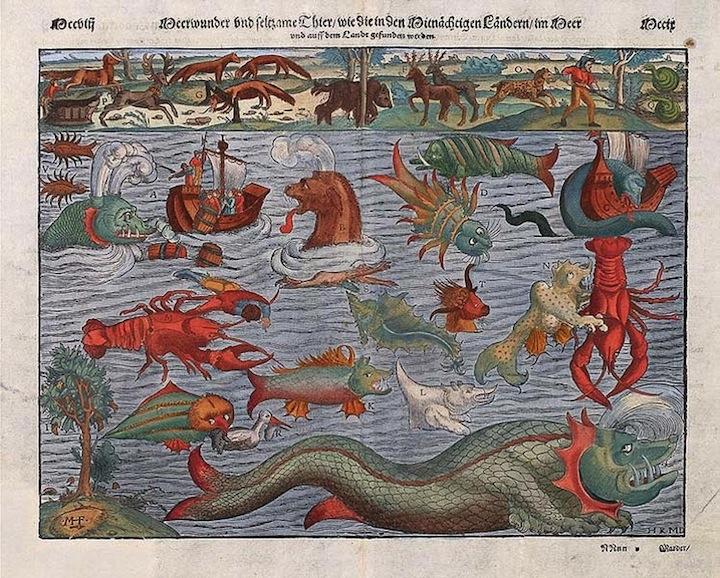
Olaus Magnus’s Carta Marina from ca. 1540. Source

CORRECTION: In the title of yesterday's post, the artist's name, Jonathan Bartlett, was incorrectly written and is now corrected in the Archive and on Facebook. Apologies to Jonathan and to the School of Visual Arts (SVA).