


David Goldblatt at the New Museum
For a country the size of South Africa, whose recent history is not easily understood beyond newspaper headlines, making sense of its social geography through photographs would be a feat. This is what South African photographer David Goldblatt has accomplished with Intersections Intersected, the first major exhibition of his work in the U.S., which just opened at the New Museum.
Born in 1930 to Jewish parents whose own parents fled persecution in Lithuania, Goldblatt understood from childhood what it means to be an outsider. When apartheid was enacted in 1948, he was already making photographs to document life in the newly segregated "race zones," or areas where whites, or blacks, or coloreds, or Indians were forced to live.
As a photographer in the documentary style, Goldblatt shot in black and white until Nelson Mandela's government took over in the 1990s. Recognizing that a new era in his country's history was beginning, he began a study of its social landscape through large format color photography.
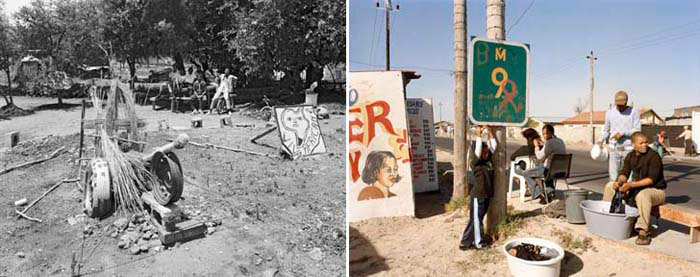
Left: The Crossrods
Peoples' Park, Oukasi, Brits, North West, 22 November 1986. Right: At Kevin Kwanele's Takwaito Barber, Lansdowne Road, Khayelitsha, Capetown, in the time of AIDS, 16 May 2007. From the PAIRS series,
copyright David Goldblatt, courtesy the New Museum.
The exhibition includes a section called Pairs, in which black and white images he made during the apartheid era are paired up with more recent color images that give a different perspective to the same subject. The nuance of both subject and place in each set is so finely observed that most viewers will want to read the detailed captions Goldblatt has written in order to understand the realities depicted. A close reading of photographs and captions reveals that Goldblatt's country is one where the sharp differences that make for good new coverage can easily mask the largely uneventful, but telling, happenings of daily life.
For a group of eleven color photographs in a section called AIDS, the phrase "in the time of AIDS" is included in each caption. On walking through the gallery where they are hung, I was trying to understand the meaning of this phrase. Was he implying that the time of AIDS was past or that it is now and forever? It was only when I mentioned the appearance of the color red in a photograph to my companion that we suddenly realized that each photograph included a representation of the AIDS ribbon. In one photo, it was part of a reflection in a store window advertising family benefits "including a funeral plan." In another it was on a piece of black-and-white stationery posted in the cashier's window of a municipal office. The ribbon was there, in each photograph, usually as an element in the landscape and usually in a monochromatic rendition. Finally we came upon an image that included a row of red ribbons, crudely painted on doors in a row of public lavatories.
One in a group of 7 tryptichs depicts an ordinary scene that includes a gas station and convenience store, seen from three different vantage points. A sign advertises "Lotta Cash Cash Loans." A pile of truck tires filled with concrete holds up a lamp post. Several black people are hanging around not doing much, although one seems to be waiting for a bus. As I kept looking, trying to find the subject of this photograph, I discovered several signs written in Afrikaans, the Dutch-based language of the white settlers' ancestors, which was kept alive well past colonial times in order to prevent blacks from understanding the conversation of their masters.
Intersections Intersected: The Photography of David Goldblatt continues at the New Museum through October 11, 2009. 235 Bowery at Prince Street, New York, NY. 212.219.2000. An iPod tour by the photographer is available; upcoming public programs include a 3-part African Film festival, starting August 29st.
072209 goldblat-1