


The American West at MoMA
You've got to see it to believe it. - White man
You've got to believe it to see it. - Indian man
- M. Scott Momaday, Native American (Kiowa) b.
1934)
Many of us are still looking for whatever it is we believe the West offers-reinvention, escape. We believe it will be easier here; it will be different.
- Katy Grannan,
American, b. 1969
Just as photography has shaped and changed our view of the American West, the American West has shaped and changed our vision of an American national identity. Its vastness is a subject in itself, explored by photographers who have been drawn to the land by western mythologies for as long as cameras have been available here. Its vastness has also been one of the reasons for the desecration of its natural grandeur: there has always seemed to be more than enough land and resources to go around - free for the taking.
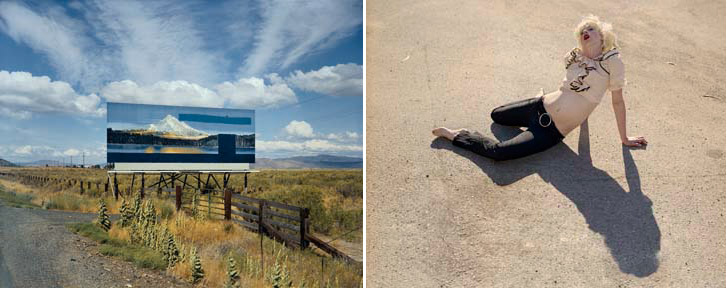
Left to right: Stephen Shore (American, born 1947); U.S. 97, South of Klamath Falls, Oregon. July 21, 1973; (c) 2009 Stephen Shore; courtesy the artist and 303 Gallery, New York. Katy Grannan (American, born 1969); Nicole, Crissy Field Parking Lot (I). 2006, (c) 2009 Katy Grannan; courtesy The Museum of Modern Art, New York.
A new photography exhibition that opens Sunday at The Museum of Modern Art explores the lure of the West for photographers, which began around 1840 when the first American camera patent was issued. Comprised of over 150 images, it presents an up-to-date view, as seen by 75 photographers whose images have made and continue to define the region a place for "discoverers, dreamers, and drifters"
That is how curator Eva Respini characterizes the allure of the roughly two million square miles that lie between the Mississippi River and the Pacific Ocean. The show begins with Richard Prince's Untitled (Cowboy) from 2003, a buckaroo skipping through his twirling lariat, tightly cropped from a re-photographed Marlboro ad. Prince's strategy of appropriating and conferring a new identity on what is arguably the most iconic of all brand images of the 20th century offers a clue for this fast-paced show, which is thematically organized under two main subjects: The Land and The People.
In the first gallery, poetic visions of the land, from Eadweard J. Muybridge's 1872 view of Yosemite (which outdoes Albert Bierstadt's paintings of the place ten to one for beauty and the sublime), and Ansel Adams' famous Moonrise, Hernandez, 1941, give way to Robert Adams' clear-eye view of Colorado's suburban sprawl, Richard Misrach's Desert Fire Number 43, 1983 and other depictions of terra firma under siege.
The people are introduced in the next gallery, with an albumen print of Eadric L Eaton's Sky Chief, ca. 1867 and Gertrude Kasebier's 1899 portrait of an American Indian in full regalia. Robert Frank's 1954 portrait of an urban cowboy lighting a smoke, wearing denim distressed by hard living, is as many miles and worlds apart from the Marlboro Man as it is from the daguerreotype of a gunslinger with his saddle, made around 1850 by an unknown photographer. And James Luna, a Native American, takes a poke at identity politics with Half Indian/Half Mexican, 1991.
It soon becomes apparent that photographers have been bending "camera truth" for as long as documentary-style pictures of the West have been made. Some were commissioned by government agencies seeking to implant the call of Manifest Destiny into the national psyche and others by commercial interests, such as railroad companies luring settlers with the promise of cheap land and steady jobs. Even photographers intent on conserving wild places like Yosemite, including Carleton E. Watkins, often manipulated their prints to include a sky full of dramatic cloud formations rather than a dull gray background.
The exhibition continues to reveal its stated mission, and with every image that you might hope to see in a thematic view of the West, there are several more that come as surprises. Happy to see an extraordinary print of Robert Frank's Covered car-Long Beach, California, 1955-56, I was also pleased to see Adam Bartos' 1985 scene of dirt-colored cars parked before a dirt embankment under towering expressway ramps.
Richard Avedon's iconic portrait of a down-and-out blackjack dealer, from 1983, finds a contemporary counterpart in Katy Grannan's portrait, Nicole, Crissie Field Parking Lot (1), made just last year. And Steven Shore's 1975 view of Beverley Boulevard gas stations is complemented by Dennis Hopper's Double Standard, 1961, which riffs on an adjacent road trip landscape, seen through a rear-view mirror in signature style by Lee Friedlander.
Suburbanites, starlets, hustlers, drifters, homesteaders and discoverers are all given fair treatment here, just as natural disasters, industrial desolation and nature's majesty are - although the show leans more heavily towards marginalized people and ecological disaster, if only because those subjects tend to be more intriguing.
Into the Sunset: Photography's Image of the American West is on view from March 29 to June 8, 2009. Museum of Modern Art, 11 West 53rd Street, New York, NY. 212.708.9431. An excellent heavily illustrated book of the same title accompanies the show. Please check the website for related public programs, including film screenings.
032509 sunset