


Takahiro Kaneyama's Shumafura
Takahiro Kaneyama has lived in New York since 1993, and each year he returns to Japan for several months. Between photography assignments and other work, he takes his mother, his two aunts, and their little dog for short trips to historic sites around Japan.
"I was raised by my mother, grandmother and two unmarried aunts," says Kaneyama. "My mother, diagnosed with schitzophrenia when I was a teenager, became a totally different person overnight. It almost seemed as if the history of her life had been erased; it got so you couldn't have a decent conversation with her. The only way to prove who she had been was with photographs from before she became ill."
After his grandmother died, Kaneyama began photographing his family every time he went home. The loss of his grandmother, he says, "made me acutely aware of how much time had passed without me really noticing." These photographs have been one of the main subjects of Kaneyama's work for the past decade, and were featured in Japan Society's recent exhibition, Making a Home: Japanese Contemporary Artists in New York.
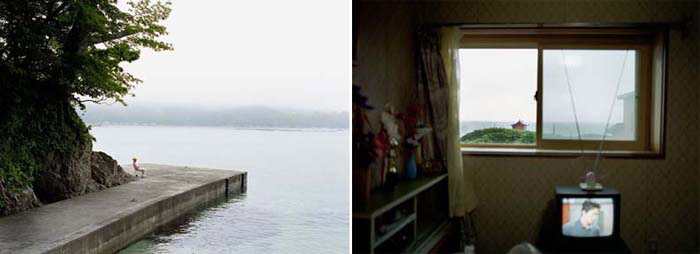
Photographs copyright Takahiro Kaneyama from the series, Shumafura, courtesy of the artist.
Last year on his trip to Japan, Kaneyama decided to visit a relative whom he had never met. His great uncle Hideo Yanagi, the younger brother of his grandmother, lives in a remote fishing village on the Shimokita Peninsula, about six hours from Tokyo. The difficulty of travel there had made it impossible for family visits since the 1960s, but his mother and aunts maintained a regular correspondence with Yanagi. "I decided to photograph Shimofuro," says Kaneyama, "and perhaps, in the process, fill in some of the blanks in my personal history."
In a town where most of the young people have left to find better jobs elsewhere, inns and guest houses are shuttered; the streets are empty; even the local convenience store has only the bare necessities. But the village, which was called Shumafura in the language of the region's indigenous people, has a history as a famous hot springs frequented by samurai more than a thousand years ago. Photographing under stormy skies, Kaneyama captured the isolation and decay of the present that imbue his photographs with a melancholic beauty.
On pier jutting into the Straits of Tsugaru, a dandified man in spectator shoes and a jaunty straw hat enjoys a respite from the rainshowers. A modern jetty of rocks precisely cut into geometric forms and set into place with mathematical precision snakes away from the shoreline, highlighting the profile of an old shrine atop the adjacent hillside. The homes of local commercial fishermen, built cheek by jowl alongside the ocean's edge, look like the kind of sturdy but undistinguished houses that are built in seaside villages everywhere.
Great uncle's house, where the robust 83-year-old man lives with his wife, is full of the paraphernalia accumulated by previous generations, including a photo album that contains a portrait of his mother at age 21. Although the women of Kaneyama's family did not make the trip to the village this time, his mother's image infuses the place with her presence.
Takahiro Kaneyama's Shumafura is on view at M.Y. Art Prospects through April 11. The opening reception is Thursday, March 5th from 6-8 pm. 547 West 27th Street, 2nd Floor. New York, New York, NY. 212.268.7132.
030509-taka