


Villas for China's New Elite
For anyone who has had to ditch the idea of building their dream house, an intriguing exhibition at The Architectural League might be just the kind of fantasy that's needed for hard times. 13:100 Thirteen New York Architects Design for Ordos presents scale models, renderings, architectural drawings, and verbal commentary about the process of designing luxury villas for Kangbashi, a new city in Inner Mongolia.
Housing and a cultural center for Kangbashi, located in the coal-rich desert area of Ordos, is being developed by Cai Jang, a 42-year-old native of the region who made his millions in natural resources and has since moved on to real estate. Mr. Cai first contacted Jacques Herzog and Pierre de Meuron, the Swiss architects who are famous in China for their Bird's Nest Olympic stadium. The architects, however, suggested hiring 100 up-and-coming architects from around the world and brought in Ai Weiwei, the Chinese artist-provacateur, to organize the design project.
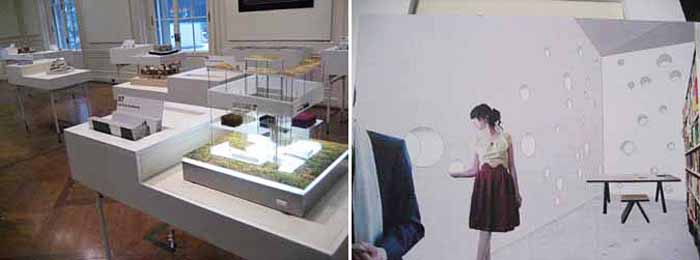
Model and rendering of Ordos villa by Lyn Rice Architects. Photo: Peggy Roalf
As Mr Ai conceived the program, 100 architects would be invited to design 100 villas, each 10,000 square feet, within a period of 100 days. Lyn Rice, who recently completed Parson's Johnson Design Center said, "If I had three wishes for a dream project, they would be: A client who doesn't tell us what to do. A schedule that doesn't run too long. And we don't have do construction documents."
The exhibition includes scale models, drawings and renderings. Each project is displayed on a counter-height white cabinet that also houses speakers broadcasting the architects' commentary about the design process. Slade Architecture took advantage of the local brick making industry and cheap labor to create a sculptural surface for their villa. "We realized we could do something unusual and inventive with the brick surfacing that we wouldn't have been able to do in the States," says Hayes Slade.
OBRA Architects used 19th century woodblock prints as a point of departure. They observed that traditionally, trees and shrubbery were confined to private gardens while public spaces were barren hard-scrapple places. They saw the challenge of the Ordos project to "go beyond the individuality of the villa in itself and achieve in the togetherness of all 100 villas an urban totality with a coherent sense of whole," much like the traditional villages depicted in the prints.
Curator Gregory Wessner, mindful of the environmental and social issues that have been overlooked by the developers writes, "The site plan has been characterized as a poorly considered culturally inappropriate reinterpretation of a 1950s American suburb. And a collection of 100 large villas in a country where families are limited to one child is considered by many to be unseemly, if not obscene." But Wessner also points out that it is fascinating to discover through a study of Ordos the complexity of how buildings are being designed today.
13:100 Thirteen New York Architects Design for Ordos continues through November 16 at The Urban Center, 457 Madison Avenue, New York City. Free and open to the public. Please check The Architectural League of New York website for information.