


The New Basics: Point, Plane and Beyond
When a copy of Graphic Design: The New Basics landed on my desk, it was like having a visit from the vivacious daughters of an old friend. The book, by Ellen Lupton and Jennifer Cole Phillips, who are colleagues at Maryland Institute College of Art (MICA), presents the study and practice of graphic design today. In the introduction, the authors have outlined a history of the discipline as it emerged through Modernist traditions of the Bauhaus School in Dessau, Germany. One of the legendary figures mentioned is Swiss designer and teacher Emil Ruder, whose Typography: A Manual of Design, is a recognizable influence on both the structure and content of The New Basics. My own copy of the 1967 classic bears the marks of my appreciation.
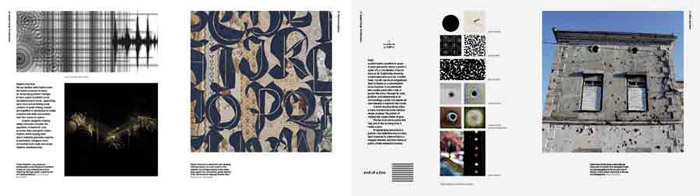
Spreads from Graphic Design: The New Basics.
Lupton and Phillips raise a simple question that has no simple answers: How do designers get ideas? Because computer literacy, including the facile use of graphics software, is pretty much a given today, the problem is how to offer designers the tools they need to break away from obvious tricks of the trade. Critical thinking and experimentation, the authors emphasize, is what makes for design excellence.
They also show us that many of the core values of the Bauhaus legacy, such as rational thinking and standardization, have become outpaced by more free wheeling opportunities offered by digital technology, and by contemporary thought about messaging and interpretation.
Starting with design basics such as point, line, plane, color, and texture - organized by the principles of scale, contrast, movement, rhythm, and balance - Lupton and Phillips begin to add elements that today are easily executed, including texture, transparency, and layering. "Powerful digital tools are commonly available to professional artists and designers but also to children, amateurs, and tinkerers of every stripe," the introduction reads. "...but they don't tell us what to make or what to say. It is the designer's task to produce works that are relevant to living situations...and to deliver meaningful messages and rich, embodied experiments."
While the authors celebrate randomness as a desirable outcome, the beautifully designed book is anything but accidental. Organized in chapters that begin with Bauhaus basics of Scale; Figure/Ground; Hierarchy; Modularity, it advances to the new basics of Layers; Transparency; Time and Motion; and Rules and Randomness. Like their precursor Emil Ruder, they demonstrate these powerful concepts through examples by their students and by colleagues who head up notable design offices.
For example the statement, "Scale is a verb" is illustrated by drastically enlarging the dimension of one axis of a graphic element. A striking example by designer Paul Sahre rescales two lines of type to the extreme, resulting in near unreadability - and tremendous graphic impact.
Swarming, by which thousands of tiny elements flock together to create a larger surface, is a concept in contemporary art that suggests movement and change; this idea introduces the use of patterned surfaces in visual identities and graphics. The identity mark for MICA, designed by Abbott Miller and Kristen Spillman of Pentagram, makes a clear statement about a complex notion.
The variety of artwork provides a visual feast that should also be enjoyed apart from a study of the highly readable text. Not only are there design examples; photographs and paintings also come into play. Printed Layers is explained through a painting by artist and designer Ryan McGinness; Capturing Tension is illustrated by an Aaron Siskind photograph; and Connecting Time and Space through a photo essay by Katherine Wolkoff documenting a piece by choreographer Mark Morris.
Throughout, multifaceted concepts are realized in examples that span the entire practice of graphic design, from maps and diagrams to surface design to motion graphics. The closing chapter looks at ways to use rule-based processes - such as style sheets for magazine layouts and design manuals for identity programs - to generate unexpected results.
Graphic Design: The New Basics (Princeton Architectural Press 2008) by Ellen Lupton and Jennifer Cole Phillips, with 248 pages and 400 color illustrations, is available in soft cover. The companion website includes a variety of student responses to the design problems featured in the book.