


Art at a Cultural Crossroads
Last January, Parsons The New School for Design had a ribbon-cutting ceremony for the Sheila C. Johnson Design Center, which joins four disparate structures at ground level to form a new "urban quadrangle." Viewed as a place where the design process can unfold before the public eye through the center's physical design and transparency, it is intended to bring public participation into the mix.
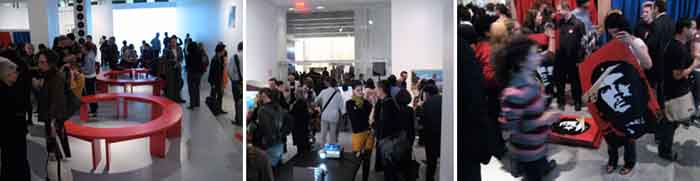
Scenes from the opening of Ours: Democracy in the Age of Branding, photos: Peggy Roalf.
If the dignified January ceremony could be called a "soft opening," the opening last night of Ours: Democracy in the Age of Branding was an event that used the space in a way even livelier than its planners had probably intended. As visitors began arriving, the crack exhibition design and production team was quickly and surefootedly finishing up the installation. There were ladders everywhere; wires snaking across the gallery floor; the roar of electric drills, the smell of wet paint and the shouting of orders to the crew. A casual observer might think this was a designer's worst nightmare, but for design students, it was a live lesson in how to get things done. Suddenly the space grew quiet as the installers departed, with ladders in tow.
The exhibition looks at democracy positioned as a brand and asks questions about the polarities that exist in democracy now, such as participation and individuality. It includes work in an array of media new and old, from video interviews by Carlos Motta; to a piece by Runo Lagomarsino in which a single slide is projected on a miniature movie screen using an outmoded Kodak Carousel projector; to a photographic reproduction of an oil painting, by Komar & Melamid, from their People's Choice series; to Sharon Hayes' videotaped performances of all 36 official addresses made by President Ronald Reagan; to Aleksandra Mir's posters of Che Guevara, distributed free to the public during the show, to name just a few.
The curator, Carin Kuomi, who also heads up the Vera List Center for Art and Politics, gave a group of journalists an exhibition tour and explained how certain works in the show haven't yet materialized. For example, Ashley Hunt's World Map of power structures will be created on a colossal chalkboard over a 10-day period, followed by a period in which members of the public are invited add their own commentary. Each week, the map will be documented and uploaded into the exhibition's dedicated website.
Kuoni pointed out that the exhibition space will also be used for design sessions open to the public. A work by Liam Gillick commissioned for this purpose "creates an area of heightened awareness and participation - or a place where people can retreat and dwell on their own thoughts - which are attributes the artist ascribes to democracy," she said. This gray platform rising a foot above the floor, with four circular red benches where students will work and where visitors can quietly contemplate the work on display, is visible through the 13th Street window wall.
There is seriously transgressive work as well as kind-hearted slapstick. There are works that investigate the ways in which corporate branding corrupts democratic ideals. There is an investigation into cultural identity in an age of global migration. And a clue-based scavenger hunt by PetLab that offers a history of New York City through its sites of activism, protests, and riots is scheduled for Election Day.
Ours: Democracy in the Age of Branding continues through February 1, 2009 at the Johnson Design Center, 66 Fifth Avenue at 13th Street, NYC, and is free and open to the public. For information, please check the exhibition's dedicated website, which is updated to provide the latest information about workshops, lectures, and various actions taking place during the show's run. Also check the Vera List Center for Art and Politics website for more public programs.