


Live Forever: Elizabeth Peyton
The title of Elizabeth Peyton's retrospective, which opens today at the New Museum, offers much to think about - and suggests a number of ways in which to view this show of 104 paintings, drawings and prints.
On the surface, "Live Forever" alludes to the celebrity of many of her subjects, from Kurt Cobain and Sid Vicious to David Hockney and Susan Sontag. When she arrived on the New York art scene in the early 1990s, Peyton's jewel-like portraits, mostly done from news photographs, caused a stir. Here was an artist swimming against the tide of wall-size abstractions, making figurative art that drew from the common well. Even the way her work was shown - at art dealer Gavin Brown's apartment in the days before he opened a commercial gallery - was viewed by some as a little contrived.
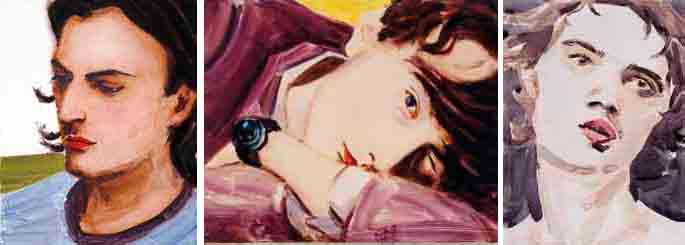
Left: Marc, 2004. Center: Jarvis, 1996. Right: Pete (Pete Doherty), 2005. All copyright Elizabeth Peyton, courtesy of the New Museum.
The youthful beauty of her mostly male subjects, several of whom met an early death, is elevated to an almost elegaic level without seeming precious. Whether done from photographs (Cobain, Vicious, John Lennon, Sontag, and JFK, Jr.) or from life, as much of her more recent work is, Peyton creates a living presence in her subjects' eyes - even in those of the dog in Harry and Tittie, 2003.
The simplicity with which Peyton describes the features and the physical mass of subjects such as Jake Chapman 1995 or Blue Liam, 1996, recalls the iconic clarity of late Medieval portraits that can be seen in the Metropolitan Museum of Art. And the way in which she uses art-historical reference material becomes clear in a series of drawings and prints in the show.
A charcoal drawing of Napoleon she made in 1991 sets an economic linear style Peyton follows in many of the paintings done over the next five years. In a 2005 study after a 1797 portrait of the emperor by Jacques-Louis David, Peyton creates a likeness that bristles with an intensity missing from the original. Could her selection of Napoleon as a subject be a sly comment on her detractors' criticism of her choice of celebrity subjects? As if to say, "Don't be absurd; neither Jacques-Louis David nor any of his peers ever painted the ordinary folks."
Throughout the show are examples in which Peyton explores the methods of past masters. For example, during a stay in Berlin, she suggests the style of the German Expressionist painter Egon Schiele in a portrait of her lover, Tony, while Edvard Munch's influence can be felt in September (Ben), 2001. Pati, 2007, in which a glass holding brilliant red anemones fills the frame, can be seen as an homage to Henri Matisse through its composition and fluid wet-on-wet brushwork.
More than anyone, though, Edouard Manet seems to have been her mentor, an influence that seems evident in Jarvis, 1996 (above). Peyton's constant explorations have resulted in the steady acceleration in her artistic prowess. This, combined with her choice of fellow artists to portray, bookends the idea that art lives forever.
One of the great delights of this exhibition is the installation, in which the mostly small-scale paintings are spaced far apart on the great white walls, each one precisely spotlighted. Live Forever: Elizabeth Peyton, is at the New Museum through January 11, 2009. 235 Bowery between Prince and Stanton Streets, NYC. 212.219.1222, Please check the website for information and related programs.
Until November 16, Elizabeth Peyton: Portrait of an Artist, the 2006 Larry Aldrich Award Exhibition, is on view at the Aldrich Contemporary Art Museum, 258 Main Street, Ridgefield, CT. 203.438.4519. Please check the website for information and directions.