


New Bamboo at Japan Society
On entering Japan Society's serene Modernist lobby, visitors will now be greeted by an installation in the atrium pond that seems destined to be there. From a grassy platform in the water set among the resident bamboo plants rises a controlled tangle of cured bamboo. Its writhing forms are reined in by a series of green bamboo stalks that look much as they would growing in a forest.
The sculpture, Enclosure, by Kawana Tetsunori, is a powerful evocation of the elements - earth, water, fire, wind, and sky - and creates the illusion of a sheltered grove in which to contemplate nature. This soaring piece announces New Bamboo: Contemporary Japanese Masters, the first major exhibition of a new genre in art that employs centuries-old methods of basketry to create striking sculptural forms.
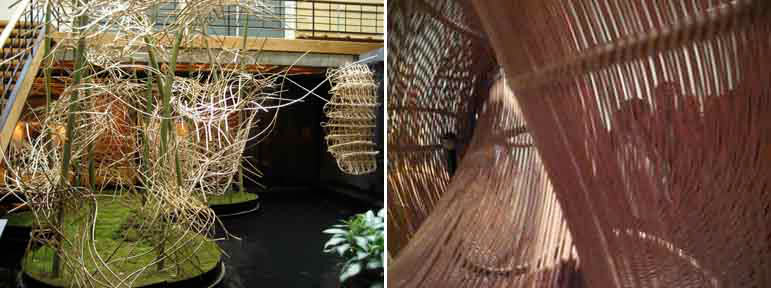
Above left: Enclosure by Kawana Tetsunori and Ribbon Candy by Stephen Talasnik. Right: Winding by Fujitsuka Shosei, detail.
The story unfolds in the upstairs galleries, where every way of shaping, sizing, coloring, and fastening strips and stalks of bamboo can be found. Curated by Japan Society's Vice President and Gallery Director Joe Earle, it begins with an array of pieces that can be imagined as containers or backgrounds for floral arrangements. In fact the opening piece, Outsized Flower Basket by Matsumoto Hafu, holds a Modernist arrangement of autumnal flora, but is meant to also stand alone as sculpture. Fashioned from wide strips of pale bamboo interwoven like an endless knot, its swooping bands are held in place with delicate bamboo ties.
The exhibition traces the development of this new art form, which has been around for only a couple of decades. Sequentially organized, it offers viewers a clear understanding of how a highly refined artisinal craft has been turned inside out, exploded, in a way, by artists who remain pretty much outside the mainstream of Japanese contemporary art.
In the lavishly illustrated catalog, Earle details the evolution of this fascinating genre and its practitioners, all but one of whom he has met and spent time with in the course of preparing the exhibition. Many of the artists, he explains, grow and prepare their own bamboo, which often takes longer than it does to create the work itself. Most came through the traditional art of basketry, having studied with master artisans or at one of Japan's schools and universities where traditional decorative arts are taught.
One of two women featured in the show, Tanabe Mitsuko, came from a traditional bamboo craft-world family. The expressive form and rough-hewn plaiting style of her pieces, while strongly sculptural, still evoke the idea of bamboo containers. Cappadocia, whose form refers to primitive Christian churches in eastern Turkey, is woven in a crudely speckled bamboo called torachiku, or "tiger bamboo."
The exuberant form some of these pieces take belies the transgressive nature of bamboo as a sculptural material. The last gallery presents work by younger artists, some of whom have adopted computer design software to re-envision the notoriously difficult material. Ueno Masao, for example, creates pieces whose sophisticated forms and finishes are unlike the traditional arts they spring from but honor the influence they have had on the artist through their subtle lacquer-and-gold finish. Originally trained as an architect, Masao has created many large-scale public pieces in England, China, and Thailand.
The 22 Japanese masters are joined by New York artist Stephen Talasnik. His six-foot-high sculptures called Ribbon Candy occupy the atrium wall opposite Kawana's Enclosure. Talasnik explores the linear quality of bamboo, using narrow strips to create the effect of an isometric ink-line drawing floating in space.
New Bamboo: Contemporary Japanese Masters is on view at Japan Society, 333 East 47th Street, New York, NY, through January 11, 2009. Please check the website or 212-715-1258 for related events, including docent tours, performances and educational programs. The exhibition can next be seen the Clark Center for Japanese Art, Hanford, CA, February 7 - May 9, 2009.