


Chris LaMarca's Forest Defenders
In Forest Defenders: The Confrontational American Landscape, photographer Christopher LaMarca has profiled the hidden reality of logging on public lands. An Oregonian with a degree in environmental studies and biology, he spent five years documenting protests against illegal logging in Forest Service-protected wilderness areas.
When La Marca learned that the Bush administration had rescinded the Roadless Area Conservation Rule, allowing the U.S. Forest Service to sell logging rights on a wilderness area designated for special protection, he contacted a friend who knew one of the activists. She agreed to take him into the forest where the protestors had set up camp. They had banded together after tens of thousands of letters from the public, and protests from the governor, had failed to halt illegal logging in Oregon.
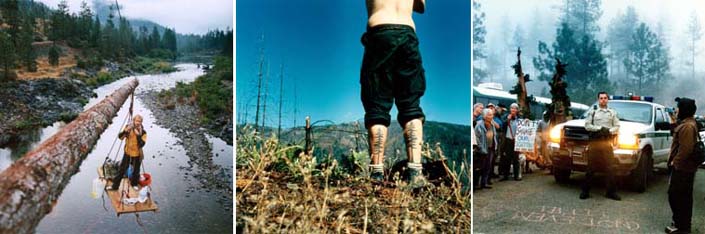
Left to right: Defender Laurel Sutherlin as he hangs from a tree blockading a bridge; defender Gedden scans the horizon for Forest Service activity;
forest defenders blocking a Forest Service access road in the Kalmiopsis Wilderness; all by Christopher LaMarca, Courtesy of Redux Pictures.
The activists, who were routinely characterized by lumber companies as "eco-terrorists," included college students, a lawyer, and a 72-year-old grandmother who had been a Freedom Rider during the Civil Rights movement. Some had learned the tactics of passive resistance during demonstrations against the 1998 World Trade Organization meeting in Seattle. Organized and determined to stop the illegal logging, they were prepared for a long haul.
I spoke with Chris last week to get a better understanding of these events, which seem to largely fly under the radar. "That's right," Chris said, "there is a serious disconnect between the public, the wilderness, and the media." He decided to make this a long-term project because there was so much at stake and no public forum to speak of.
This collection of photographs, and writings by the participants, unmasks a world of extremes: one of people dedicated to bringing public awareness to illegal actions by the government; of a logger who recognizes the impact his presence has on the wilderness; of local police and Forest Service officials using "pain tactics," including pepper spray, when arresting protesters; and what hard, dirty work it is to blockade an access road or to cut a 400-year-old tree. The highly charged atmosphere of a face-off between the Forest Service and the forest defenders vividly makes the point of how seriously the authorities take the protesters.
What began as passive resistance by a group of mostly local people became part of a landmark effort by 20 conservation organizations that finally resulted in successful lawsuits against the Bush administration by the governors of Oregon, California, Washington and New Mexico to reinstate the Roadless Area Conservation Rule.
A series of images from Forest Defenders is included in the exhibition Shifting Landscapes, now on view at powerHouse Arena. Chris LaMarca will be on hand at the reception tomorrow night, April 22, from 6:00 to 9:00, to sign copies of his book. powerHouse Books, 37 Main Street, Brooklyn. For information and directions, please visit the website or call 718.666.3049.