


Daniel Bauer: Landscape of Memory
As a young man, Daniel Bauer would ride a dirt bike through the hills near Modi'in, a new city mid-way between Jerusalem and Tel Aviv. Passersby walking along paths would shout at Daniel and his friends to be careful, to avoid falling into wells in an ancient Palestinian village that lay hidden beneath the grasses. During the installation of his first solo exhibition in New York, at the Andrea Meislin Gallery, the photographer said that he's been trying ever since to photograph these ancient hills.
On the wall before me is pair of large-scale color photographs, two from a triptych (below), that offers a sense of past, present and future in one view. To its left are two black-and-white photographs, made in the nearby desert, which depict eruv demarcations -- tall, spindly poles strung with twine that create symbolic boundaries that are observed during Sabbath rituals. Beyond the eruv are young trees in a "memory forest" planted by the Jewish National Fund. Daniel by now has explained the meaning and purpose of the eruv; I begin to notice them in almost every photograph.
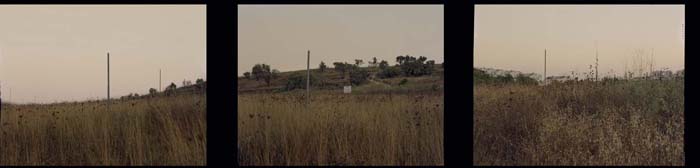
Daniel Bauer,
Sans Personne a Qui Parler, 2008, 59 x 39.5 inches, Chromogenic color print, Edition of 5. Courtesy of Andrea Meislin Gallery.
On an adjacent wall is a color image shot from the edge of the ancient Roman road that ran between Jerusalem and Tel Aviv but is today a 6-lane highway. On the right stand several eruv missing their twine and a pair of granite bollards placed by the Romans. Running through the middle is a sandy road that skirts Israel's Green Line, the Armistice line agreed to by Israel and its neighbors after the 1948 War of Independence.
Spread out on a high table is an eight-foot-wide panoramic view of a steep hillside near Jerusalem. Its title, Composed View #2 (detail), 2003 - 2008, offers clues needed to understand the meaning of these photographs and how they were made. Here, as Daniel explains, an Arab village on the right seems to be an organic part of the landscape while a Jewish settlement flaunts its modernity atop the crest of a hill to the left. The image was photographed in sections over a period of years, he said, so that he could take advantage of the landscape's coloration during the brief period between seasons: not scorched, as it is in summer, and not the bright green it can be at other times. By shifting the camera's placement along a linear trajectory, he has effectively flattened the image. The photograph demands to be read in the way a Japanese scroll is read: flat, spread out on a table.
The idea of gluing the panoramic image to a horizontal surface arose from the photographer's wish for viewers to read the picture carefully, not to simply glance at it and walk on. And once read as a group, the photographs suggest that all of the lines, roads, fences and partitions that carve their way through Israel have only symbolic value. In fact, says Daniel Bauer, there has never been an accurate map of Israel for this reason.
What gradually becomes evident through these photographs is the significance of place and placement; site and situation; land and landscape. Allusions to the history of photography also abound here, making this exhibition a fun scavenger hunt for references such as Henry Fox Talbot's Pencil of Nature, in which photographs become substitute drawings, and Frances Firth's Egypt and the Holy Land, with scenic views printed as ovals, like windows onto an exotic world. And for the present, according to the caption for the tabletop panoramic, "the image masks the crime in the sublime."
Daniel Bauer: The Combination of Limits runs through May 3, 2008 at the Andrea Meislin Gallery. The opening reception is Saturday March 22, from 6:00 - 8:00 pm.