


Robert Mapplethorpe in L.A.
In 2011 the J. Paul Getty Trust and the Los Angeles County Museum of Art jointly acquired art and archival materials by or associated with Robert Mapplethorpe. The vast majority was a generous gift from the Robert Mapplethorpe Foundation and the remainder was purchased with funds provided by the David Geffen Foundation and the Getty Trust. In Focus: Robert Mapplethorpe at the J. Paul Getty Trust and the Los Angeles County Museum of Art's concurrent show Robert Mapplethorpe: XYZ celebrate this landmark acquisition; both exhibitions continue through March 24, 2013.
The exhibition at the Getty showcases 23 images captured by the artist during the 1970s and 1980s, including a number of last edition prints, rarely seen mixed-media projects, and Mapplethorpe's signature Polaroids. The collection sweeps the spectrum of self-portraits, nudes and still lifes beginning with Mapplethorpe's early collaged work, demonstrating the artist's tendency to deconstruct the sexual, fetishistic images of magazines apparent in works like "Leatherman #1" and "Banana & Keys." The latter piece, a 1973 shadow box construction, reflects both the homoerotic iconography Mapplethorpe gravitated toward as well as the influence of his idol and predecessor, Andy Warhol.
Born in Queens, New York, Mapplethorpe studied graphic arts at Pratt Institute in Brooklyn. His early work included collage, found objects, and jewelry. Before he took up the camera, Mapplethorpe often used pictures he cut out of magazines as collaged elements to explore sexuality and eroticism.
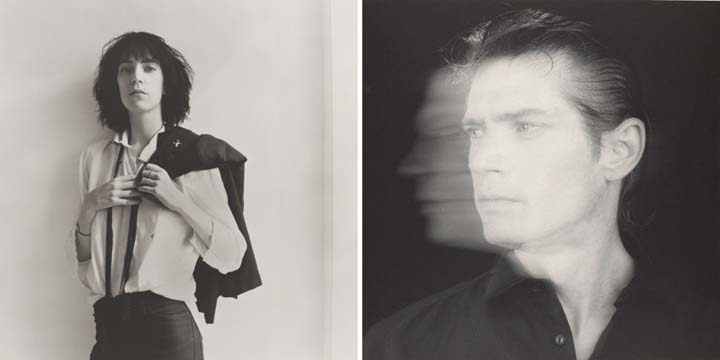
The mid-1970s marked the period in which Mapplethorpe turned almost exclusively to photography, shooting black and white portraits of close friends, models, and himself. The Getty exhibit features a number of key works from this era, including Mapplethorpe's first commercial portrait of Patti Smith, created as the cover for her 1975 debut rock album, Horses. The longtime friend and sometimes lover of the artist is shown in men's attire, outfitted in the androgynous stylings for which Mapplethorpe was famous. These intimate portraits are contrasted with the classically staged images he created a decade later in the 1980s. Reminiscent of the poses of ancient Greek art, Mapplethorpe's nude bodies of varying skin tones are seen arranged in pieces like "Ken and Lydia and Tyler" that provide striking visual representations that defy gender or racial categorization.
In 1972 Mapplethorpe met two influential curators: John McKendry, who gave him a Polaroid camera, and Samuel Wagstaff Jr., who became the artist's lover and mentor. By the mid-1970s, Mapplethorpe had acquired a medium format camera and began documenting New York's gay S&M community.
The X, Y, and Z Portfolios (published in 1978, 1978, and 1981, respectively), on view at LACMA, summarize Mapplethorpe’s ambitions as a fine-art photographer and contemporary artist. The portfolios were intended as an expression of the division of his mature work: homosexual sadomasochistic imagery (X); floral still lifes (Y); and nude portraits of African-American men (Z). Mapplethorpe’s work has consistently provoked strong reactions, notably during the so-called Culture Wars of the 1980s. The exhibition is an opportunity to assess Mapplethorpe’s confrontational photographs—with their paradoxical mix of classicizing, austere form and raw, uninhibited content—through three series that defined not only his artistic career, but also a moment in American cultural politics.
From 1970 until his untimely death in 1989, Mapplethorpe continually returned to the self-portrait as a means of expression. Inspired by a sculpture he had in his own collection, Mapplethorpe made this picture (r) as an experiment in motion. The double portrait that resulted represents a sharp break with his earlier self-depictions, in which he adopted various guises. This image suggests powerful awareness of the transience of life and his vulnerable position in the face of the AIDS crisis. Mapplethorpe died at age forty-two from complications of AIDS. A year earlier, he established a foundation to support the causes he believed in, such as art programs and HIV/AIDS prevention and care.
In order to consistently produce results that stood up to his high artistic standards, Robert Mapplethorpe exerted a great degree of control in his studio and over his models and portrait sitters. On Wednesday, January 9, 2013, 7 pm, a distinguished group of photographers, critics, and models who worked directly with Mapplethorpe join this panel to offer their insights into the methods, goals, and personality of the artist. Panelists include: photographer Brian English, former studio assistant to Mapplethorpe; photographer Judy Linn, professor of art at Vasaar College and a sitter for Mapplethorpe; and Robert Sherman, model for one of Mapplethorpe's most celebrated works. Moderated by writer and critic Philip Gefter, former Getty Museum scholar, former picture editor at the New York Times, and author of a forthcoming biography of Mapplethorpe's mentor, Sam Wagstaff. Free; reservations recommended. Call (310) 440-7300 or reserve online. The Getty Center is located at 1200 Getty Center Drive in Los Angeles, CA.
Photo credits
Left: Robert Mapplethorpe (American, 1946 - 1989) Patti Smith, negative 1975, Gelatin silver print. The J. Paul Getty Museum, Los Angeles, Jointly acquired
by the Los Angeles County Museum of Art, with funds provided by The David Geffen Foundation, and The J. Paul Getty Trust. © Robert Mapplethorpe Foundation.
Right: Self-Portrait, Robert Mapplethorpe, 1985. Jointly acquired by the Los Angeles County Museum of Art, with funds provided by The David Geffen Foundation, and The J. Paul Getty
Trust. © Robert Mapplethorpe Foundation.