


Jay DeFeo at SFMoMA
Before and since her death at 60 in 1989, Jay DeFeo's reputation has hinged on one colossal work: The Rose (1958-66), which belongs to the Whitney Museum of American Art. A retrospective currently on view at San Francisco Museum of Modern Art corrects that overemphasis as well as introducing DeFeo to a broad public as an artist of wide and diverse accomplishment.
Organized by the Whitney Museum of American Art, New York, the retrospective places The Rose in the context of her larger body of work, tracing DeFeo's visual concerns and motifs across more than four decades of art making. The San Francisco presentation is overseen by Corey Keller, curator of photography at SFMOMA.
"DeFeo is well known for her magnum opus, The Rose, but her full and complex oeuvre has not yet been given the serious consideration that it merits. This exhibition will be a revelation. A nationally recognized artist, she was also a major figure in the Bay Area art community, and beloved by many here, says Keller.
Born in 1929 in Hanover, New Hampshire, Jay DeFeo was one of the few women of her generation to rise to artistic prominence but one who has not been given her due until now. Her unconventional approach to materials and intensive, physical process makeDeFeo a unique figure in postwar American art and she defies easy categorization.
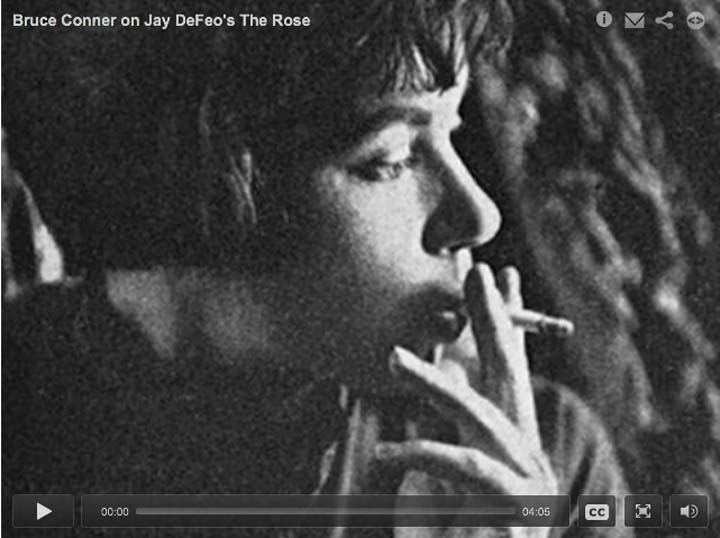
View Bruce Conner's film about Jay DeFeo.
DeFeo made her first mature body of work while traveling through Europe on a fellowship, shortly after graduating from the University of California, Berkeley, in 1951. Not long after her return in 1953, she settled among the San Francisco community of artists, poets, and musicians later labeled the Beat generation. Her larger circle of friends and peers included Wallace Berman, Joan Brown, Bruce Conner, Sonia Gechtoff, Ed Kienholz, and the artist Wally Hedrick, whom she married in 1954.
The legendary curator Walter Hopps was an early champion and he placed DeFeo's work in several gallery and museum exhibitions in the 1950s and 60s, among them the inaugural show of the Ferus Gallery in Los Angeles in 1957, which was followed by several other group shows and a solo presentation there in 1960. Dorothy Miller included DeFeo's work in the seminal 1959 Museum of Modern Art, New York, exhibition Sixteen Americans, alongside Frank Stella's black striped paintings and Jasper Johns's flags. At that moment DeFeo was among the most prominent women artists of her generation.
From 1958 to 1966, DeFeo worked almost exclusively on The Rose, and when she finished, the work consisted of so many layers of paint that it weighed close to one ton. Exhausted, both physically and mentally, DeFeo then took a three-year hiatus from making art and largely faded from the public's consciousness. It was only after The Rose was finally given a museum exhibition in 1969 at the Pasadena Art Museum, which then traveled to SFMOMA (then the San Francisco Museum of Art) the same year, that she began working again.
During the 1970s, DeFeo lived in Larkspur, California, and taught at several Bay Area schools and, for a time, at SFMOMA. She resumed making art and worked prolifically, exploring photography in depth and incorporating it into her practice in innovative ways. A 1973 National Endowment for the Arts grant allowed her to further pursue her photographic experiments and she created a highly inventive body of hybrid works on paper.
Although DeFeo worked spontaneously, her paintings, drawings, and photo-collages evolved through a slow technique of building up an image and then reworking it, or erasing it and starting all over again. This open-ended process, which the artist described as a "cliff-hanging experience," allowed for highly expressionistic forms and an astonishing range of surface modulation. Yet DeFeo'sintuitive and expansive method of working was tempered by her sense of compositional order and an often restrained grisaille palette. It is this state of balance, between carefully composed images and lush surfaces, expressive forms and subtle coloring, that intensifies her unique and utterly compelling body of work.
In 1981 DeFeo moved to Oakland and joined the faculty of Mills College, where she was awarded tenure in 1986 and taught until her death. She continued to produce art and was the subject of several significant shows including a 1984 solo presentation at the San Francisco Art Institute as the recipient of the Adaline Kent Award and a 1989 exhibition, Jay DeFeo: Works on Paper, at the Berkeley Art Museum.
Jay DeFeo: A Retrospective continues through February 3, 2013 at San Francisco Museum of Art. 151 Third St., San Francisco, CA. Following its presentation at SFMOMA, the exhibition will be shown at the Whitney Museum of American Art from February 28 through June 2, 2013.