


Mysteries of Life Explained, Saturday in Brooklyn
If you were one of those kids who began nearly every sentence with “why,” a new book called The Where, the Why, and the How: 75 Artists Illustrate Wondrous Mysteries of Science is just what you’ve been waiting for. This self-described "science book like no other," The Where, the Why, and the How attempts to answer 75 "unanswered" questions like "What existed before the big bang?," "Why do we dream?," and "Can evolution outpace climate change?" in a fun and informative way.
A trio of illustrators and animators, Julia Rothman, Jenny Volvoski and Matt Lamothe, who formed ALSO, a small company to produced books, print projects, and websites, invited a group of 75 artists and a number of scientists to get down to the questions that bug us, from how we got here to where we are going.
Some of the biggest (and smallest) mysteries of the natural world are explained in essays by working scientists, which are then illustrated by artists given free rein to be as literal or as imaginative as they like.
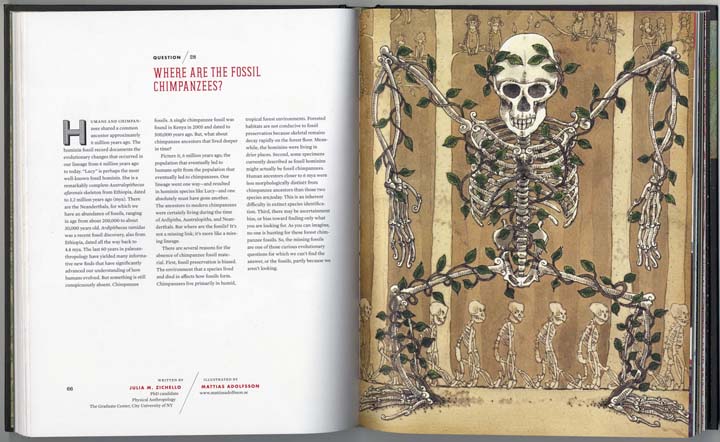
For example, the question “Where are the Fossil Chimpanzees?” is answered by Julia M. Zichello, a PhD candidate in Physical Anthropology at CCNY, who writes, “There are several reasons for the absence of chimpanzee fossil material. First, fossil preservation is biased. The environment that a species lived and died in affects how fossils form. Chimpanzees live primarily in humid, tropical forest environments. Forested habitats are not conducive to fossil preservation because skeletal remains decay rapidly on the forest floor….So the missing fossils are one of those curious evolutionary questions for which we can’t find the answer, or the fossils, partly because we aren’t looking.”
The accompanying illustration by Mattias Adolfsson is a elegy for chimps, almost an evocation for a primate Day of the Dead celebration.
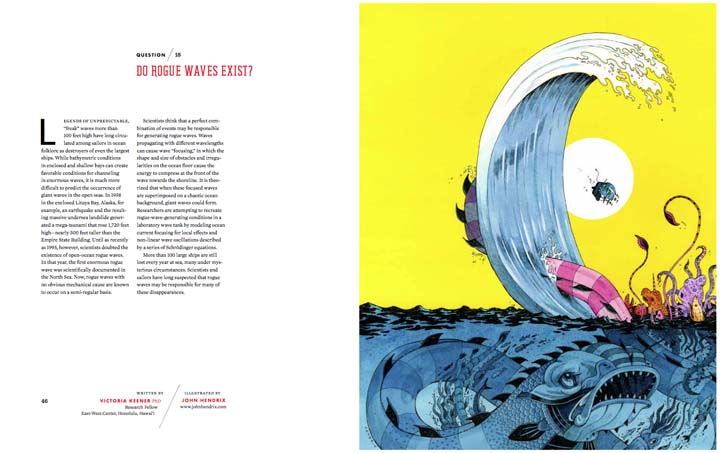
If you’ve been wondering if rogue waves exist, your question is answered by Victoria Keener, PhD, who is a research fellow at the East-West Center in Hawaii. The illustration by John Hendrix, the master of disaster, might inspire colorful nightmares for anyone headed on a tropical seaside vacation. [his work on AI-AP.com]
One of my favorites, “How do migrating birds and animals find their way home?” is answered by Alex Gershenson, who explains that they do so in variety of ways - from using the stars for navigation, using the earth's magnetic fields, or in the case of sea turtles, by following almost indistinguishable traces of soil. The text is accompanied by a sublime illustration by Harriet Russell that is informed by her interpretation Earth’s magnetic field. [see her work on AI-AP.com]
The book is a celebration of the wonder that inspires every new discovery. Featuring work by such luminaries as Jordin Isip, Lisa Congdon, Jen Corace, Neil Farber, Susie Ghahremani, Jeremyville, Jon Klassen, Jacob Magraw, and many more, this is a work of scientific and artistic exploration to pique the interest of both the intellectually and imaginatively curious. And if you have children like the one described above, the book could help you save face for years to come.
You can meet Julia Rothman this Saturday at a book signing, at 2 pm: The Where, the Why, and the How | 75 Artists Illustrate Wondrous Mysteries of Science (Chronicle Books 2012) with Brooklyn author/illustrator Julia Rothman. Brooklyn Museum Shop, 200 Eastern Parkway, main floor, Brooklyn, NY. Information.