


Talbot's World at Hans P. Kraus, Jr.
It is a little bit of magic, realized: of natural magic. You make the powers of nature work for you, and no wonder that your work is well and quickly done….But after all, what is nature but one great field of wonders past our comprehension?
William Henry Fox Talbot (1800-1877)) spoke of his invention of photography as if it were a fairy tale in his presentation to a group of London scientists, in 1839. While the “official” invention of photography is credited to Louis-Jacques-Mandé Daguerre, with the introduction of the Daguerreotype in Paris in 1939, Talbot had been making “sun pictures”—images on paper exposed by sunlight—since the early 1830s. In 1841, he would introduce the first photographic multiples, which he called “calotypes.”
Talbot was a member of the landed gentry, and as such, managed the family estate, Lacock Abbey, and became a member of Parliament. But his work as a scientist was his passion. He was well known in his lifetime for his contributions to the fields of optics, chemistry, botany, and mathematics as well as photography. Even before his invention of the calotype, for which he consulted leading scientists among his circle, including Michael Faraday, Talbot was involved in the study of phosphorescence as a natural phenomenon. He was on to the magic of nature and devoted his life to revealing its elusive forms as multiple images on paper.
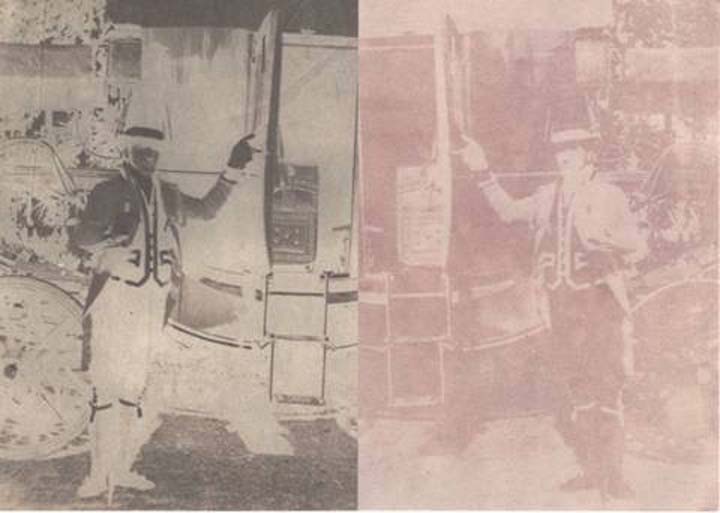
William Henry Fox Talbot, Footman at Carriage Door (details), calotype negative and its salt print, 14 October 1840. CourtesyHans P. Kraus Jr. | Fine Photography.
Currently on view at Hans P. Kraus Jr. | Fine Photographs is a luminous exhibition that brings together one of Talbot’s early botanical studies—a photogenic drawing negative of a maidenhair fern from around 1839—along with some of the earliest pairs of paper negatives and positive prints made in 1839 and the early 1840s. Among them is an image of a footman standing by an elegantly outfitted state carriage (above). In his introduction to the catalogue, Mr. Kraus writes, “I have retained this negative for more than twenty years waiting to join it with a suitable print. This animated picture is the first significant photograph on paper depicting a standing human figure."
Two Men in the North Courtyard of Lacock Abbey, 1841-1844, is a staged narrative composition capturing a daily scene at the Abbey. The main characters are shown in a staged but surprisingly natural pose considering the several seconds needed for making this calotype negative. It survives in perfect condition, together with a salt print. Talbot’s calotype marked the shift from the printing-out to the developing-out process, in which a latent image produced in the camera was turned into a visible image through chemical development.
The title of this exhibition is drawn from a recently discovered 1839 pamphlet by Talbot, A Description of the Instruments Employed in the Gallery of Natural Magic. As Talbot scholar Larry J. Schaaf writes in the exhibition catalogue, “No one was more surprised at the magical dimensions of photography than the inventor himself, William Henry Fox Talbot. His scientific side realized that he had simply harnessed natural magic. Everything that he had accomplished could be explained within Nature’s laws, yet that made the new art no less a marvel to him.”
The exhibition Talbot’s World: A Gallery of Natural Magic has been extended through Friday, November 16th. Hans P. Kraus Jr. | Fine Photographs. 962 Park Avenue, NY, NY. Information.