


A Robert Adams Retrospective + New Work
Since the late 1960s, Robert Adams has made the American West the subject of his work, both as a photographer and as a writer. Although his landscapes often record the uneasy meeting of nature and human culture, Adams does not shoot from a position of moral outrage. He sees prefab houses, gas stations, and industrial plants for what they are: characteristic aspects of the region where he lives.
In The New West, (1974), Adams explored housing tracts that were being built along Colorado’s Front Range in the late 1960s and early 1970s. The developments filled with people who had migrated west in search of a new Eden, only to discover themselves isolated in an artificial landscape. "People had moved [to Denver] to enjoy nature,” Adams wrote, “but found that nature was mostly inaccessible except on weekends."

Left: Pikes Peak, Colorado Springs, Colorado, 1969. Right: New development on a former citrus-growing estate, Highland, California, 1983. © Robert Adams, courtesy Yale University Art Gallery.
Striving for “an unarguably right relationship of shape, a visual stability in which all components are equally important,” Adams articulates his photographs with formal qualities that seem at odds with their content. Even in his pictures of roadside utility depots and service stations, a sense of proportion and balance gives dignity to the banal structures; nature still exerts a surprising grace, seen here in the rolling foothills of Colorado’s Front Range.
Certain elements of this new landscape recur in Adams' photographs: the uniform, boxy houses, concrete, cars, and dirt plots, as well as the loneliness and isolation that attend rapid suburban growth. The photographs in The New West exemplify Adams vision of the confluence of harmony and discord, of beauty in the commonplace. "The subject of these pictures is...the source of all Form, light," he wrote. "I love the light," underscoring that the deeper subject of these pictures is not the tract homes or freeways they depict but the shape of those features that define the places where we live.
This seemingly simple statement, the minimal content of his photographs, combined with his mastery of black-and-white printing that primarily features a wealth of lush middle tones, was baffling at the time they first began appearing, in the early 1970s. The other Adams, Ansel (no relation), had claimed the American West as a place of unbounded beauty, majestic peaks, and pristine wilderness. It took a while for the brilliance of Robert Adams’ photography to become ingrained in the thought and practice of his contemporaries and their viewers.

Left: Clatsop County, Oregon, 1999–2003. Right: Old-growth stump, Coos County, Oregon, 1999–2003. © Robert Adams, courtesy Yale University Art Gallery.
Fast forward nearly four decades: this seems to be the Year of Robert Adams. During the summer, he finalized a selection of 169 prints from his own archive for the National Gallery of Art to acquire. As reported in The New York Times, his choices not only chart his entire career, they also complement the 25 images by him that the museum already owns.
A retrospective of Adams’ work continues at the Yale University Art Gallery until October 28th. The exhibition features over three hundred prints from the Gallery’s master sets of the photographer’s work, along with a large selection of his monographs. The exhibition traces Adams’s deep engagement with the geography of the American West, weaving together various aspects of his work into a cohesive, epic narrative of the American experience.
Part of his own experience is of deforestation, in particular, of clear-cutting in his adopted state. A series titled “Clatsop County, Oregon” (1999-2003) shows the devastation brought on by this practice. Mr. Adams writes, “As I recorded these scenes, I found myself asking many questions, among them: What of equivalent value have we inherited in exchange for the original forest? Is there a relationship between clear-cutting and war, the landscape of the one being in some respects like the landscape of the other? Does clear-cutting originate in disrespect? Does it teach violence? Does it contribute to nihilism? Why did I never meet parents walking there with their children?”
Robert Adams: The Place We Live, a Retrospective Selection of Photographs continues at the Yale University Art Gallery, 1111 Chapel Street, New Haven, through Oct. 28. For information: (203) 432-0600. The exhibition has been seen in Vancouver, Denver, and Los Angeles prior to its stop in New Haven. It begins its European tour in January 2012. Information. The exhibition catalogue, a 3-volume set, is available from Yale University Press, as well as several of Adams’ monographs.
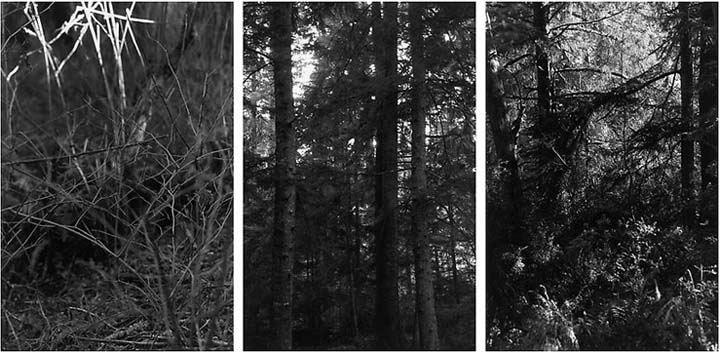
Robert Adams, Light Balances (VA-C), 2001-2012. © the artist, courtesy Matthew Marks Gallery.
Matthew Marks Gallery, in Chelsea, is currently presenting two new bodies of work by Robert Adams that reveal the clarity of his vision and his passionate commitment to nature (as described by William Henry Fox Talbot) as a “field of wonders past our comprehension.” Light Balances, a group of 50 photographs of deeply forested terrain, capture the essence of his earlier statement about the form-giving qualities of light. Images of trees alone in the forest, with light drifting among their branches from different points of the compass to define their leaves, trunks, and rootedness, present the magic of photography in physical terms, with effortless beauty.
In a separate room, a group of images from the series “On Any Given Day in Spring” offer a lyrical view of the ocean’s edge, with flocks of seabirds flying, landing and taking off, or riding the waves under endless skies defined by towering cloud formations. A group of three close-up photographs of their tracks in the sand could be read as a metaphor for the individual as an essential force in society, whether avian or human. The title comes from Adams’ statement, “There is no certainty, on any given day in spring, that the birds will be there,” due to the dramatic decline of eelgrass, which the birds depend on for their survival.
Robert Adams: On Any Given Day in Spring and Light Balances continues through November 3rd at Matthew Marks Gallery, 523 West 24th Street, NY, NY.