


Tobogganing in Afghanistan
Kandahar Air Field (KAF), Kandahar Province, Afghanistan. I am sitting in a small corner of shade on the edge of the runway at KAF. My flight has been pushed to the right once already this morning.
Four days ago I began a seemingly never-ending travel odyssey with a ride down from the budding Tur-Muryani strongpoint, which will — when complete — overlook Mizan Valley in Zabul Province. I shook the hands of the U.S. Security Force Assistance Team (SFAT) 42 members, who are be stuck up there for at least a week more. “It was great, guys. Thanks.”
Somehow Sgt. Patton kept us in the dust as huge boulders on either side of the “road’ whipped by at ever-increasing speeds. We hit the flat at the bottom doing 60 km/h, somehow held onto the gravel beneath enough to make a fork in the road, and slowed to a not particularly graceful halt. Sgt. Patton had either almost killed me or just saved my life.
I rode the rest of the way out along the road – it had been registered ‘black,’ meaning nothing like secure – standing up in the back of the Gator, filming with a helmet Camera [view]. The road was now under constant over watch, but in the moon-dust-like sand it takes only seconds for someone to place an Improvised Explosive Device (IED).
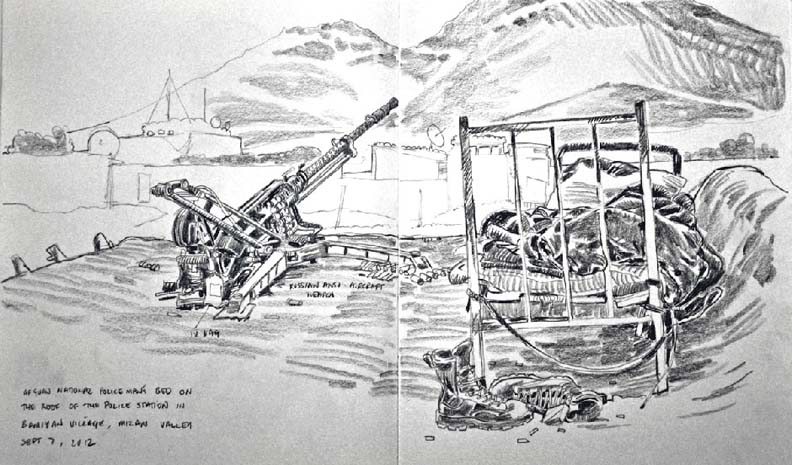
The bed of an Afghan National Policeman on the road of the police station in Bamiyan Village, Mizan Valley, September 7, 2012.
I had enough time to get cleaned up, feel thoroughly refreshed and grab some food before I found myself sitting on the gravel Helicopter Landing Zone waiting on a scheduled ride out. Almost four hours later, sweating, sunburned and smelly again I realized that no helicopter was coming.
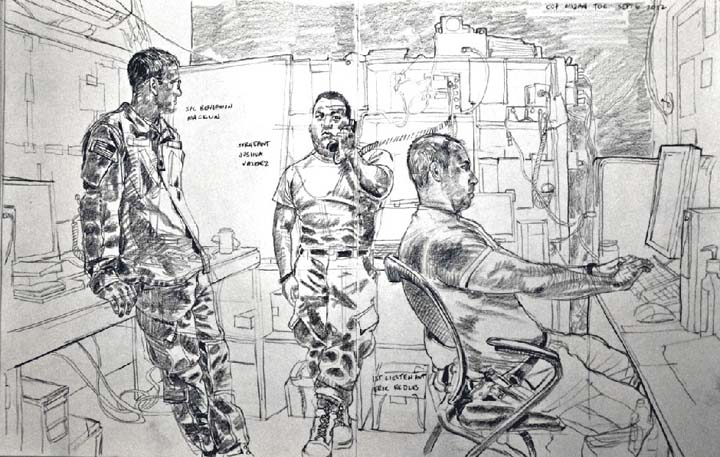
I spent the evening in the Tactical Operations Centre killing time and sketching while a variety of U.S. soldiers coordinated a mortar team in support of the guys on Tur-Muriyani hill (below).
Everything happens for a reason – I guess. The next morning – thanks to my delay – I attended a shura of local villagers organized and led by Afghan National Army Colonel Altafullah of the 6th Kandak. It was an opportunity for him to smooth the ruffled feathers of the purported civilians who were now trapped in a ‘no man’s land’ between the ANA on Tur-Muryani and the Taliban on the other side of the Arghandab River Valley.
The all-male crowd contained a large number of fighting age men – something that had been missing on my patrols through the villages in the Valley. The meeting took place under the large spreading branches of a tree in the courtyard of the local Afghan Uniform Police (AUP). About 100 almost entirely bearded men waited for to Colonel Altafullah talk.
When the Colonel arrives, the first question from the villagers is, “Why did you not bring chai (tea)?” The Colonel, clearly annoyed, replies, “I just came from a mission, we sent out an ANP on a motorcycle to tell anyone to come to this shura, and someone set off an IED near him.”
The colonel sits on a chair in the sun. Everyone else is kneeling or squatting under the tree. The crowd seems neither hostile nor friendly. For a few minutes no one says anything. Then Colonel Altafullah speaks.
“We have to keep our friendship. All of Afghan people are proud and they have pride in being Afghan. We want to promote our country and keep our friendship. We should be all the time working together. I am trying now to provide security to make that happen,” he said.
Trust between the villagers — who have been living just outside the area of influence of the Government of Afghanistan – and the Afghan National Army (ANA) and AUP who have been being attacked nightly from in and around these same villagers’ homes and compounds, is a little fragile.
“The ANA is working for you. We should talk about peace. The ANA is part of your government. The Taliban are fighting against the Afghan government but the government is saying ‘Come and make peace with us. Put your weapons away and come and join the ANA or be a farmer.’ Only through this diplomacy can we be successful,” the Colonel said.
The U.S. SFAT and ISAF forces keep themselves to the far background.
As a show of trust, no one is wearing body armour. I feel naked. The ISAF forces are here to observe only, in a show of commitment, not a show of force. There are guards from all branches on the surrounding rooftops, and each high-ranking officer has his own security. All are watching for outside threats, while also keeping a wary eye on those around them. All are armed. More.
Editor's note: This article originally appeared in the National Post on September 10th.
The National Post’s Richard Johnson is on his third tour of Afghanistan. Work from his earlier assignments won international awards and a place in the Smithsonian Museum’s permanent collection.Follow his work here nationalpost.com/kandaharjournalOn Twitter at @newsillustratorOr see more of his work here at newsillustrator.comOr contact Richard in the field atkandaharartist@gmail.com