


Photography for Insomniacs
One of the fun workshops being offered at Photoville this weekend is How to Make a Camera out of Anything, presented by Liz Sales, an instructor at the International Center of Photography. But if this Brooklyn destination is not on your calendar, you can still get in on this DIY craze with Pinhole Cameras, a Do-It-Yourself Guide (Princeton Architectural Press), by Chris Keeney.
The author covers every aspect of this age-old method of making photographs, with sound advice at every step along the way. “To enter the world of pinhole photography is to leave behind the concept of perfect, blemish-free photographs,” he writes in the Introduction. With this sound advice, backed up by an inspiring quote from the legendary photographer Minor White, the reader is set free to explore and innovate in ways that are just about the opposite of high-priced “gearhead” photography.
Keeney covers the history of pinhole photography (complete with a timeline), then gets down to the essentials from Finding the Right Container for Your Camera (my favorite: a Spam can) to Film or Paper Negative, to How to Make a Pinhole. With the basics covered in detail, but with stunning brevity, he offers, in “case study” style, eight different types of construction, along with everything you need to know about how to build it, how to use it, and what kinds of camera effects are unique to each model.
You can start with a basic camera using a matchbox, with a shutter envelope made out of file-folder stock, and a 35-mm film winder. At this level of simplicity, there’s also an Altoids-tin model, a Quaker Oats cereal box model, and a standard shoebox model. Moving up the technology scale is the PinHolga for those who yearn for medium-format 120-mm film. For this one, the author includes a recipe to block light leaks: equal parts of India ink and Elmer’s glue; you can’t go wrong with this kind of attention to detail that Keeney provides throughout this engaging book. At the technological pinnacle, you are offered the DSLR Pinhole camera, and I won’t spoil the fun of discovery for this one.
This is an analog environment at its best, using tools you probably thought were extinct, such as the X-ACTO knife, along with household items like bamboo barbeque skewers. Keeney makes suggestions about film processing to avoid—or embrace—the kind of mishaps that are likely to occur with automatic printing systems. And one of the best how-to’s will get you a tripod mount made out of common hardware-store items.
The closing chapters include a Gallery of pinhole camera images in color and black-and-white; Practical and Creative Tips to get the most out of pinhole photography; Darkroom Procedures; a Glossary; and the Pinhole Toolbox, an illustrated matrix of 64 items that will surely come in handy in the pursuit of lens-free photography. At the level embraced by Keeney, pinhole photography is not for the casual snap-shooter; in fact, it would be an ideal photo-obsession for the sleep-impaired.
The book is built to stand up to constant pawing, with heavy cover-stock pages and a giant Double-Wiro binding so the pages always lie flat. Designed by Deb Wood, the clean, gridded layout, bold typography, and restrained use of color make the content both accessible and inviting. Information.
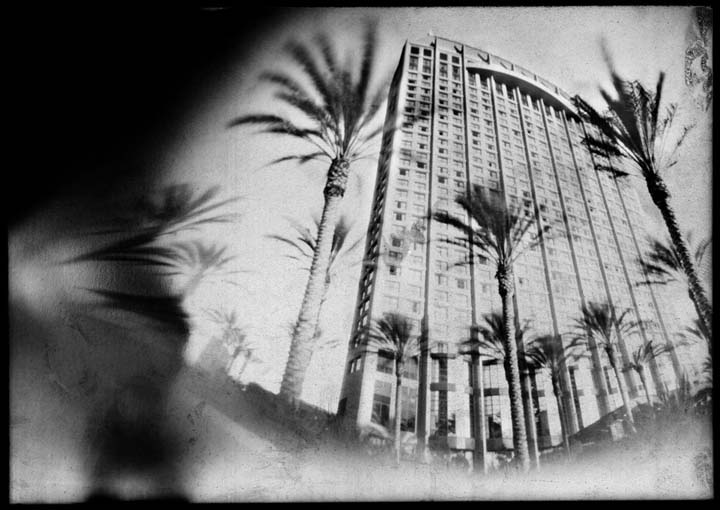
Above: 5x7 photographic paper negative pinhole photograph of buildings in downtown San Diego created with coffee can pinhole camera, by Chris Keeney. A graduate of the Rochester Institute of Technology, Chris Keeney is a professional photographer living and working in San Diego, California. Although schooled in analog film and paper photography, he now uses digital photographic processes in his professional work, but enjoys the spontaneity and creative freedom of making his own DIY pinhole cameras.