


Textile Pioneers at Japan Society
Major exhibitions on fiber arts don’t come along very often. But when the do, as with Slashed: Paper Under the Knife, at Museum of Arts and Design in 2009, they offer art lovers a fresh and often challenging way of looking at sculptural form.
Fiber Futures: Japan’s Textile Pioneers, currently on view at Japan Society, offers not only a privileged view of some of the top contemporary Japanese artists in the field, but also a series of public programs in which participants can get their hands and spirits into some of the remarkable ideas and materials to be found in the show.
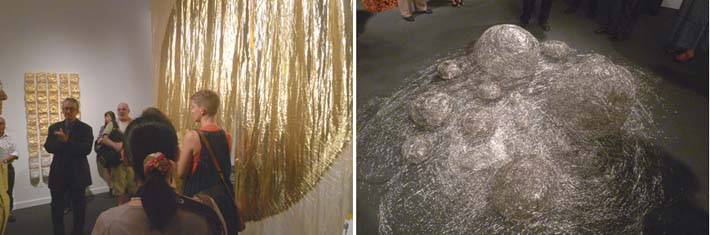
Left: Director of Galleries, Joe Earl, leads a walkthrough of Fiber Futures: Japan’s Textile Pioneers. Shop curtain by Jun’ichi Arai at right. Right: Toki no katachi (The Shape of Time) by Kyoko Kumai. Photos: Peggy Roalf.
The 30 artists represented in the show were chosen by a jury that met at the Tama Art University, which included Joe Earle, Director of Japan Society Gallery and curator of the exhibition. In the walk-through last week he said that four jurors working independently unanimously selected 52 of the 57 works finally included.
The pieces on display range from the finest of silk threads delicately combined into three-dimensional form by Yasuky Iyanaga to a house with a fiber roof by Dai Fujiwara, the creative director of Issye Miyake Studio.
What makes this show so engaging is the variety of approaches and the different materials that come into play. According to Earle, the Japanese Folk Craft ethic of letting materials tell the artist what to do next, in the sprit of tariki, a Buddist term meaning the ‘power of another,’ is often evident.
“The very qualities that are unique to fabric inspire me and my fellow artists to try to move beyond mere technical mastery to create daring and beautiful works of art,” says Hiroko Watanabe, a professor at Tama Art University and one of the artists represented in Fiber Futures.
The only object on display that can be touched is an eye-popping pair of “shop curtains” (above left) that are 11 by 11 feet and made from a filmy gold and silver cloth created through a technically complex process, invented in part by the artist, Jun’ichi Arai. The first of the two curtains forms the entrance to the gallery where the exhibition begins.
In some cases, reusing – and abusing – old materials is part of the artists’ intent, including a work by Hideho Tanaka called Vanishing and Emerging. Cotton sandwiched between painted paper, then stitched into squares, creates an undulating elliptical form; the edges of the squares are burned, transforming the materials yet again, and creating another type of surface.
The abuse of fabric becomes part of the meaning of the artwork in the case of Kazuyo Onoyama’s Orikata (Folded Form). Here the artist has taken a thin yellow polyester fabric and folded it over and over, much like the Origami practice of folding a thousand cranes to pray for recovery from illness. The artist says this work is “a prayer for happiness, peace, abundance and good health, and an expression of the close relationship that should exist between human life and our natural environment.”
Fiber Futures: Japan’s Textile Pioneers continues through December 18th at Japan Society. 333 East 47th Street, NY, NY. A series of public programs, including an evening with Dai Fujiwara on November 17th; a shibori- dying workshop on December 3rd; and an embroidery workshop with Joetta Maue, on December 10th, among others. Information.
09232011