


Letter from Shanghai
MY WIFE VIVIENNE FLESHER AND I ARE IN SHANGHAI for the week to celebrate the opening of my show at Jianwei Fong's Stir Art Gallery, and he's giving us a tour of the city. "My driving has improved since I moved to China," says Jianwei, as he turns 90 degrees to the right, cutting across five lanes of oncoming traffic. Then he speeds down a one-way street in the wrong direction and veers sharply into a gas station, almost hitting three cars along the way. "But when I return to the U.S.A., I must remind myself to follow the rules."
The next day we visit Sing Lin, formerly of Chronicle Books, and his wife Anita Luu, formerly of Pentagram. They moved here recently from San Francisco to open a branch of their office, Affiche Design. Sing says they find Shanghai energizing. "I feel like a cowboy," he says. "People here don't get upset when others break the rules, in driving or anything else, as long as it works and no one gets hurt."
"In San Francisco," Anita explains, "we did good work, but there was a lack of excitement. Here there is no status quo and it doesn't take a lot of money to do things. If Shanghai doesn't already have something, you can simply start it yourself."
The local government wants to make Shanghai into an arts center, so they've encouraged clusters of artists' studios, like M50. On a visit there we find corridor after corridor of rooms occupied by artists trying to become China's Next Big Thing. Frankly, we weren't impressed. But on Tai Kang Road, we visit The Pottery Workshop, where owner Caroline Chang shows amazing pottery by Japanese, American, British, and local artists.
But today, Ms. Chang's concern is safety, not aesthetics. Across the street pilings being driven for a new skyscraper are rocking her building, opening cracks in the walls and causing a water heater to tumble onto the floor. "We're afraid not just for the ceramics but for our lives," she complains.
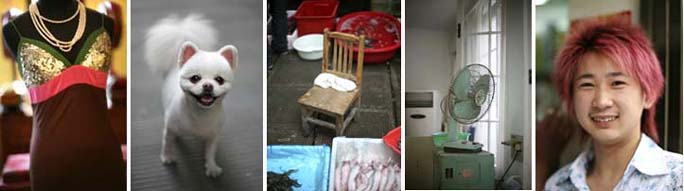
Everywhere in town old is giving way to new, with little concern for safety or aesthetics. High-rises mix architectural styles wildly, and at night they are lit with thousands of colored lights which change frequently: 50 stories of pink, then yellow, green, blue. It's exciting, funny, visually cacophonic. Photos above: Vivienne Flesher's views of Shanghai
All of which is the opposite of Jeremy Kuo's Spin, a store of exquisite and austere ceramics which are highly influenced by Japanese aesthetics but remain somehow Chinese. "Locals don't appreciate our plain ceramics," says Kuo, formerly of Boston, "but foreigners love them."
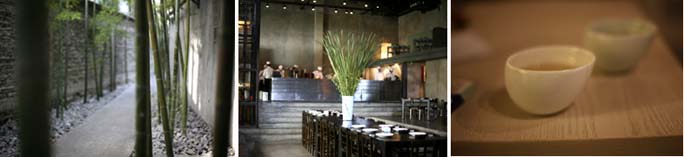
And we love the style of his two restaurants across the street, both hidden within an ordinary building at 803 and 805 Ju-Lu Road. There is no signage, just unmarked openings in the facade through which one enters. Shintori, a cavernous Japanese restaurant of great beauty, lies at the end of a bamboo-lined walkway. Ying Qi, a Chinese restaurant, has two heavy solid doors on each side of a grid of circular holes in the wall. To get in, one must intuit that a hand placed in the correct hole will cause the door to open, soundlessly. Similarly, the bathroom door handles seem unremarkable, except that they don't work. But when you push the side of the door where there should be hinges, the doors swing open - to a darkened room whose lights turn on only after the door is closed and locked. Magic! And funny. And strange. Like Shanghai itself. Photos above, left to right: Ju-Lu Road; interior of Shintori restaurant; tea at Jeremy Kuo's Spin. Photos: Vivienne Flesher.
Artists Ward Schumaker and Vivienne Flesher live and work in San Francisco.