


Isaac Mizrahi at The Jewish Museum
Isaac Mizrahi's quintessentially New York style—as a designer, an artist and an entrepreneur—is on view in an exhibition of his life’s work, so far, opening Friday at The Jewish Museum. Aptly titled Isaac Mizrahi: An Unruly History, the show highlights his witty and intelligent mix of high and low, which extends from the runway to stage and television in a mashup of ideas and materials that, in other hands might result in mishap. Here, in a presentation encased in a shimmering wrap that effectively erases the museum’s wood-paneled walls, the workings of his multi-platform creativity become evident.
Visitors are greeted by a 30-foot wall of fabric samples, a spectrum of colorful elements framed in a grid that introduce one of Mizrahi's signature differences—his use of color in an arena often cloaked in restrained neutral tones. “Color is the biggest luxury there is,” he said, and went on to prove it in his first collection for Isaac Mizrahi New York, the label he produced between 1987 and 1998.
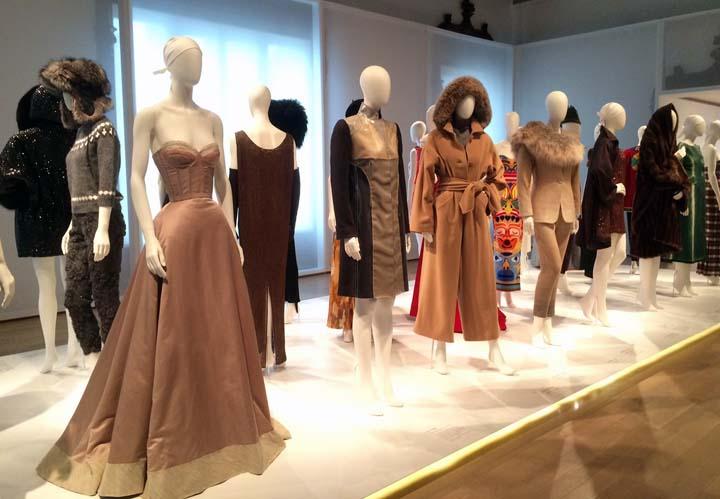
The first gallery presents about 20 “looks” he created for the line, including Ballgown Sport, a lavish rose taffeta skirt with a train topped with a cotton T-shirt which became a fashion icon; Swirl, Mizrahi's 1990 collaboration with artist Maira Kalman, inspired by Henri Matisse’s designs for the Ballet Russes; and Desert Storm, a camouflage-printed halter dress that responded to the 1990 Persian Gulf War.
A small space crammed with more than 100 of his “sketches”—highly refined gouache drawings, in fact—reveal his working methods, from
his way of designing directly on the model to the orchestration of his runway shows. Next is a selection of Nick Waplington’s behind-the-scene photographs of the designer in studio, with
the girls for whom the term “super model” was invented—among them, Linda Evangelista and Naomi Campbell—along with the chameleon-like Stella Tennant. A second group of 20 or so
designs includes High and Low, Mizrahi's diffusion-line 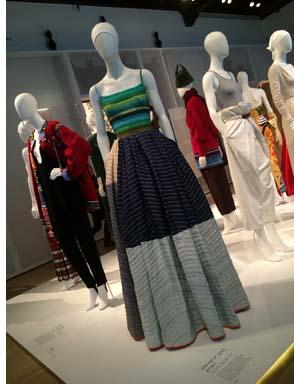 sweater
for Target paired with re-embroidered lace pants; Elevator Pad Gown, 2003, which riffs on a commonplace but executed in delicate silk and grosgrain ribbon, and TEE PEE, a
beaded shearling coat that tops a black catsuit.
sweater
for Target paired with re-embroidered lace pants; Elevator Pad Gown, 2003, which riffs on a commonplace but executed in delicate silk and grosgrain ribbon, and TEE PEE, a
beaded shearling coat that tops a black catsuit.
Mizrahi's designs for theater, ballet, opera and television are grouped in a room with a monitor displaying his chosen venues, which include the Mark Morris Dance Group and Project Runway. Since 2007 he has directed and narrated Prokofiev’s Peter and the Wolf at the Guggenheim, with different sets and costumes for each production. Currently, the designer has a regular spot on the QVC network and is working on a TV series of his own. In another area, his designs for shoes (executed by Christian Louboutin), jewelry (a necklace combining Central Park rocks and platinum bibelots), and accessories (a skunk-like riff on the ‘50s mink stole) and his signature star-of-David belts, are on display.
The show concludes with a three-panel room-size video installation with excerpts from Mizrahi's runway shows, the film Unzipped, and Project Runway among others, as well as archival film clips that have inspired his designs.
Isaac Mizrahi: An Unruly History is organized by guest curator Chee Pearlman, with Kelly Taxter, Assistant Curator at The Jewish Museum. It runs from March 18 to August 7, 2016. Info A series of public programs begins on April 7, when Isaac Mizrahi speaks with Wendy Goodman, Design Editor of New York magazine. Info A fully illustrated exhibition catalogue, published by Yale University Press is now in stores. Info Russ & Daughters Café is now open at The Jewish Museum. Info Photos: Peggy Roalf