


Robert Frank: The Americans
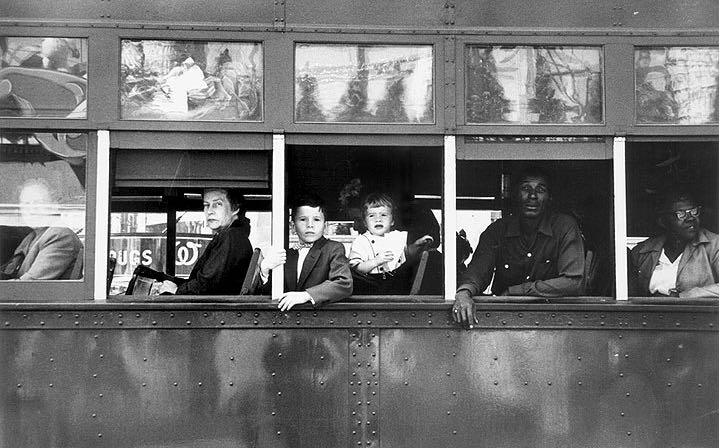
Following presentations in Los Angeles, San Francisco, Paris and New York, Sotheby's will offer a
collection of 77 of the 83 photographs from Robert Frank's The Americans tonight.
Published in 1959, after Frank made several cross-country road trips funded by his first Guggenheim Fellowship, The Americans changed the approach to picture-making by documentary photographers in the second half of the 20th century.
Frank's unorthodox shooting-from-the-hip style, however, was not appreciated at the time. Popular Photography magazine skewered Frank's black-and-white photos of bar rooms, political rallies, and lonely hotel rooms for both their their commonplace subject matter and "meaningless blur, grain, muddy exposures, drunken horizons and general sloppiness." But his work was taken up by visual artists, musicians and writers of the Beat Generation, who felt a kinship with Frank's free-wheeling approach to documenting the social fabric of the time. And it paved the way for photographers like Diane Arbus, Garry Winogrand, and Joel Meyerowitz, who said, "It was the vision that emanated from the book that lead not only me, but my whole generation of photographers out into the American landscape."
Frank had uncovered an American scene overlooked by other photographers who were caught up in the 1950s boom times, interested only in depicting the "American Dream" in pictures defined by a sense of pictorial integrity, clean lighting and perfect exposures. With The Americans, a different country came into view, one that was racially divided, and populated by people who struggled to find meaning in life at the margins of society.
It also portrays a country that was, nevertheless, deeply patriotic and community-minded. Images of American flags play out a contrapuntal rhythm throughout the book, seen by Frank in unusual settings and from skewed points of view.
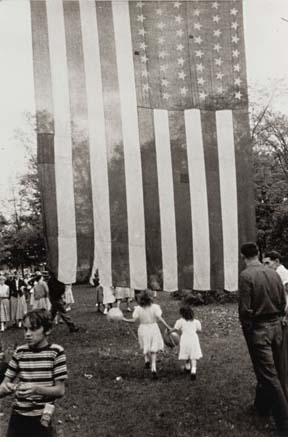 One of these, shot
in upstate New York, presents a tattered and patched flag so old and worn that it becomes a transparent scrim hanging above a small-town Fourth of July celebration. The image suggests the fragility of
the social equality that the flag, as an icon, represents.
One of these, shot
in upstate New York, presents a tattered and patched flag so old and worn that it becomes a transparent scrim hanging above a small-town Fourth of July celebration. The image suggests the fragility of
the social equality that the flag, as an icon, represents.
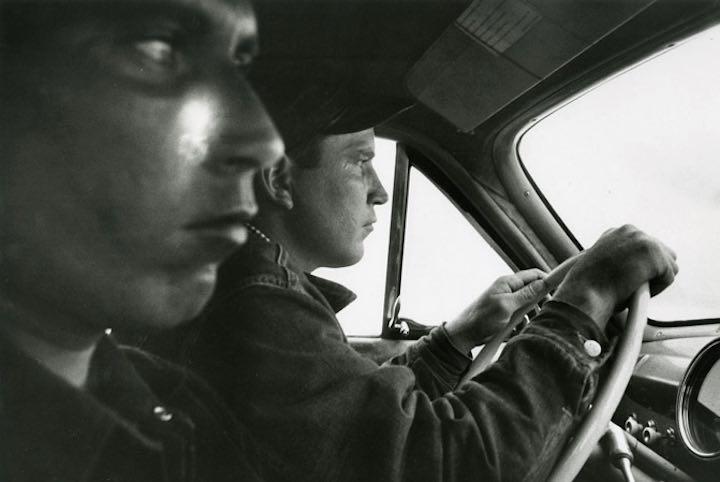
More than a few images in this series point to fault lines in the social landscape that have since erupted in a plague of mass shootings and racial violence. In "Blackfoot, Idaho" (U.S. 91, leaving Blackfoot Idaho), above, a close view of two young men, one at the wheel of a car, both projecting a physical intensity that is almost palpable, you might read a prelude to the Oklahoma City bombing into the picture.
And in "Chicago" (Political Rally), a politician on the stump, shouting his message with outstretched arms to an unseen crowd below, seems to be the incarnation of demagoguery.
The sale of these photographs, states Sotheby's, will represent the first time such an extensive collection of photographs from The Americans, which was assembled by Ruth and Jake Bloom of Los Angeles, has appeared at public auction.
This auction, Robert Frank: The Americans The Ruth and Jake Bloom Collection, will take place Thursday, December 17, 6 pm, at Sotheby's, 1334 York Avenue, NY, NY. Catalogue.
Photo, top: Robert Frank, "New Orleans" (trolley), 1956; above: "Blackfoot, Idaho" (U.S. 91, leaving Blackfoot Idaho, 1955; left: "Jay, N.Y," (Fourth of July), 1956. Images courtesy Sotheby's.