


Alex Katz, At Large

In his 88th year, Alex Katz is having a year to celebrate. With exhibitions at The High Museum, Atlanta; Gavin Brown’s Enterprise, New York; and the Colby College Museum of Art, Waterville, Maine, Katz has been drawing deserved attention. On Wednesday night at the New York Public Library, he discussed his new book, Brand-New & Terrific: Alex Katz in the 1950s (Prestel 2015), which is also the title of the exhibition at Colby College. Above: Alex Katz, Bather, 1959. © Alex Katz, courtesy Colby College Museum of Art.
The book surveys the incredible body of work created by the acclaimed painter as he came of age as an artist in the wake of Abstract Expressionism. Setting out to reinvent representational painting, Katz struggled at first to find an audience, destroying hundreds of canvases in the process. This book explores the artwork that survived from this momentous decade, one in which he first painted outdoors, innovated with collages, and met Ada Del Moro, his wife and muse.
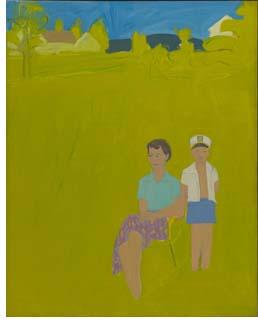 The essays in this book contextualize Katz’s painting, consider how he and his peers
looked at one another, mined 19th-century portraiture, and borrowed from television, advertising, and cinema. The result is a fascinating study of a young artist laying the groundwork for an
astonishingly successful career.
The essays in this book contextualize Katz’s painting, consider how he and his peers
looked at one another, mined 19th-century portraiture, and borrowed from television, advertising, and cinema. The result is a fascinating study of a young artist laying the groundwork for an
astonishingly successful career.
Right: Alex Katz, Slab City Road, 1959. Private collection, © Alex Katz, courtesy Colby College Museum of Art.
Katz has never been reticent about speaking for his work, whose color, design, and subject matter is New York cool and subjectively mysterious in equal measure. Following are extracts from his blog.
I make
paintings, and part of the painting is for painters – that has to do with craft. It’s very subtle – and quite elitist. If you don’t know very much about painting, you’re
not going to see what I’m doing. Painters are the audience I appreciate the most. Another part is the literary or historical meaning of the images: that is for another audience. Then you have
images and surface: that is for yet another audience. So you make these parts for several different audiences.
Manners and taste become very important. They are crucial:
without them the work will never have any energy. It’s all manners and taste. My idea of good manners is to say something interesting; an intellectual’s idea of manners is to be
interesting at all times.
But even by saying something interesting at all times, you can never make someone see something differently. You have to confront people to make them see differently. You must tell them, ‘This is what things look like, regardless of what you think’. When you step out that far, you often have some problems.
It has to do with what you like and what you don’t like. It’s that simple. You like a painter, but you don’t like the way he did this. You don’t want to do that because you know someone else who did it. At the same time, you have absorbed it and taken part in it. If I had to make a career out of ideas, I don’t think that I could do anything very well. To me, ideas are subject matter and not that important.
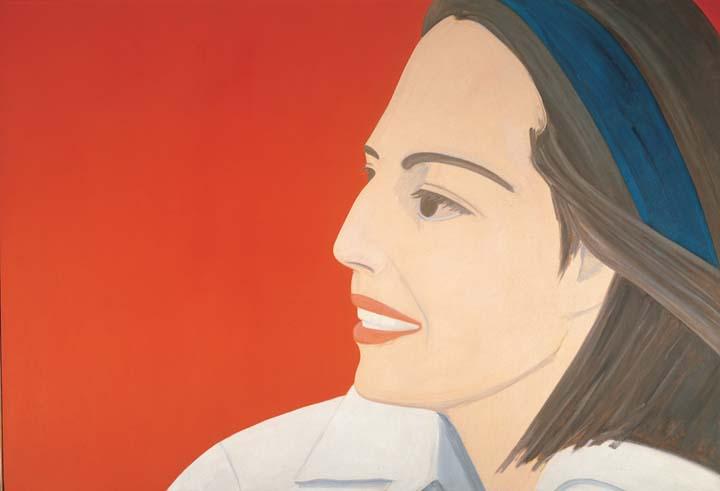
Alex Katz, The Red
Smile, 1963. © Alex Katz, courtesy The Whitney Museum of American Art.
Katz's work has been the subject of more than 200 solo exhibitions and nearly 500 group exhibitions internationally since 1951. Brand New and Terrific, an exhibition of works from the 1950s at the Colby College Museum of Art continues through October 18. Information. On view through September 27 at the Whitney Museum of American Art, on the 6th floor, is The Red Smile (1963), in America Is Hard To See. This Is Now, recently seen at the High Museum, Atlanta, opens at the Guggenheim, Bilbao on October 23. Information. Works by Alex Katz can be found in over 100 public collections worldwide, including the Metropolitan Museum of Art, the Whitney Museum of Art and the Museum of Modern Art in New York, the Tate Gallery in London, and the Albertina in Vienna.