


The Mexican Suitcase at ICP
WAR IS HELL! screams the 72-point headline of a magazine photo-essay by Robert Capa in the late 1930s. The photographer who famously said, "If your pictures aren't good enough, you're not close enough," changed the way the public came to expect information from the front lines to be delivered by embedding himself with the troops. He began doing this during the Spanish Civil War, and his most famous images from that bloody conflict have, until now, been seen only through magazine reproductions and reproductions of those reproductions.
Most of his negatives from that period disappeared during the chaos surrounding the Nazi Occupation of France, when Capa was living in Paris. A Hungarian Jew and a Communist, he knew that getting out early was his only choice. He left his negatives behind with his darkroom manager and fled. Like many who lost everything during the war, he eventually assumed that the materials never made it out of France.
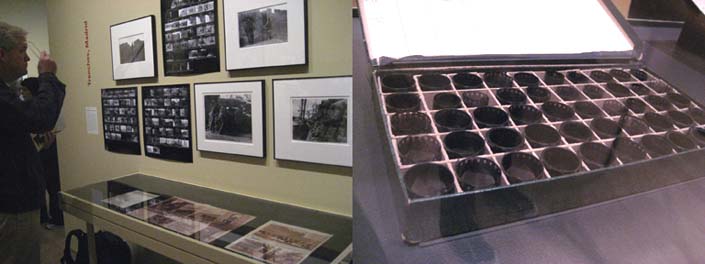
Left: Installation of contact sheets, modern enlargements and vintage magazines. Right: One of the "valises," with rolls of 35mm film and notations inside the cover. Photos: Peggy Roalf.
When three tattered film boxes, called "valises," turned up in Mexico City a number of years ago, the International Center of Photography, which was founded by Cornell Capa, Robert's brother, began the long and tortuous process of acquiring the work. Finally in 2007, what has become known as "The Mexican Suitcase" was given to the museum, which began an intensive study of its contents. An exhibition of the work opens today at ICP.
Among the 4,500 negatives, it turned out, were also images by David Seymour (known as Chim) and Gerda Taro, at one time Capa's lover and also his professional partner. From inside the conflict they created vivid battle sequences, and showed the harrowing effect of war on civilians that, in a sense, formed the beginnings what we know as photojournalism. On display are enlarged contact sheets of their huge output that show, frame by frame, how each one developed a story, and how Capa and Taro often worked together. Taken in its entirety, the work also shows how the three worked together to shape their careers during a tumultuous era.
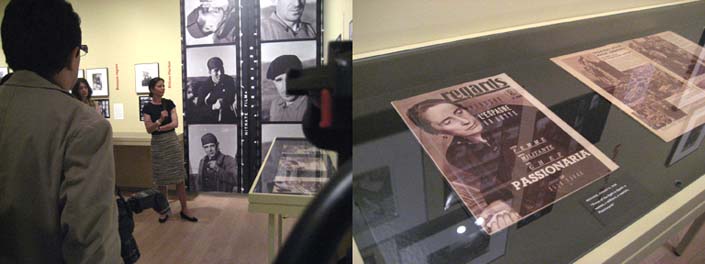
Left: Assistant Curator Cynthia Young, who organized the exhibition, at the walkthrough yesterday. Right: Taro's potograph of Dolores Ibarruri, aka La Pasonaria, the most visible woman of the Republican cause. Photos: Peggy Roalf.
The Spanish Civil War, which raged on from 1936 to 1939, was an ultimately successful attempt by General Francisco Franco, with the help of Hitler in Germany and Mussolini in Italy, to overthrow a democratically elected government. The photographers were passionately committed to the Republican cause of stopping the rising tide of Fascism in Europe and their international magazine coverage added support. The exhibition includes many examples of the original periodicals in which the work appeared, such as Regards, Vu, Life, and Schweizer Illustrierte Zeitung, and shows the increasing use of image over text to tell a story.
While Taro died in a tank assault on Brunete in 1937, the professional bond that existed between Capa and Chim led to their founding of Magnum Photos (together with Henri Cartier-Bresson and George Rodger) in Paris shortly after World War II ended. The work contained in the Mexican Suitcase can be viewed as a turning point in the history of photojournalism. Brian Wallis, chief curator at ICP says, "Capa established a mode and the method of depicting war in these photographs, of the photographer not being an observer but being in the battle, and that became the standard that audiences and editors from then on demanded," he said. "Anything else, and it looked like you were just sitting on the sidelines. And that visual revolution he embodied took place right here, in these early pictures."
The Mexican Suitcase will be on view at the International Center of Photography (1133 Avenue of the Americas at 43rd Street) from September 24, 2010 through January 9, 2011. The contents of the Mexican Suitcase are presented in a two-volume edition (ICP/Steidl 2010) that includes all 4,500 negatives and illustrated scholarly essays. Please visit the website for information and a schedule of public programs. The complete story of the Mexican Suitcase, from its recovery to the joint conservation effort with the George Eastman House, can be explored at ICPs dedicated website.
092410