


Unnatural History at ClampArt
Suspending disbelief is second nature to film buffs but when it comes to still photography, it's almost a split decision: to capitalize on photography's fictional capabilities or to document reality. When it comes to the natural sciences, questions about realism get even more interesting. And when you add art and photography to that equation, you've got a fascinating platform for inquiry.
This Thursday, Brian Clamp opens The Museum of Unnatural History, an exhibition of photographs and paintings by artists who have dug beyond the enchantment that natural history studies often provoke at first glance.
Some of the participating artists took up where Hiroshi Sugimoto left off. The Japanese photographer's famous statement about photographing at The American Museum of Natural History has inspired two generations of photographers. "Upon first arriving in New York in 1974," he wrote, "I did the tourist thing. Eventually I visited the Natural History Museum, where I made a curious discovery: the stuffed animals positioned before painted backdrops looked utterly fake, yet by taking a quick peek with one eye closed, all perspective vanished, and suddenly they looked very real. I'd found a way to see the world as a camera does. However fake the subject, once photographed, it's as good as real."
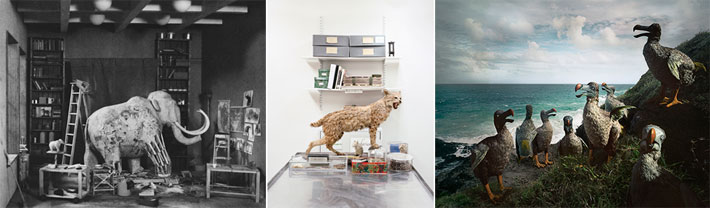
Left to right: Lori Nix, Mastodon, 2009; Nicole Hatanaka, Storage, 2009; Harri Kallio, Benares #4, Mauritius, 2004. Images copyright the artists, courtesy ClampArt.
Dioramas such as these have, in fact, supplied a minefield of creativity, and a platform for raising serious questions about representation. The theme for the show at ClampArt, in fact, was inspired by a new series by photographer Lori Nix, in which she painstakingly constructs tiny dioramas from imaginary natural history museums and photographs them in black and white, as Sugimoto had done. The beautifully rendered palladian prints hilariously depict behind-the-scenes possibilities that highlight the human need to collect, amass, and display elements of the natural world.
Photographer Matthew Pillsbury has taken elaborate natural history dioramas directly as a subject. In his photograph of the Grand Galerie de l'Evolution in Paris, a parade of giraffes, zebras, rhinos and other African wildlife are shown housed in an elaborate man-made structure that makes a vain attempt at total control and comprehension of the natural world. In its point of view and perfect execution, this photograph indirectly questions the phenomenon of scientific inquiry by field biologists who spend years studying wildlife - and perhaps getting a little too close to pandas and gorillas for them to remain unaffected by human contact.
Harri Kallio, a Dutch artist whose pseudo-scientific inquiry on the natural history of the dodo, in Mauritius, was one of the triumphs at Ecotopia, ICP's 2006 Triennale, is represented here by one of those images. His project as a whole details our obsession with scientific fact with a precision so extreme it almost mocks our fascination with the subject.
Amy Stein's use of taxidermized critters in photographic re-enactments of stories about the interaction between people and wild animals in a rural Pennsylvania town become what she calls "modern dioramas of our new natural history." In effect, she becomes an alchemist who has taken something that no longer exists and made us believe it is real.
The artists represented in The Museum of Unnatural History are Richard Barnes, Justine Cooper, Jason DeMarte, Blake Fitch, Jill Greenberg, Nicole Hatanaka, Harri Kallio, Hippolyte-Alexandre Michallon, Lori Nix, Matthew Pillsbury, Elliot Ross, Amy Stein, and Marisol Villanueva. The exhibition opens Thursday February 25, 6:00 - 8:00 pm and continues through April 10, 2010. ClampArt, 521-531 West 25th Street, Ground floor, New York, NY. 646.230.0020. Please visit the website for hours and information.
022310