


Marc Riboud at The Rubin Museum of Art

Before beginning his career as a photographer, Marc Riboud worked as
a factory engineer until 1951. After a week on holiday, during which he covered the cultural festival of Lyon, Riboud dropped his engineering job for photography and moved to Paris in 1952.
He was invited by Henri Cartier-Bresson and Robert Capa to join Magnum as an associate that same year. Photo above: ©
Marc Riboud, Darjeeling, India, 1956.
Between 1954 and 1957, Riboud traveled throughout India and China. He spent the next 10 years reporting on the independence movement in Africa and Algeria, the Vietnam War and resulting anti-war demonstrations, and the Bengali revolt in east Pakistan (now Bangladesh).
He won the Overseas Press Club prize for his books ‘The Three Banners of China’ in 1966 and the ‘Face of North Vietnam’ in 1970. In 1975 Riboud was elected president of Magnum, a post he served until 1979.
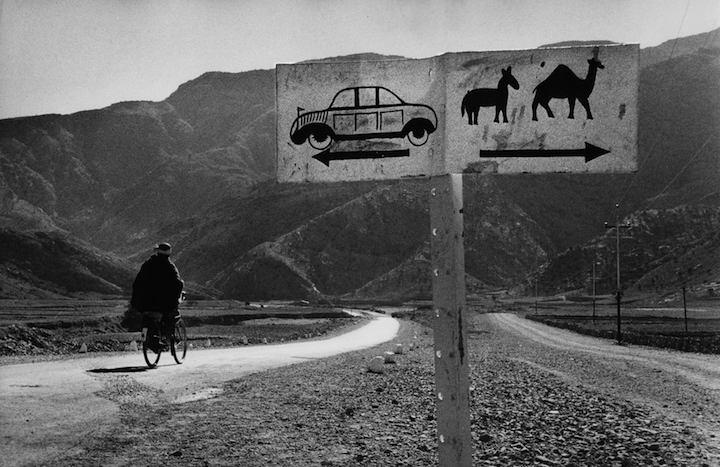 © Marc Riboud, Road to Khyber
Pass, Afghanistan, 1956
© Marc Riboud, Road to Khyber
Pass, Afghanistan, 1956
While his métier is photojournalism, Riboud has the eye of a poet, proven by some of his best-known images, such as the Eifel Tower painter, from 1953, or the peacenik he encountered at an anti-war demonstration in Washington, DC, in 1967. He wrote,
"For me photography is not an intellectual process. It is a visual one. I agree so much with Walker Evans’ definition of the photographer; ‘a joyous sensualist for the simple reason that the eye traffics in feelings not in thoughts. He is a voyeur by nature, a reporter, a thinker and a spy’. The (photographic) ‘artists’ have some excuse as the world we live in is submerged by thoughts, words, comments and concepts of all sorts. We forget that our language is based on the eye and for the pleasure of the eye. Whether we like it or not, we are involved in a sensual business.
“The eye is made to see and not to think….A good photograph is a surprise. How could we plan and foresee a surprise? We just have to be ready. The French poet, Rene Char, advised us ‘to foresee as a strategist and to act as a primitive’. We should be proud to act as primitives. Everybody can become a professional. It is more difficult to become a primitive or to act like one.”
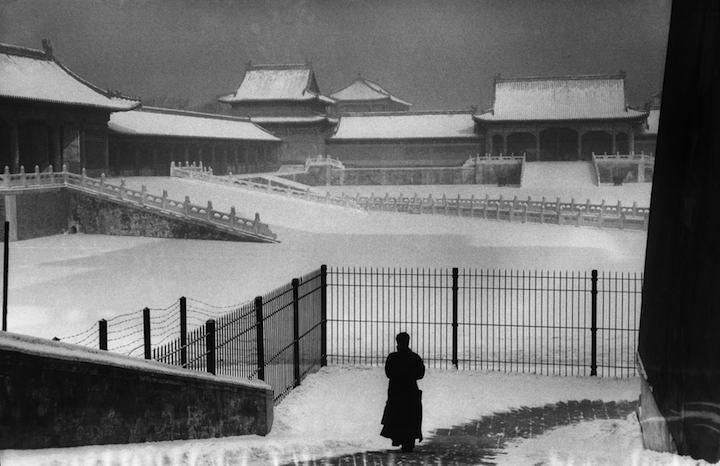 © Marc Riboud, Forbidden
City, China, 1957.
© Marc Riboud, Forbidden
City, China, 1957.
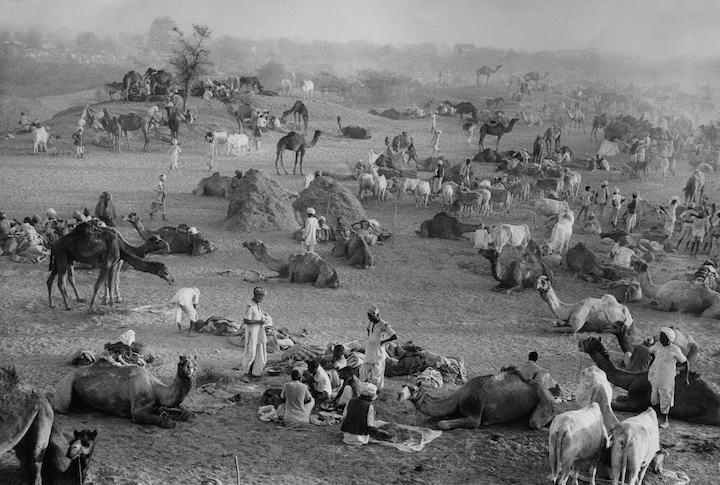 ©
Marc Riboud, Camel Market, Nagaur, Rajasthan, India, 1956.
©
Marc Riboud, Camel Market, Nagaur, Rajasthan, India, 1956.
Witness at a Crossroads: Photographer Marc Riboud in Asia, Marc Riboud’s first New York exhibition in 25 years, continues at The Rubin Museum of Art through March 23, 2015. 150 West 17th Street, New York, NY. Information. All photographs courtesy The Rubin Museum of Art.
View more images by Marc Riboud at Peter Fetterman Gallery.