


Gabriele Munter, Contours of a World

Gabriele Münter (1877-1962) had everything her male counterparts could look for in a woman: wealth, social standing—and a great figure. Instead of looking for a match and a comfortable bourgeois life, however, Münter set out on a journey of self-discovery that led to her commanding artistry in the fields of painting and printmaking. Above: Gabriele Münter, Self-Portrait (1909–10), detail. Collection of the Museo Nacional Thyssen-Bornemisza, Madrid
Having received a large inheritance upon her mother’s death, Gabriele and her sister Emmy traveled through the United States from 1898 to 1900 to explore the country while visiting relatives in Missouri, Arkansas, and Texas. Arriving in New York City, where photography was fast on its way to becoming a celebrated artistic medium, she went to museums and began filling her sketchbook with urban scenes. During their travels, Münter acquired a Kodak Bulls Eye No. 2 camera—the newly introduced precursor of the Brownie Box camera. She quickly took command of the medium, producing a continuous stream of images of people in their particular environments—close to 400 images over two years. While she never showed this work publicly, it clearly represents her innate grasp of form and space, attributes that later became the backbone of her compositional skills as a painter. These photos also show her recognition of the importance of her heritage as the daughter of German immigrants who had returned to their homeland during the American Civil War and her own position as a woman seeking independence.
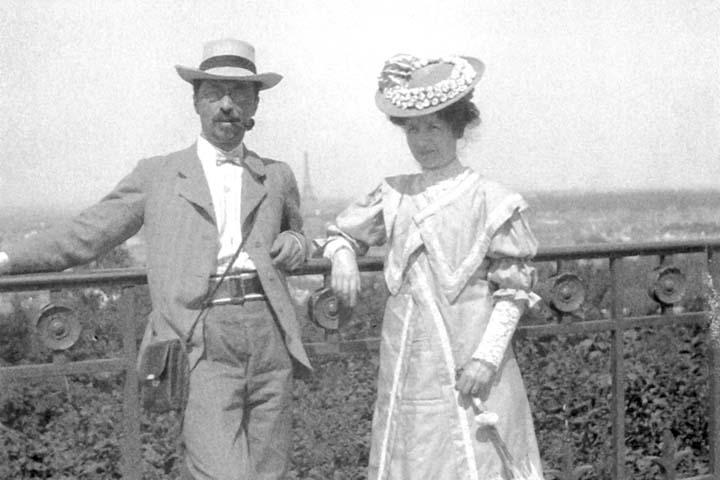
On her return to Germany, Münter moved to Munich to continue her studies. At the time, women were not allowed to enroll in established art academies, so she took courses in the Womens Academy, and later joined Phalanx-Schule,
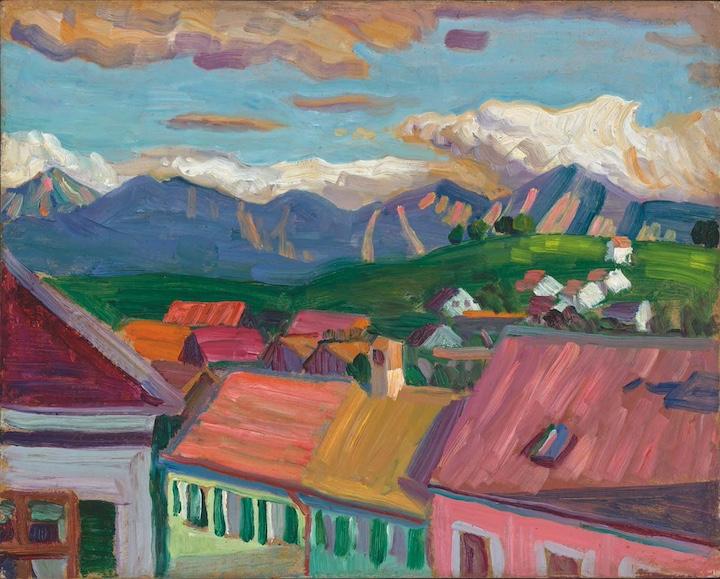
In 1911, Münter and Kandinsky, along with Franz Marc and August Macke, co-founded Der Blaue Reiter [The Blue Rider], a loose collective dedicated to exploring color’s expressive and spiritual potential. Münter hosted many of the group’s meetings in her Murnau home, which became an informal center for the movement. While the other artists explored the realm of avant-garde abstraction, Münter’s innovation lay in translating the new abstraction into the realm of everyday life, using bold colors and compressed space to make everyday scenes pulse with life. Above: From the Griesbräu Window (Vom Griesbräu Fenster), 1908.Courtesy of the Gabriele Münter and Johannes Eichner Foundation, Munich; below: Still Life with Queen, 1912, courtesy of the Art Institute of Chicago.

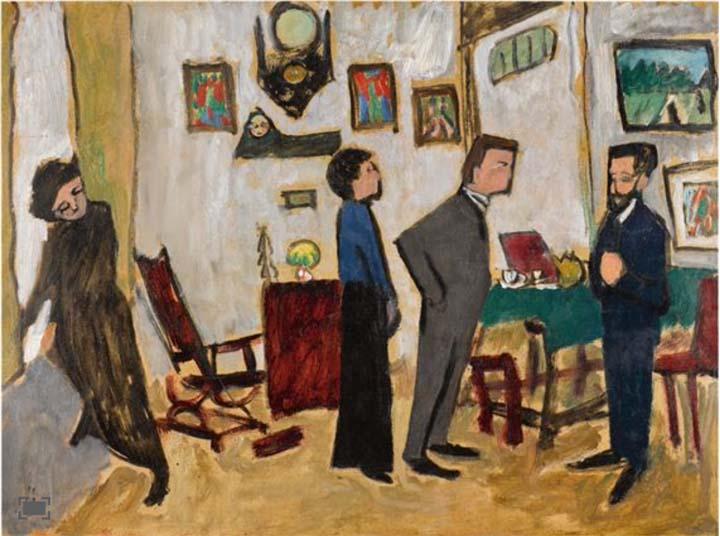
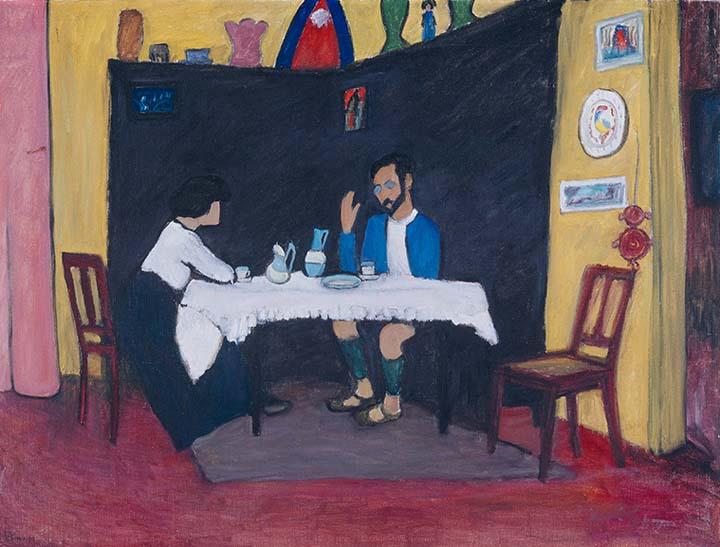
When World War I erupted in 1914, Münter left Germany for Scandinavia, while Kandinsky returned to Russia; their relationship fell apart in 1917. She spent the next six years in Denmark, Sweden, and Norway—a period of forced exile that produced some of her most introspective work. Münter’s palette sharpened; she painted quiet interiors, emotive portraits, and spare winter landscapes. The expressive color of her earlier canvases remained but was tempered by a new stillness and precision. Above: After Tea II (Kandinsky with the Art Dealer Goltz at Aimillerstrasse 36, Munich)), 1912
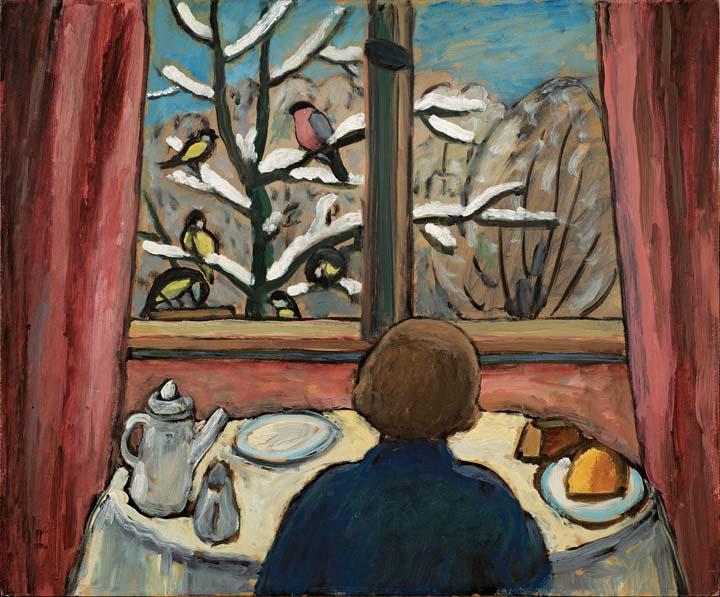
“I extract the most expressive aspects of reality and depict them simply, to the point, with no frills…[T]he forms gather in outlines, the colors become fields, and contours—images—of the world emerge,” the artist once said, according to curator Megan Fontanella, who borrowed the title of the Guggenheim exhibition from the quote. The exhibition presents over fifty works that show the depth of Gabriele Münter’s achievements as an innovative modernist painter. Many of her male peers approached modernism through myth and abstraction, but Münter applied the same formal innovations to ordinary interiors and portraits. Above: Breakfast of the Birds (Das Frühstück der Vögel), 1934. Photo: Courtesy National Museum of Women in the Arts. Below: Kandinsky and Erma Bossi, 1910, courtesy of Princeton University Art Museum
While Münter's work expanded what counted as a serious modern subject, for decades her achievements were eclipsed by the men around her. Contours of a World asserts that her work was as radical—and as foundational—as that of any of her peers in German Expressionism and Der Blaue Reiter movement. Here is just a sampling of her exceptional work. I have focused on the early pieces, which show the artist at her most experimental, and to my eye, most compelling. Gabriele Münter, Contours of a World continues through April 26, 2026. The exhibition is accompanied by a comprehensive and beautifully produced catalog. Info
Solomon R. Guggenheim Museum, 1071 Fifth Avenue at 88th Street, New York, NY Info