


Earth & Fire: Flamenco at Aperture
It only takes a few minutes of scanning the walls of Aperture Gallery's new installation to see that flamenco and the camera were meant for each other. Images by some of the grandees of photography, including Brassai, Manuel Alvarez Bravo, Henri Cartier-Bresson, Inge Morath, and Lucien Clergue hang next to prints by "Photographer Unknown." As depicted here, flamenco is performed in a dusty lot high above a hazy city; in a gypsy caravanserie on the edge of a rural village; on stage in a theater; and, of course, in dance studios where children learn the arts of their parents.
The exhibition covers the love affair that began not long after photography made its way to Spain. A studio portrait from 1858 shows a regal woman of a certain age dressed in fine clothes much like what is worn by flamenco dancers today. One of the great surprises in the show is a photograph of a Gypsy dancer whose exultant gesture signifies a fire within; it was made by the French painter Pierre Bonnard in 1901.
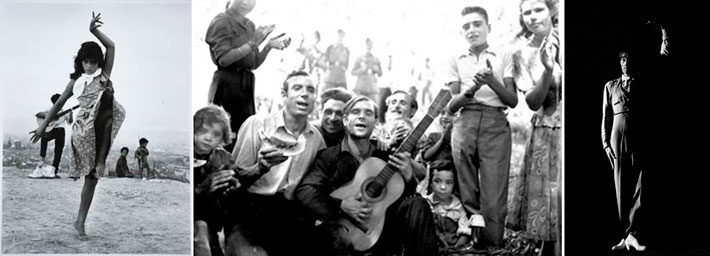
Left to right: La Singla, Barcelona, 1962, photograph by Xavier Miserachs; Gypsies, ca. 1945, photograph by Paul Himmel; Vicente Escudero, Barcelona, 1962, photograph by Colita. Courtesy Aperture Foundation.
Like tango in Argentina, flamenco in Spain has been alternately celebrated and reviled, proudly performed and suppressed by despotic rulers. Originating in Gypsy and Moorish culture in southern Spain, it was celebrated at the turn of the 19th century, when it became widely popular in Europe. During the Spanish Civil War, Flamenco was marginalized, then brought back as a signifier of national identity by the Franco regime in the 1950s.
When commercial jet flights began in the 1960s, making it possible for students to travel abroad, self-styled ethnomusicologists and photographers began to collect and catalogue this unique form of Spanish dance and music, making it more visible to the world at large. The music has become part of the "world music" category and has influenced some of the most popular performers today.
The fire and soul of flamenco comes through in these photographs, even in the few obligatory scenes of celebrities - notably a shot of The Beatles, in which John Lennon strikes a flamenco pose for the paparazzi. Around the same time, Xavier Miseracha, a well-known Catalan photographer, captured the passion of the dance as performed by Antonita La Singla.
No Singing Allowed, curated by Jose Lebrero Stals, opens tonight at Aperture Gallery from 6:00-8:00 pm. Pastora Galvan, an important new figure in flamenco dance, will perform at the opening. The exhibition is being presented in two sections, with an opening Friday, February 6, from 6:00-8:00 pm at Instituto Cervantes, where flamenco singer La Tremendita and guitarist Paco Cruz will perform. Both exhibitions continue through April 1, 2010.
Aperture
Gallery, 547 West 27th Street, 4th floor, New York, NY. 212-505-5555. Instituto Cervantes, Amster Yard Gallery
at 211 East 49th Street, New York, NY. 212-308-7720.
Flamenco at the opening at. Both shows will remain on view until April 1, 2010.