


New York, Tokyo, Prague, Berlin: Seen
What is street photography? What makes a street photographer? What is a street? These questions and more invaded my consciousness as I poured over images in the Keizo Kitajima mini-retrospective at Amador Gallery this morning.
Little known in the U.S., Kitajima was a student at Daido Moriyama's Tokyo Workshop Photography School in the 1970s. His first exhibitions, raw images of Tokyo's seamy night life, were performances, much like the happenings that took place in New York City at the time. Kitajima pinned rolls of enlarging paper onto the gallery walls and projected his negatives, one by one, onto the paper, He then processed the images using sponges to apply the developer, fixer, and water bath, essentially turning the gallery into a darkroom.
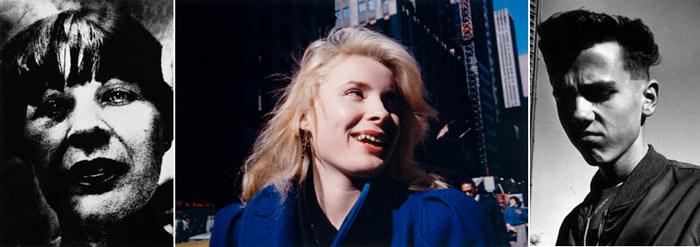
Left to right: Tokyo Shinjuku, 1979; New York, 1984; Juli 1983, West Berlin. Copyright Keizo Kitajima; courtesy Amador Gallery.
All that remains of the large-scale images are installation shots from the photographer's archive. But he re-photographed many of the images from the series, a selection of which is currently on view. Taken from a close vantage point, they portray desperate fun-seekers who seem to be drinking their way to oblivion. Kitajima's original printing process created high-contrast images, grainy and graphic, that look as if he had shot with recording film.
In 1981, Kitajima traveled to New York for a three-month visit. He frequented new wave night spots, incuding CBGB and the Mudd Club, shooting from the hip and using a garish flash setup reminiscent of Weegee's police work. It was his desire to "come into contact with something toxic, to take photographs that would leak venom" that attracted him to downtown clubs where it could be just as dangerous inside as it was out on the dark city streets.
The following year he published the work in book form and won a cash award that enabled him to travel to Berlin, New York, Seoul and Beijing. On his second trip to New York, he photographed on the streets, in color, creating a body of work that is unique in its portrayal of strangers shot on the fly. You can't help but think of images by Philip Lorca-diCorcia, or Joel Meyerowitz, masters of street photography, but Kitajima's photographs are fundamentally different.
In every instance, the camera is so close that the subjects become one with the action, making the portraits the essence of the individuals captured. "It's almost as if the photographer doesn't exist," said Paul Amador as we looked at the 1984 New York series together. "They don't react at all to this weird foreigner who's camera is in their face." Technically, the color work is worlds apart from his black-and-white images. Fine grained, with naturalistic color, the portraits confer an odd, stylized glamour on the ordinary people Kitajima encountered.
In the Eastern Bloc countries he visited on his 1983-84 tour, Kitajima again took up black-and-white film, but used it with natural light to capture the darkness of the times, the bleakness of the landscape, and the stoic expressions of people living in dire circumstances. His portraits, grave and formal, reflect the hunger that oppressed people experienced under Soviet rule.
Keizo Kitajima: The Joy of Portraits continues through November 7, 2009. The gallery has copies of The Joy of Portraits (Rat Hole, 2009, 874 pages) as well as the catalogue for the Kitajima retrospective currently on view at the Tokyo Metropolitan Museum of Photography. Amador Gallery, 41 East 57thStreet, 6th floor. 212-759-6740.
092209 kitajima