


Manmade/Genuine: The Dutch Landscape
When 17th-century Dutch artists took up landscape as a subject for painting, they were flying in the face of European conventions regarding what was considered worthwhile in art. At the time, history painting ruled and the bloodier the battle, the more likely it was for the painter to secure patronage. Perhaps the artists of the golden age of Dutch landscape painting were prescient. Maybe they realized that the bucolic rural settings they pictured would soon be history. When the Industrial Revolution took over the Western world less than 100 years later, the Netherlands, much like New England, became urbanized, industrialized, and permanently transformed in the process.
Now, less than 200 years later, the Netherlands has become even further transformed due to its inundation by the sea; by uncontrolled pollutants; and by highways that have encircled and criss-crossed its cities. A number of new cities have sprung up on previously contaminated sites that were cleaned up and filled in. Classic windmills have been outnumbered by mechanized turbines marching through agricultural lands. The Dutch landscape, according to the official tourist bureau, is nothing like what can be seen from the A10 Ringweb.
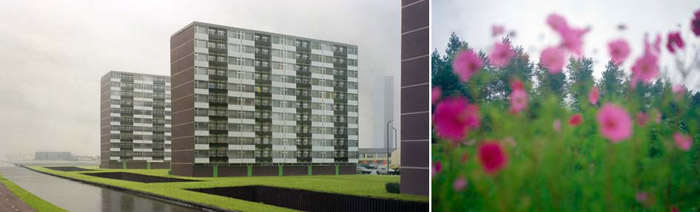
Left: Edwin Zwakman, Later..., 2000. Right: Marnix Goossens, Beach, From the series Regarding Nature, 2000. Courtesy Aperture Foundation.
Nature as Artifice, a survey of contemporary Dutch landscape photography, opens tomorrow night at Aperture Foundation in conjunction with the 400th anniversary of the Dutch arrival in New York harbor. More than 100 photographs and several videos present views of the "natural" world as seen by artists who take a particular approach to what looms before them.
For them, beauty is not an issue. Nor is a socially conscious condemnation of the evils of development. They take a somewhat oblique view of their subject, finding pleasure in trivial enjoyments of the out-of-doors, much as Martin Paar does in his work. They eschew the towering clouds and menacing skies of their painterly antecedents in favor of an even hazy light that almost denies definition - much as Stephen Shore did in Uncommon Places (Aperture 1988).
Hans Aarsman, who heralded a resurgence in Dutch landscape photography with the 1989 exhibition of his series, Dutch Scenes, created a new model with his carefully composed images shot with a field camera. He avoided fancy darkroom techniques that "improved" his pictures in favor of perfectly exposed images of his chosen scenes, dead cows and all. Aarsman is represented here with a recent series presented as 4 x 5 contact sheets. There is irony and humor in his images of common places, of people relaxing in a familiar landscape that is often anti-picturesque and sometimes includes elements that are genuinely cute
Wout Berger's Poisoned Landscape series depicts polluted sites where incredibly lush foliage has taken hold against all odds. Cary Markerlink and Theo Baart's Highways in the Netherlands occupies an entire wall of the gallery. A celebration of wheeled transport of all kinds, in both color and black-and-white, in various sizes and different types of frames, the series replicates the dizzying experience of high-speed travel on terra firma.
Edwin Zwakman, according to the catalogue, occupies a unique position within "Nature as Artifice." He creates simulations of the manmade landscape in the form of precise maquettes that he then photographs in large format. The work is conceptual but not idealized, in the sense that he works from memory of his observations, which he calls his "database." The photographs, presented as mural size prints, are oddly affecting. Unlike the German photographer Thomas Demand's precise, photographed models of places where misfortunes have occurred, Zwakman's images offer a thoughtful gaze on places that he says are part of a quest towards identifying a personal mindset.
Among the videos, Frankendael 2001 by Driessens & Verstappen, presents the evolution of the seasons in an Amserdam park modeled on a traditional English garden that emulates the natural environment. The point of the video is that this artificial landscape seems altogether real, a fact that the municipality promotes as a reason to spend time there enjoying Nature.
Nature as Artifice: New Dutch Landscape in Photography and Video Art opens at Aperture Gallery on September 10, with an artists reception from 6:00-8:00 pm, and continues through October 15, 2009. The exhibition was curated by Maartje van den Heuvel of ALIA Amsterdam/Leiden University and is now making the last stop on its U.S. tour. The catalogue, by Maartje van den Heuvel and Tracy Metz, is available at the gallery.
Related programs, free and open to the public, include:
Panel Discussion with Artists and Curator at SVA Theater
Moderated
by Tracy Metz, catalogue co-editor, panelists include exhibition curator Maartje van den Heuvel; Alison Nordstrom, George Eastman House; and exhibited artists Jannes Linders, Hans van der Meer, Frank
van der Salm, and Edwin Zwakman.
Saturday, September 12th at 1:00 pm. 333 23rd Street (between 8th and 9th avenues)
New York, New York. (212) 592-2982.
Artist's
talk with Hans Aarsman at Aperture Gallery
Tuesday, September 15, 6:30 pm. 547 West 27th Street, 4th Floor, New York, NY.
090909 artifice