


Identity / Identities
Editor's note: Seth Greenwald's essay accompanies the exhibition Identity Identities, opening tonight at Aperture Gallery.
"Who are you?" said the Caterpillar. This was not an encouraging opening for a conversation. Alice replied, rather shyly, "I, I hardly know, sir, just at present...at least I know who I was when I got up this morning, but I think I must have been changed several times since then." "What do you mean by that?" said the Caterpillar sternly. "Explain yourself!" "I can't explain myself, I'm afraid, sir" said Alice, "because I'm not myself, you see." (From Alice's Adventures in Wonderland (1865) by Lewis Carroll.)
Identity, it has been suggested, is not static and immutable fact; but, rather a fluid and shifting state of affairs that can be investigated, assimilated and, then, rejected as one does an outfit or new hairstyle. What had once appeared to be unmoving coordinates -- social, political, even sexual - are now components to be applied, in varying combinations, to an ongoing experiment, in role-playing.
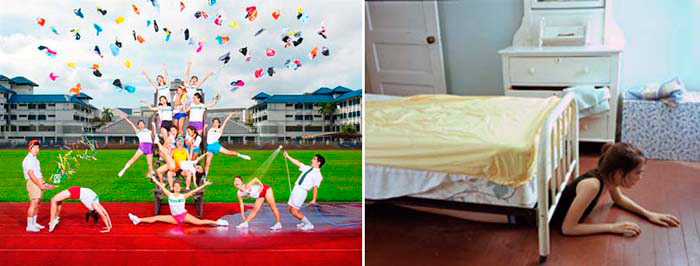
Left: Jess Schaffer, Bed, 2006. Right: Jing Quek, Ken Series (Schoolboy Obsessions), 2009. Copyright the artists, courtesy Aperture Foundation.
Perhaps we have moved beyond hard definitions to embrace flux and mutation as our normal condition; perhaps, in the 21st Century, we actually define ourselves through uncertainty. Alice quickly gathered that the self was elastic and that phenomenological perceptions of reality had become invalid; this is no less true for us. In all manner of things, technology challenges orthodox notions of belongingness and the fixity of points in space and time.
Today, successful face transplants performed in France, China and the United States; gender reassignment surgery; the increasing ubiquity of cosmetic procedures; emotional modification through pharmacology; the commercial cloning of family pets; telecommuting in the work place; virtual doppelgangers living parallel existences in Second Life geolocation services that provide orientation and findability anywhere on the planet; social networking tools that facilitate new communities able to function outside standard parameters of geography: all examples of how the ways in which we identify, with ourselves and others, are bending, changing and evolving.
Young artists invariably reflect these phenomena in their work. Theirs is a sensibility that is post atomic-age anxiety, post identity crisis, beyond conventional classifications of race, gender or nationality, past art as a sacral and inviolate construct. Though the object matter of their work may differ, their subject matter is frequently this multivalent nature of the self, and their methodologies follow suit, seamlessly fusing new technologies with traditional tools.
For much of our culture, meaning is inextricably linked to representation. The omnipresence of advertising and the televisual provides a continual flow of pictorial information through which we gauge our place in the world. The fixing of the photographic image, in 1825, and subsequent refinement of photomechanical reproduction helped to establish this phenomenon: the sense that likeness had become a surrogate for the Real.
Today, of course, both public and private space is routinely suffused with visual information; from public rest rooms, to point-of-purchase displays in retail environments, to the screens of mobile devices, image is simply everywhere. Yet, this is about something more than just pictures. These images are social referents and establish mechanisms of relating and a collective language. Images are the new words.
Identitiy / Identities, curated by Stephen Frailey, Chair of the
BFA photography Department at the School of Visual Arts, presents work by 11 recent graduates of the program at Aperture Gallery, through August 20th. The opening reception is Thursday, July 30, 6-8pm. 547 West 27th Street, New York, NY. 212.505.5555.
Seth Greenwald is an instructor at the School of Visual Arts and the New School, both located in New York City. Previously, he was Director of Photography for
Photonica.
073009 greenwald