


Erattaplex
A full-page infographic decrying fraudulent practices in the olive oil industry, which ran in The New York Times Sunday Review on January 26th, came under scrutiny. As a writer responsible for my own fact-checking and typos, I sympathize with the artist [Nicholas Blechman], the editor, and he or she who was charged with writing this epic erratum [the longest I’ve ever seen the Paper of Record]—and not least, the fact-checker who had the last read. Here is the correction for Extra Virgin Suicide: The Adulteration of Italian Olive Oil.
An earlier version of this graphic contained several errors.
Olives that are used in substandard oil are typically taken to mills days, weeks or even months after being picked — not “within
hours.”
The graphic conflated two dubious practices that can be found in parts of the olive oil industry. Some producers mix olive oil with soybean or other cheap oils, while
others mix vegetable oils with beta carotene and chlorophyll to produce fake olive oil; the two practices are not usually combined.
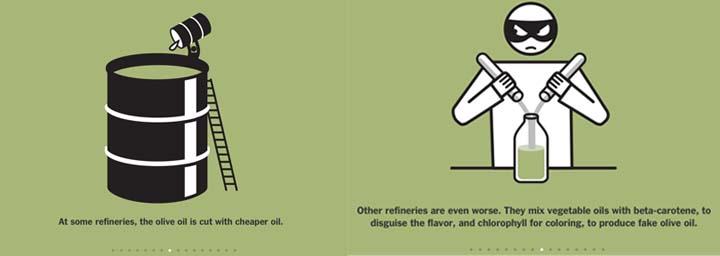
The original captions read, (l) At a refinery, the olive oil is cut with a cheaper oil (r) and
mixed with beta-carotene, to disguise the flavor, and chlorophyll for coloring.
Olive oil bottled in Italy and sold in the United States may be labeled “packed in Italy” or “imported from Italy” — not “produced in Italy” — even if the oil does not come from Italy. (However, the source countries are supposed to be listed on the label.)
A 2010 study by researchers at the University of California, Davis, found that 69 percent of imported olive oil labeled “extra virgin” did not meet, in an expert taste and smell test, the standard for that label. The study suggested that the substandard samples had been oxidized; had been adulterated with cheaper refined olive oil; or were of poor quality because they were made from damaged or overripe olives, or olives that had been improperly stored or processed — or some combination of these flaws. It did not conclude that 69 percent of olive oil for sale in the United States was doctored.
Finally, the graphic incorrectly cited Tom Mueller, who runs the blog Truth in Olive Oil, as the source of the information. While Mr. Mueller’s blog and other writings were consulted in preparation of the graphic, several of his findings were misinterpreted.
The illustrations here are from The New York Times Interactive; the print version was a full-page info graphic. Personally, I preferred the print version for it's colossal scale and great layout. However, the online version includes some very cute animations, including the character on the right, whose eyes dart back and forth in a shifty, post-Warner Bros. way.