


Stage Pictures in Three Acts: Act 2
The Russian Avant Garde, Futurism, and Cubism are joined by Pop Art and Minimalism to create designs for the theater in the exhibition, Stage Pictures: Drawing for Performance, on view at the Museum of Modern Art. For people who love the theater in all its forms, from drama and opera to ballet, musical theater and even happenings, this exhibition, and another at the Morgan Library & Museum, offer an in-depth exploration of stage design.
The show at MoMA emphasizes the allure of the theater for artists who envision a total artwork on an epic scale with a desire to create something new. The magic of the paintings and drawings on display is the ways in which their makers have used the simplest of means to create a mood through light and shadow; to articulate a complex architectural setting; to manipulate bodies in space; and to imagine the appearance and psyche of the characters.
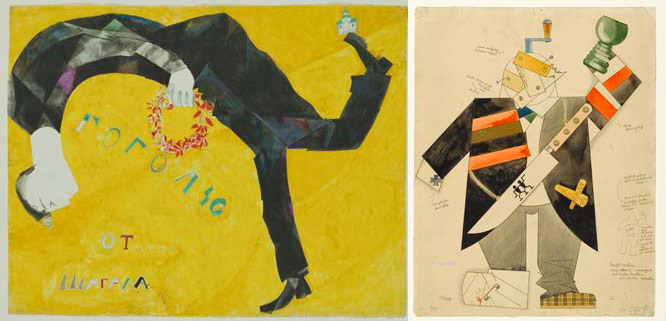
Left: Homage to Gogol by Marc Chagall, 1917. Right: Costume design for the play Methusalem by George Grosz, 1922. Courtesy the Museum of Modern Art.
MoMA's collection of designs for the theater began in 1939 when Lincoln Kirstein, who later founded the New York City Ballet, gave his personal collection of performance-related books and other printed matter to the Museum. Kirstein was a patron of avant-garde arts who commissioned many Russian composers and artists, including Igor Stravinsky, to create work for his ballet company.
The opening section of the exhibition reflects those interests with a 1930 suite of twelve prints by the Russian artist, Alexandra Exter, at the entrance. These were not designs for specific productions but her exploration of ideas for different kinds of stage machinery and lighting, including the use of spotlights, which were something new at the time.
The Russian-born artist Marc Chagall created sets and costume designs for a 1942 production of Aleko for Leonid Massine's Ballet Theatre (later named the American Ballet Theatre). The story, based on a poem about gypsies, by Alexander Pushkin, inspired Chagall, who drew upon folk motifs from his homeland. Chagall became so involved in the project that he actually painted the backdrops, while his wife sewed many of the costumes. This display of works on paper is accompanied by a film excerpt of the production, with music by Peter Ilyitch Tchaikovsky.
Moving forward in time, the exhibition features designs by Pop artist Jim Dine for a 1966 "happening-like" production of A Midsummer Night's Dream; sets and costumes by David Hockney for the play, Ubu Roi, also from 1966; and Robert Wilson's drawings for the spaceship scene from Einstein on the Beach, 1976, which is also accompanied by a video excerpt. The last gallery includes a large-scale charcoal drawing from 2005 by South African Artist William Kentridge created for a backdrop for Mozart's The Magic Flute. Other highlights include recreations of Pablo Picasso's costumes for the 1917 Ballets Russes production of Parade, along with a video excerpt of the Joffrey Ballet's 1973 revival.
Stage Pictures: Drawing for Performance continues at the Museum of Modern Art until August 25, 2009. 11 West 53rd Street, New York, NY. (212) 708-9400. Creating the Modern Stage: Set Designs for Theater and Opera continues through August 16 at the Morgan Library & Museum. Please visit websites for information. Next week, DART takes a look at Dormitorium: An Exhibition of Film Decors by the Quay Brothers.