


Stage Pictures in Three Acts: Act 1
If you're in New York between now and mid-August, you have the rare opportunity of seeing three exhibitions that reveal the magic and the history of modern stagecraft. Bringing together the influences of the Russian Avant Garde, Italian Futurism, French Surrealism, American Minimalism, and more, these exhibitions reveal the allure of the theater for artists bent on bringing all aspects of the arts together in one setting that illuminates the director's vision, whether for a play, an opera, a ballet - even a TV drama.
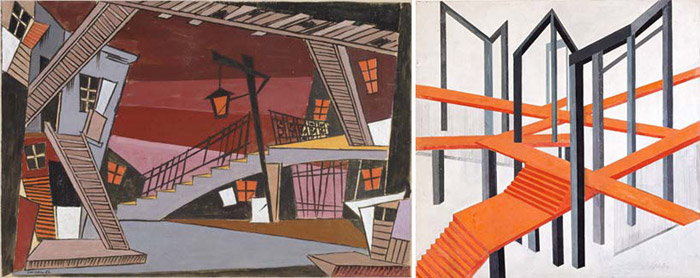
Left: Catfish Row for Gershwin's Porgy and Bess by Juozas Jankus. Right: Construction for a Tragedy by Alexandra Exter. Courtesy the Morgan Library & Museum.
Best to start out at Creating the Modern Stage at the Morgan Library & Museum, where the curators have assembled supporting materials that illustrate historical contexts of the designs for theater and opera on display. The drawings and paintings are largely from the collection of Donald M. Oenslager (1902-1975), a New York set designer who became a professor at Yale University's theater department. He collected drawings and paintings by artists here and abroad, as well as related materials such as musical scores, annotated scripts and performance photographs of the finished sets and costumes.
The influence of the Russian Avant Garde of the early 1900s on American theater is well documented here, with designs by Alexandra Exter, Leon Bakst, and Natalia Goncharova, among others. The Constructivist device of using ladders and platforms in order to create an abstract, multifaceted theater machine is seen in Exter's 1925 drawing, Construction for a Tragedy (above right).
Russian folk motifs join abstract forms in Natalia Goncharova's design for Diaghilev's Ballets Russes production of Tamara. Here, folk inspired textile designs meet Futurist-ic mountains and clouds, blending diverse influences in a form that was uniquely hers.
Many of the early designs were much more radical at the time than they seem today. To really appreciate the stark minimalism of Robert Edmond Jones' 1930 design for Shoenberg's The Hand of Fate, you only need to take a few steps into the adjacent gallery for a comparison. Here, the curators have included a 19th-century design by Paul von Joukovsky for Wagner's Parsifal, done in a naturalistic style a la Fragonard, which seems naive and fussy by comparison.
Ideas about modern stage design traveled from Moscow, Bayrouth and Paris to New York, Philadelphia, San Francisco - and later to Vilnius, the capital of Armenia. Here in 1967, Juozas Jankus created sets for the Gershwins' Porgy and Bess, which was originally produced in New York in 1935. His drawing of Catfish Row (above left), one of the best in the show, pays homage to W.P.A. murals and the topsy-turvy style of the American Modernist painter, Stuart Davis.
Several listening stations offer excerpts from some of the operas envisioned in the gallery. Display cases add to the mix, with Playbills, posters and advertisements and other ephemera. One of the treasures is a limited edition of Shakespeare's Hamlet, illustrated by Edward Gordon Craig for Konstantin Stanislavski's 1928 production at the Moscow Art Theater. Printed by the Cranach Press, it was typeset in the custom-designed font, Hamlet-Fraktur.
Creating the Modern Stage: Set Designs for Theater and Opera continues through August 16 at the Morgan Library & Museum, 225 Madison Avenue, New York, NY. 212.685.0008.
Next week, DART looks at Stage Pictures: Drawing for Performance, at the Museum of Modern Art.
071609 oenslager