


Beauty and the Beast
Beauty Last night Pace/MacGill Gallery opened an exhibition of Duane Michal's new color work. Based on forms created by 19th century Japanese wood block artists who depicted the urbane pleasures of Ukiyo-e, or the floating world, Michal's series presents images of a contemporary pleasure dome completely isolated from mundane affairs.
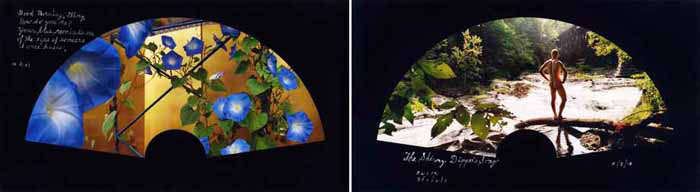
Left: Good Morning Glory, 10/2/07. Right: The skinny dipper's song, 8/2/08. C-prints with hand applied text, 11" x 20." Copyright Duane Michals; courtesy Pace/MacGill Gallery, New York.
Michal's Photographs from the Floating World are mostly cropped into a fan shape, a graphic convention often used by Ukiyo-e artists. The prints typically include written comments by the artist, in this case done in white ink on the black background surrounding the fan-shaped photographs.
A realm of earthly delights unfolds in photographs of beautiful flowers, beautiful objects, beautiful men and beautiful women. The artist's backyard garden also appears, photographed from above through the four seasons. His inscription for the fall view, "Autumn is the pot of gold," typifies the joyous expressiveness in both imagery and text.
In Good Morning Glory, trellised blue flowers with golden eyes appear before a wall painted the same yellow hue of Monet's dining room at Giverney. This art-historical reference, one of many throughout the series, offers a nice recap of a form that was prized, and often emulated, by Impressionist and Post-Impressionist French painters.
Duane Michals: Photographs from the Floating World continues through January 10, 2009. Pace/MacGill Gallery, 32 East 57th Street, 9th Floor. 212.759.7999. Please check the website for hours and location.
The Beast A world and several neighborhoods away is the mid-year exhibition of work by School of Visual Arts MFA Illustration as Visual Essay candidates, on view at the West Side Gallery in Chelsea. One of two exhibitions is The Call of Cthulhu, curated by Viktor Koen. The exhibition is a result of his students' work for the Book Seminar course, which he describes as a one semester mini-thesis.
The assignment was based on the text of a sci-fi horror story by H.P. Lovecraft (1890-1927), which has everything a visual artist could hope for, including a secret cult, a sea monster, and a high priest who manipulates the dreams of his subjects. While most students followed the text, those who came up with viable variants were given free rein to extend Lovecraft's mythology into new realms.
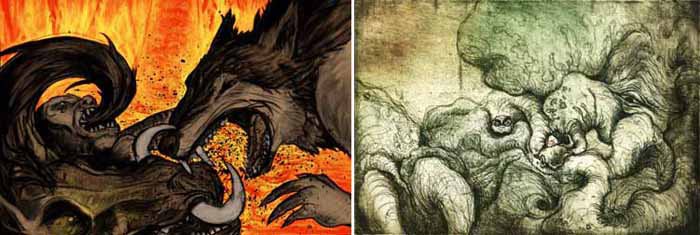
Left: John MacConnell, mixed media, from The Call of Cthulu. Right: Nu Ryu, etching, from The Call of Cthulu. Courtesy of the School of Visual Arts Department of Communications.
Many of the students, says Viktor, were fully fledged artists prior to entering the 2-year program. Works in the show run the gamut from highly finished paintings in acrylic (Lisel Ashlock); etchings (Nu Ryu); scratchboard (Edwin Vasquez), and the usual array of graphic media.
John MacConnell's selections, reminescent of Hieronymus Bosch's fearful domain, give contemporary relevance to the story, and could be interpreted as an anti-war statement. Russ Spitkovsky, who has feasted on William Blake to great advantage, created large-scale lithographs that express the darkness and doom of Lovecraft's tale. Y.J. Lee created art for a picture book in which a city has been taken over by monsters that issue black clouds of poisonous matter. A lighter side is found in a series by You Byun, who hates monsters, according to Koen. She reinterpreted the beast as a pet, monstrous only in its scale, that takes its human on a tour of New York City attractions.
The Call of Cthulhue continues through December 13 at The Visual Arts Gallery, 601 West 26th Street, 15th Floor. Please check website for hours and location.