


Paris/New York, 1925-1940
"Let's work together. Let's throw a bridge across the Atlantic. New York is the nearest city to Paris." When the visionary French architect Le Corbusier (born Charles-Edouard Jeanneret in Switzerland, 1887-1965) said this, the ocean liner SS Normandie, called "France afloat," had become that bridge. By the mid-1930s it was most desirable mode of transportation and cross-fertilization between the two world capitals.
Paris/New York: Design Fashion Culture 1925 - 1940, an exhibition opening today at the Museum of the City of New York (MCNY), traces New York's transformation through the adaptation of French style in architecture, the decorative arts, fashion, and more. It also documents the City of Light's love affair with New York's skyscrapers, American movies, le jazz hot and its proponents, including Josephine Baker.
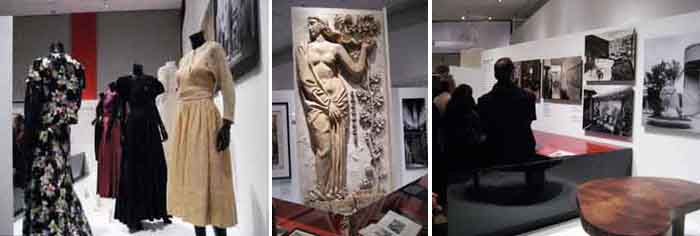
Scenes from opening night of Paris/New York at the Museum of the City of New York. Photos: P. Roalf.
Organized by Donald Albrecht, the museum's curator of architecture and design, Paris/New York contextualizes this rich exchange, which begins at the height of the Jazz Age and the 1925 Paris Exposition, and continued without losing steam throughout the Great Depression. It demonstrates that history unfolds differently in great cities because of their visionary leaders in industry, the arts, and government.
In New York, this kind of leadership enabled Rockefeller Center to be in record time, employing hundreds of artisans schooled in the decorative arts, French style. There are examples of Art Deco ornamentation in the form of full-scale mock-ups, renderings and photographs from Rock Center and other major structures still in existence a short bus ride away from the museum.
By the 1930s, New York had just about caught up with its rival city, and the new profession of industrial design, headed by American designers, shook off the influence Art Deco. Raymond Loewy, born in Paris and transplanted to New York, and Donald Deskey, from Minnesota, evolved as advocates of the streamlined idiom, which became the most popular style throughout Depression-era America. The exhibition includes examples at every scale, from a model of an ocean liner by Norman Bel Geddes to a Sears Roebuck refrigerator by Loewy.
But the epitome of French style was still the Normandie. French Line advertisements proclaimed that all a New Yorker had to do to be in Paris was to board the ship and take in its deluxe interiors, which were a showcase for the decorative arts. Many items from the ship's interior, from gold lacquered wall panels for the Grand Salon to silver service by Christophle of Paris are included in the exhibition.
In 1939 the French painter Fernand Leger was creating decor inspired by the Machine Age for Nelson Rockefeller's New York apartment. At the same time, the Herman Miller furniture company had retained Gilbert Rhode, a French architect who became known through the 1937 Paris Exposition. One of his biomorphic tables for the company, itself clearly influenced by Surrealist artist Jean Arp, can be seen as a precursor of the ubiquitous American boomerang of the post-war era.
The exhibition is packed with furniture, architectural drawings, paintings, scale models (including a 6-foot-long model of the Normandie), advertising and ephemera, and artifacts (including diamond jewels by Van Cleef & Arpels). A group of gowns from MCNYs collection shows the emergence of American designers, such as Hattie Carnegie and Norman Norell, who gave French couturiers a run for their money.
The closing section highlighting the 1939 World's Fair shows that by 1940, New York had become a formidable presence in design and retailing, propelled by power, imagination, and optimism. It had created its own fusion of art and industry that rivaled and sometimes outpaced Paris. And it offered a home to many who had come from France for the fair and remained in New York because of World War II, and went on to create a new American appetite for French cuisine.
The exhibition, designed by Pure+Applied, which also designed the handsome exhibition catalog (Monacelli Press 2008) inaugurates the museum's new 2-storey high exhibition gallery designed by Polshek Partnership. Paris/New York: Design Fashion Culture, 1925-1940 is at the Museum of the City of New York, 1220 Fifth Avenue at 103rd Street, (212) 534-1672, through Feb. 22, 2009.
Please check website for related programs, and save the date for a Special Event for DART subscribers. Join Donald Albrecht and experts from Christies and Van Cleef & Arpels on Thursday, October 23 at 6:30 pm for a discussion about Art Deco jewelry. An invitation will be sent to subscribers a week befpre the event.