


MAD About Art and Design
The way things are going in our nation's capitol, the opening this weekend of the new Museum of Arts and Design (MAD) might be the last great museum moment in New York City for a long while. On Saturday and Sunday, from 10:00 am to 6:00 pm, the public is invited, free of charge, to explore the newly renovated building on Columbus Circle and to discover one of the city's great treasures, which has been quietly reinventing itself during the last several years over on West 53rd Street.
Now it is housed in what was originally the Huntington Hartford Museum, designed by Edward Durrell Stone and fondly known as "the lollypop building." The 1965 structure was recently stripped down to its core elements and recreated by Brad Cloepfil of Seattle-based Allied Works Architecture. The formerly windowless galleries have been opened up through ribbons of glazing that let natural light flood in, and which connect visitors with its spectacular surroundings: the rebuilt Columbus Circle, and Central Park to the north. All that remains of the original design are the ground floor windows, whose lollypop shapes are discernable only from the inside.
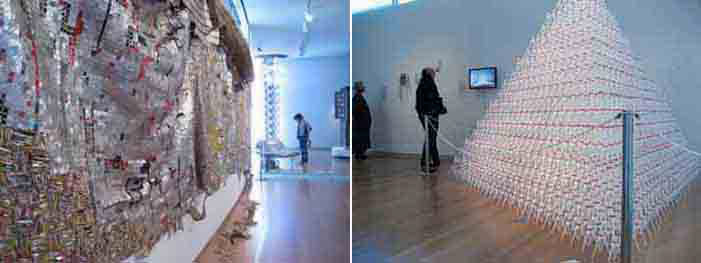
Installation views on ribbon cutting day at the Museum Arts and Design. Photos: Peggy Roalf.
The building's light filled interiors are a stroke of genius appropriate for the museum's collections - three-dimensional works of contemporary art, craft and design, many of which are free-standing sculptural objects. This is where visitors are in for a treat. And this is also where a little background could help.
The Museum of Arts and Design (first called the Museum of Contemporary Crafts and later the American Crafts Museum) was renamed in 2002 as part of the institution's mission to expand its collections to include art from around the world and to dispel distinctions between art, design, and craft disciplines. From its founding in 1956, the museum has championed emerging artists and celebrated the link between art and industry. And the inaugural exhibitions were envisioned to do just that.
On one floor is Permanently MAD: Revealing the Collection, which includes an extraordinary 1990 piece by Cindy Sherman: photographic images of the artist as Mme. De Pompadour adorn a Roccoco-style Limoges tureen produced by the historic porcelain house of de Sevres, in France. In another part of the gallery is a sculpture by Louise Bourgeoise, whose retrospective is currently on view at the Guggenheim Museum. And across the floor are massive ceramic pieces by Betty Woodman, who had a retrospective at the Metropolitan Museum of Art in 2006. From the field of decorative arts, Jack Lenor Larsen, Hiroshi Suzuki, and Wendell Castle, among others, are represented.
Second Lives: Remixing the Ordinary fills two floors with work by 54 contemporary artists from 18 countries. This exuberant, provocative, and sometimes irreverent show reflects the current interest of artists in using mass-produced items as their raw materials. Among the many eye-popping pieces are Spectacle by British artist Stuart Haygarth, a chandelier that only on close inspection reveals that it is made of over 1,000 pairs of discarded prescription eyeglasses and ordinary light bulbs. In Spoons by Jill Townsley, also from the UK, the artist transforms plastic deli flatware into a monumental pyramid (above right). Nigerian-based artist El Anatsui's site-specific tapestry (above left) is made entirely of foil from cast-off liquor bottles and refers to the use of liquor as payment for salves in the days of the triangular trade between the American colonies, the West Indies, and Africa.
But this is just the tip of a gleaming iceberg that includes the Gallery and Study Center for contemporary jewelry, funded by the Tiffany & Co. Foundation; an education floor with artists-in-residence creating work before your eyes in a glass-walled classroom; an interactive collections database designed by Pentagram; a theater; and a gift store stocked with objects of use and beauty.
Museum of Arts and Design, 2 Columbus Circle, New York City. Free and open to the public on Saturday and Sunday, September 27-28, 10:00 am to 6:00 pm. For information about public programs, please visit the website.
Correction: In DART: Art for the Political Animal, Politics 08 at The Society of Illustrators, Luba Lukova's name was misspelled.